Thank you for visiting SNEWPapers!
Sign up free
Editorial
June 20, 1945
The Daily Alaska Empire
Juneau, Juneau County, Alaska
What is this article about?
Editorial urges Alaskans to exceed Seventh War Loan quotas, especially E bonds, to demonstrate unwavering commitment to the war against Japan, citing Gen. Vandegrift's warning that enemies watch for signs of American fatigue.
Clipping
OCR Quality
95%
Excellent
Full Text
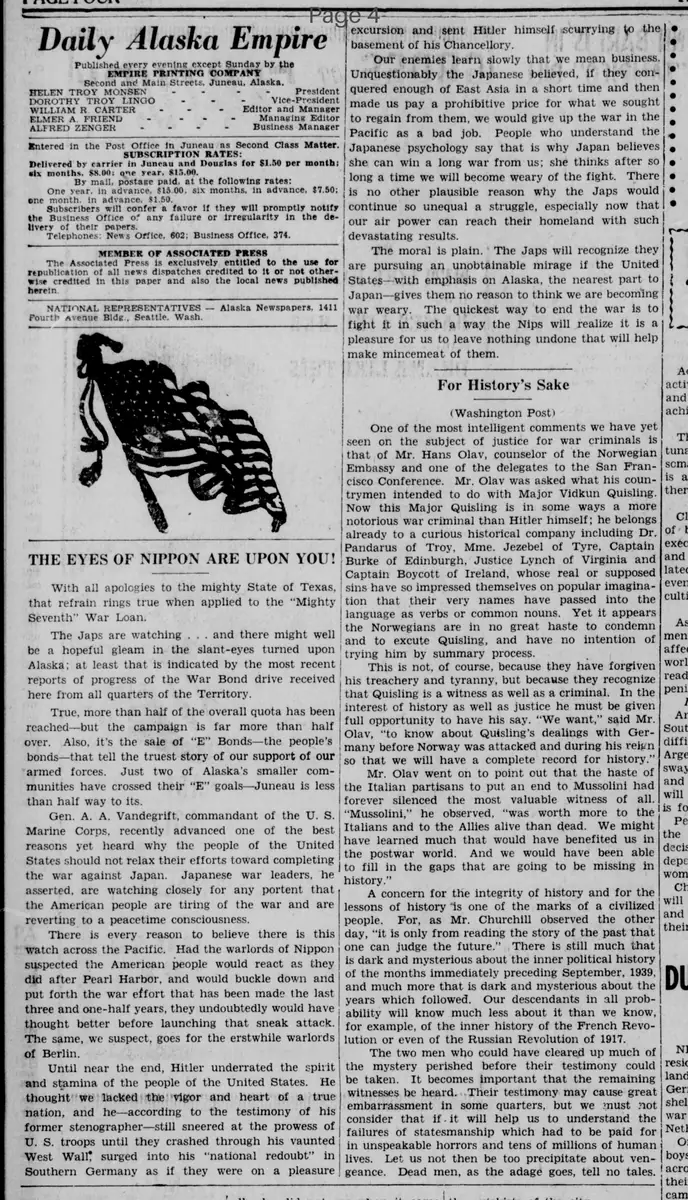
THE EYES OF NIPPON ARE UPON YOU!
With all apologies to the mighty State of Texas,
that refrain rings true when applied to the "Mighty
Seventh" War Loan.
The Japs are watching . . . and there might well
be a hopeful gleam in the slant-eyes turned upon
Alaska; at least that is indicated by the most recent
reports of progress of the War Bond drive received
here from all quarters of the Territory.
True, more than half of the overall quota has been
reached--but the campaign is far more than half
over. Also, it's the sale of "E" Bonds-the people's
bonds-that tell the truest story of our support of our
armed forces. Just two of Alaska's smaller com-
munities have crossed their "E" goals Juneau is less
than half way to its.
Gen. A. A. Vandegrift, commandant of the U. S.
Marine Corps. recently advanced one of the best
reasons yet heard why the people of the United
States should not relax their efforts toward completing
the war against Japan. Japanese war leaders. he
asserted. are watching closely for any portent that
the American people are tiring of the war and are
reverting to a peacetime consciousness.
There is every reason to believe there is this
watch across the Pacific. Had the warlords of Nippon
suspected the American people would react as they
did after Pearl Harbor. and would buckle down and
put forth the war effort that has been made the last
three and one-half vears, they undoubtedly would have
thought better before launching that sneak attack.
The same, we suspect, goes for the erstwhile warlords
of Berlin.
Until near the end. Hitler underrated the spirit
and stamina of the people of the United States. He
thought"we lacked the vigor and heart of a true
nation. and heaccording to the testimony of his
former stenographer-still sneered at the prowess of
U. S. troops until they crashed through his vaunted
West Wall. surged into his "national redoubt" in
Southern Germany as if they were on a pleasure
excursion and sent Hitler himself scurrying to the
basement of his Chancellory.
Our enemies learn slowly that we mean business.
Unquestionably the Japanese believed, if they con-
quered enough of East Asia in a short time and then
made us pay a prohibitive price for what we sought
to regain from them, we would give up the war in the
Pacific as a bad job. People who understand the
Japanese psychology say that is why Japan believes
she can win a long war from us; she thinks after so
long a time we will become weary of the fight. There
is no other plausible reason why the Japs would
continue so unequal a struggle, especially now that
our air power can reach their homeland with such
devastating results.
The moral is plain. ' The Japs will recognize they
are pursuing an unobtainable mirage if the United
States-with emphasis on Alaska, the nearest part to
Japan-gives them no reason to think we are becoming
war weary. The quickest way to end the war is to
fight it in such a way the Nips will realize it is a
pleasure for us to leave nothing undone that will help
make mincemeat of them.
With all apologies to the mighty State of Texas,
that refrain rings true when applied to the "Mighty
Seventh" War Loan.
The Japs are watching . . . and there might well
be a hopeful gleam in the slant-eyes turned upon
Alaska; at least that is indicated by the most recent
reports of progress of the War Bond drive received
here from all quarters of the Territory.
True, more than half of the overall quota has been
reached--but the campaign is far more than half
over. Also, it's the sale of "E" Bonds-the people's
bonds-that tell the truest story of our support of our
armed forces. Just two of Alaska's smaller com-
munities have crossed their "E" goals Juneau is less
than half way to its.
Gen. A. A. Vandegrift, commandant of the U. S.
Marine Corps. recently advanced one of the best
reasons yet heard why the people of the United
States should not relax their efforts toward completing
the war against Japan. Japanese war leaders. he
asserted. are watching closely for any portent that
the American people are tiring of the war and are
reverting to a peacetime consciousness.
There is every reason to believe there is this
watch across the Pacific. Had the warlords of Nippon
suspected the American people would react as they
did after Pearl Harbor. and would buckle down and
put forth the war effort that has been made the last
three and one-half vears, they undoubtedly would have
thought better before launching that sneak attack.
The same, we suspect, goes for the erstwhile warlords
of Berlin.
Until near the end. Hitler underrated the spirit
and stamina of the people of the United States. He
thought"we lacked the vigor and heart of a true
nation. and heaccording to the testimony of his
former stenographer-still sneered at the prowess of
U. S. troops until they crashed through his vaunted
West Wall. surged into his "national redoubt" in
Southern Germany as if they were on a pleasure
excursion and sent Hitler himself scurrying to the
basement of his Chancellory.
Our enemies learn slowly that we mean business.
Unquestionably the Japanese believed, if they con-
quered enough of East Asia in a short time and then
made us pay a prohibitive price for what we sought
to regain from them, we would give up the war in the
Pacific as a bad job. People who understand the
Japanese psychology say that is why Japan believes
she can win a long war from us; she thinks after so
long a time we will become weary of the fight. There
is no other plausible reason why the Japs would
continue so unequal a struggle, especially now that
our air power can reach their homeland with such
devastating results.
The moral is plain. ' The Japs will recognize they
are pursuing an unobtainable mirage if the United
States-with emphasis on Alaska, the nearest part to
Japan-gives them no reason to think we are becoming
war weary. The quickest way to end the war is to
fight it in such a way the Nips will realize it is a
pleasure for us to leave nothing undone that will help
make mincemeat of them.
What sub-type of article is it?
War Or Peace
Economic Policy
What keywords are associated?
War Bonds
Seventh War Loan
Alaska
Japan
Nippon
Pearl Harbor
Vandegrift
What entities or persons were involved?
Gen. A. A. Vandegrift
Japanese War Leaders
Hitler
U. S. Marine Corps
Editorial Details
Primary Topic
Urging Support For Seventh War Loan To Show Resolve Against Japan
Stance / Tone
Strongly Pro War Effort And Anti Japanese
Key Figures
Gen. A. A. Vandegrift
Japanese War Leaders
Hitler
U. S. Marine Corps
Key Arguments
Japanese Leaders Watch For Signs Of American War Weariness
Exceeding War Bond Quotas Demonstrates Unwavering Commitment
Pearl Harbor Reaction Surprised Japanese Warlords
Hitler Underestimated American Spirit Until Late In The War
Continued Effort Will Convince Japan The War Is Unwinnable