Thank you for visiting SNEWPapers!
Sign up free
Bismarck Weekly Tribune
Bismarck, Burleigh County, North Dakota
What is this article about?
National convention of Republican clubs in New York elects officers including Wm. M. Evarts as president, features speech by Gen. Nathan Goff praising the party, and adopts resolutions on Republican achievements and future goals against barbarism.
Clipping
OCR Quality
Full Text
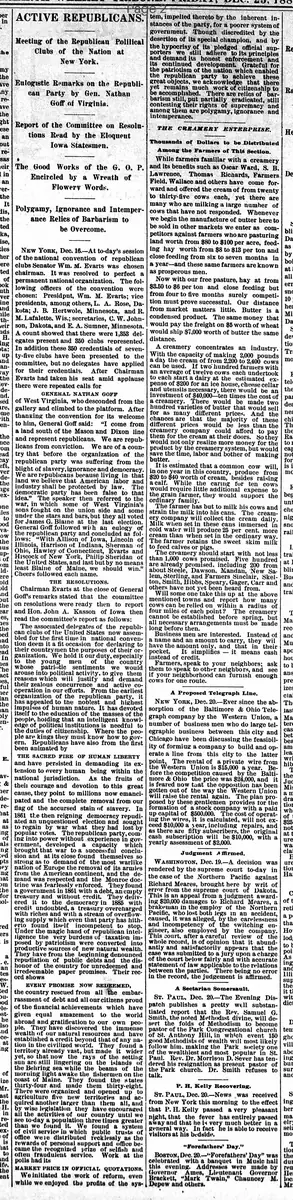
Meeting of the Republican Political Clubs of the Nation at New York.
Eulogistic Remarks on the Republican Party by Gen. Nathan Goff of Virginia.
Report of the Committee on Resolutions Read by the Eloquent Iowa Statesman.
The Good Works of the G. O. P. Encircled by a Wreath of Flowery Words.
Polygamy, Ignorance and Intemperance Relics of Barbarism to be Overcome.
New York, Dec. 16.-At to-day's session of the national convention of republican clubs Senator Wm. M. Evarts was chosen chairman. It was resolved to perfect a permanent national organization. The following officers of the convention were chosen: President, Wm. M. Evarts; vice presidents, among others, L. A. Rose, Dakota; J. B. Hertwole, Minnesota, and R. M. LaFollette, Wis.; secretaries, C. W. Johnson, Dakota, and E. A. Sumner, Minnesota. A count showed that there were 1,353 delegates present and 350 clubs represented. In addition these 350 credentials of seventy-five clubs have been presented to the committee, but no delegates have applied for their credentials. After Chairman Evarts had taken his seat amid applause there were repeated calls for
GENERAL NATHAN GOFF
of West Virginia, who descended from the gallery and climbed to the platform. After thanking the convention for its welcome to him, General Goff said: "I come from a land south of the Mason and Dixon line and represent republicans. We are republicans from conviction. We are of a country that before the organization of the republican party was suffering from the blight of slavery, ignorance and democracy. We are republicans because living in that land we believe that American labor and industry shall be protected by law. The democratic party has been false to that idea." The speaker then referred to the war, in which some of West Virginia's sons fought on the union side and some under the stars and bars, but they all voted for James G. Blaine at the last election. General Goff followed with an eulogy of the republican party and concluded as follows: "With Allison of Iowa, Lincoln of Illinois, Harrison of Indiana, Sherman of Ohio, Hawley of Connecticut, Evarts and Hiscock of New York, Philip Sheridan of the United States, and last but by no means least Blaine of Maine, we should win." Cheers followed each name.
THE RESOLUTIONS.
Chairman Evarts at the close of General Goff's remarks stated that the committee on resolutions were ready then to report and Hon. John A. Kasson of Iowa then read the committee's report as follows:
The associated delegates of the republican clubs of the United States now assembled for the first time in national convention deem it a fit occasion for declaring to their countrymen the purposes of their organization. We hold it our duty, especially to the young men of the country whose patriotic sentiments we would arouse into political activity, to give them reasons which will justify and demand their zealous concurrence and active co-operation in our efforts. From the earliest organization of the republican party, it has appealed to the noblest and highest impulses of human nature. It has devoted itself to the education of the masses of the people, holding that an intelligent knowledge of political institutions is needful to the duties of citizenship. Where the people are kings they must know how to govern. Republicans have also from the first been animated by
THE SACRED FIRE OF HUMAN LIBERTY
and have persisted in demanding its extension to every human being within the national jurisdiction. As the fruits of their courage and devotion to this great cause, they point to millions now emancipated and the complete removal from our flag of the accursed stain of slavery. In 1861 the then reigning democracy repudiated an unquestioned election and sought to regain by war what they had lost by popular votes. The republican party, coming into power without experience in government, developed a capacity which brought that war to a successful conclusion and at its close found themselves so strong as to demand of the most warlike nation of Europe the removal of its armies from the American continent, and the demand was respected and the Monroe doctrine was fearlessly enforced. They found a government in 1861 with a debt, an empty treasury and without credit. They delivered it to the democracy in 1885 with credit, undoubted, a treasury overcharged with riches and with a stream of overflowing supply which even that party has hitherto found itself incompetent to stop. Under the magic hand of republican intelligence the very burdens of taxation imposed by patriotism were converted into productive sources of new national wealth. They have from the beginning denounced repudiation of public debts and the dishonor of the country for unredeemed and irredeemable paper promises. Their record shows
EVERY PROMISE
NOW REDEEMED,
the country rescued from all the embarrassment of debt and all our citizens proud of the financial achievements which have given equal amazement to the world abroad and gratification to our own people. They have discovered the immense wealth of our natural resources and have established a credit beyond that of any nation in the civilized world. They found a territory already vast, but made it wider yet, so that now the rays of the setting sun are still lingering on the islands of the Behring sea while the beams of the morning light awake the fishermen on the coast of Maine. They found the states thirty-four and made them thirty-eight. There were organized and opened up to agriculture five new territories and acquired another larger than them all, and by wise legislation they have encouraged all the activities of our country until we see to-day a population three times greater than we found it. We found a system of civil service in which public trusts of office were distributed recklessly as the rewards of personal support and office became the recognized prize of selfish and often fraudulent service. Work at the polls had its
MARKET PRICE IN OFFICIAL QUOTATIONS.
We initiated the work of reform, even while we enjoyed the profits of the system, impelled thereto by the inherent instances of the party, for a poorer system of government. Though discredited by the desertion of its special champion, and by the hypocrisy of its pledged official supporters we still adhere to its principles and demand its honest enforcement and its continued development Grateful for the patriotism of the nation which enabled the republican party to achieve these great objects, we acknowledge that there yet remains much work of citizenship to be accomplished. There are relics of barbarism still, but partially eradicated, still contesting their rights of supremacy and among them are polygamy, ignorance and intemperance.
What sub-type of article is it?
What keywords are associated?
What entities or persons were involved?
Where did it happen?
Domestic News Details
Primary Location
New York
Event Date
Dec. 16
Key Persons
Outcome
permanent national organization of republican clubs established; officers elected including wm. m. evarts as president; resolutions affirming republican party achievements and purposes adopted.
Event Details
At the national convention of republican clubs, Senator Wm. M. Evarts was chosen chairman. Officers were elected, including vice presidents L. A. Rose of Dakota, J. B. Hertwole of Minnesota, and R. M. LaFollette of Wisconsin, and secretaries C. W. Johnson of Dakota and E. A. Sumner of Minnesota. 1,353 delegates from 350 clubs were present. General Nathan Goff of West Virginia addressed the convention, praising the Republican Party and its leaders. Hon. John A. Kasson of Iowa read the committee's resolutions, which declared the purposes of the organization, highlighted Republican achievements in emancipation, war, finance, expansion, and civil service reform, and called for overcoming relics of barbarism like polygamy, ignorance, and intemperance.