Thank you for visiting SNEWPapers!
Sign up free
Literary
May 6, 1819
Alexandria Gazette & Daily Advertiser
Alexandria, Virginia
What is this article about?
This continued essay excerpt extols the Bible's stylistic superiority in Genesis, particularly its creation narrative, over poets like Hesiod, Milton, Young, Ossian, and Pope. It highlights the concise simplicity and sublimity of biblical prose, arguing its educational value as a school book.
Clipping
OCR Quality
95%
Excellent
Full Text
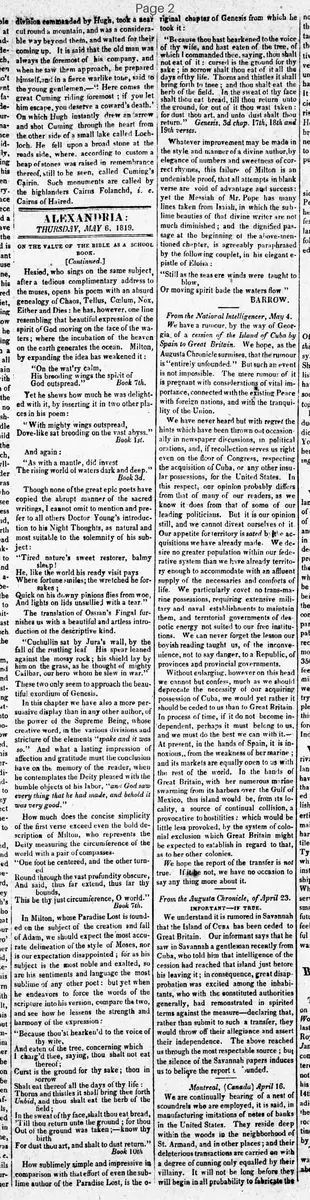
ON THE VALUE OF THE BIBLE AS A SCHOOL BOOK.
[Continued.]
Hesiod, who sings on the same subject after a tedious complimentary address to the muses, opens his poem with an absurd genealogy of Chaos, Tellus, Cælum, Nox, Ether and Dies: he has, however, one line resembling that beautiful expression of the spirit of God moving on the face of the waters; where the incubation of the heaven on the earth generates the ocean. Milton, by expanding the idea has weakened it:
"On the wat'ry calm.
His brooding wings the spirit of God outspread."
Book 7th.
Yet he shows how much he was delighted with it, by inserting it in two other places in his poem:
"With mighty wings outspread,
Dove-like sat brooding on the vast abyss."
Book 1st.
And again:
"As with a mantle, did invest
The rising world of waters dark and deep."
Book 3d.
Though none of the great epic poets have copied the abrupt manner of the sacred writings. I cannot omit to mention and prefer to all others Doctor Young's introduction to his Night Thoughts, as natural and most suitable to the solemnity of his subject:
Tired nature's sweet restorer, balmy sleep!
He, like the world his ready visit pays
Where fortune smiles; the wretched he forsakes;
Quick on his downy pinions flies from woe;
And lights on lids unsullied with a tear."
The translation of Ossian's Fingal furnishes us with a beautiful and artless introduction of the descriptive kind.
"Cuchullin sat by Jura's wall, by the fall of the rustling leaf His spear leaned against the mossy rock; his shield lay by him on the grass, as he thought of mighty Cailbar, our hero whom he slew in war.
These two only seem to approach the beautiful exordium of Genesis.
In this chapter we have also a more persuasive display than in any other author, of the power of the Supreme Being, whose creative word, in the various divisions and stricture of the elements "spake and it was so." And what a lasting impression of affection and gratitude must the conclusion have on the memory of the reader, when he contemplates the Deity pleased with the humble objects of his labor, "and God saw every thing that he had made, and behold it was very good."
How much does the concise simplicity of the first verse exceed even the bold description of Milton, who represents the Deity measuring the circumference of the world with a pair of compasses.
"One foot he centered, and the other turned
Round through the vast profundity obscure,
And said, thus far extend, thus far thy bounds,
This be thy just circumference, O world."
Book 7th.
In Milton, whose Paradise Lost is founded on the subject of the creation and fall of Adam, we should expect the most accurate delineation of the style of Moses, nor is our expectation disappointed; for as his subject is the most noble and exalted, so are his sentiments and language the most sublime of any other poet: but yet when he endeavors to force the words of the scripture into his version, compare the two, and see how he lessens the strength and harmony of the expression:
"Because thou'st hearken'd to the voice of thy wife,
And eaten of the tree, concerning which
I charg'd thee, saying, thou shalt not eat thereof;
Curst is the ground for thy sake; thou in sorrow
Shalt eat thereof all the days of thy life:
Thorns and thistles it shall bring thee forth
Unbid, and thou shalt eat the herb of the field;
In the sweat of thy face, shalt thou eat bread,
Till thou return unto the ground; for thou
Out of the ground wast taken;-know thy birth
For dust thou art, and shalt to dust return."
Book 10th
How sublimely simple and impressive in comparison with that effort of even the sublime author of the Paradise Lost, is the original chapter of Genesis from which he took it:
"Because thou hast hearkened to the voice of thy wife, and hast eaten of the tree, of which I commanded thee, saying. thou shalt not eat of it: cursed is the ground for thy sake; in sorrow shalt thou eat of it all the days of thy life. Thorns and thistles it shall bring forth to thee: and thou shalt eat the herb of the field. In the sweat of thy face shalt thou eat bread. till thou return unto the ground. for out of it thou wast taken: for dust thou art. and unto dust shalt thou return." Genesis, 3d chap. 17th, 18th and 19th verses.
Whatever improvement may be made in the style and manner of a divine author, by elegance of numbers and sweetness of correct rhymies, this failure of Milton is an undeniable proof, that all attempts in blank verse are void of advantage and success: yet the Messiah of Mr. Pope has many lines taken from Isaiah, in which the sublime beauties of that divine writer are not much diminished; and the dignified passage at the beginning of the above-mentioned chapter, is agreeably paraphrased by the following couplet, in his elegant epistle of Eloisa:
"Still as the seas ere winds were taught to blow,
Or moving spirit bade the waters flow
BARROW.
[Continued.]
Hesiod, who sings on the same subject after a tedious complimentary address to the muses, opens his poem with an absurd genealogy of Chaos, Tellus, Cælum, Nox, Ether and Dies: he has, however, one line resembling that beautiful expression of the spirit of God moving on the face of the waters; where the incubation of the heaven on the earth generates the ocean. Milton, by expanding the idea has weakened it:
"On the wat'ry calm.
His brooding wings the spirit of God outspread."
Book 7th.
Yet he shows how much he was delighted with it, by inserting it in two other places in his poem:
"With mighty wings outspread,
Dove-like sat brooding on the vast abyss."
Book 1st.
And again:
"As with a mantle, did invest
The rising world of waters dark and deep."
Book 3d.
Though none of the great epic poets have copied the abrupt manner of the sacred writings. I cannot omit to mention and prefer to all others Doctor Young's introduction to his Night Thoughts, as natural and most suitable to the solemnity of his subject:
Tired nature's sweet restorer, balmy sleep!
He, like the world his ready visit pays
Where fortune smiles; the wretched he forsakes;
Quick on his downy pinions flies from woe;
And lights on lids unsullied with a tear."
The translation of Ossian's Fingal furnishes us with a beautiful and artless introduction of the descriptive kind.
"Cuchullin sat by Jura's wall, by the fall of the rustling leaf His spear leaned against the mossy rock; his shield lay by him on the grass, as he thought of mighty Cailbar, our hero whom he slew in war.
These two only seem to approach the beautiful exordium of Genesis.
In this chapter we have also a more persuasive display than in any other author, of the power of the Supreme Being, whose creative word, in the various divisions and stricture of the elements "spake and it was so." And what a lasting impression of affection and gratitude must the conclusion have on the memory of the reader, when he contemplates the Deity pleased with the humble objects of his labor, "and God saw every thing that he had made, and behold it was very good."
How much does the concise simplicity of the first verse exceed even the bold description of Milton, who represents the Deity measuring the circumference of the world with a pair of compasses.
"One foot he centered, and the other turned
Round through the vast profundity obscure,
And said, thus far extend, thus far thy bounds,
This be thy just circumference, O world."
Book 7th.
In Milton, whose Paradise Lost is founded on the subject of the creation and fall of Adam, we should expect the most accurate delineation of the style of Moses, nor is our expectation disappointed; for as his subject is the most noble and exalted, so are his sentiments and language the most sublime of any other poet: but yet when he endeavors to force the words of the scripture into his version, compare the two, and see how he lessens the strength and harmony of the expression:
"Because thou'st hearken'd to the voice of thy wife,
And eaten of the tree, concerning which
I charg'd thee, saying, thou shalt not eat thereof;
Curst is the ground for thy sake; thou in sorrow
Shalt eat thereof all the days of thy life:
Thorns and thistles it shall bring thee forth
Unbid, and thou shalt eat the herb of the field;
In the sweat of thy face, shalt thou eat bread,
Till thou return unto the ground; for thou
Out of the ground wast taken;-know thy birth
For dust thou art, and shalt to dust return."
Book 10th
How sublimely simple and impressive in comparison with that effort of even the sublime author of the Paradise Lost, is the original chapter of Genesis from which he took it:
"Because thou hast hearkened to the voice of thy wife, and hast eaten of the tree, of which I commanded thee, saying. thou shalt not eat of it: cursed is the ground for thy sake; in sorrow shalt thou eat of it all the days of thy life. Thorns and thistles it shall bring forth to thee: and thou shalt eat the herb of the field. In the sweat of thy face shalt thou eat bread. till thou return unto the ground. for out of it thou wast taken: for dust thou art. and unto dust shalt thou return." Genesis, 3d chap. 17th, 18th and 19th verses.
Whatever improvement may be made in the style and manner of a divine author, by elegance of numbers and sweetness of correct rhymies, this failure of Milton is an undeniable proof, that all attempts in blank verse are void of advantage and success: yet the Messiah of Mr. Pope has many lines taken from Isaiah, in which the sublime beauties of that divine writer are not much diminished; and the dignified passage at the beginning of the above-mentioned chapter, is agreeably paraphrased by the following couplet, in his elegant epistle of Eloisa:
"Still as the seas ere winds were taught to blow,
Or moving spirit bade the waters flow
BARROW.
What sub-type of article is it?
Essay
What themes does it cover?
Religious
Moral Virtue
What keywords are associated?
Bible
Genesis
Creation
Milton
Paradise Lost
Poetic Style
Sublime Prose
What entities or persons were involved?
Barrow.
Literary Details
Title
On The Value Of The Bible As A School Book.
Author
Barrow.
Subject
Value Of The Bible As A School Book, Comparing Its Style To Classical And Modern Poets.
Form / Style
Prose Essay With Quotations From Poetry And Scripture.
Key Lines
"And God Saw Every Thing That He Had Made, And Behold It Was Very Good."
"Because Thou Hast Hearkened To The Voice Of Thy Wife, And Hast Eaten Of The Tree, Of Which I Commanded Thee, Saying. Thou Shalt Not Eat Of It : Cursed Is The Ground For Thy Sake ; In Sorrow Shalt Thou Eat Of It All The Days Of Thy Life. Thorns And Thistles It Shall Bring Forth To Thee : And Thou Shalt Eat The Herb Of The Field. In The Sweat Of Thy Face Shalt Thou Eat Bread. Till Thou Return Unto The Ground. For Out Of It Thou Wast Taken : For Dust Thou Art. And Unto Dust Shalt Thou Return."
"Still As The Seas Ere Winds Were Taught To Blow, Or Moving Spirit Bade The Waters Flow