Thank you for visiting SNEWPapers!
Sign up free
Story
June 5, 1864
New York Dispatch
New York, New York County, New York
What is this article about?
A Union-loyal Southern actor recounts in a theater green room his Civil War ordeals: imprisonment in Richmond for a pro-Union play, brutal treatment, forced Confederate service, and daring escape to Union lines. (187 chars)
Clipping
OCR Quality
95%
Excellent
Full Text
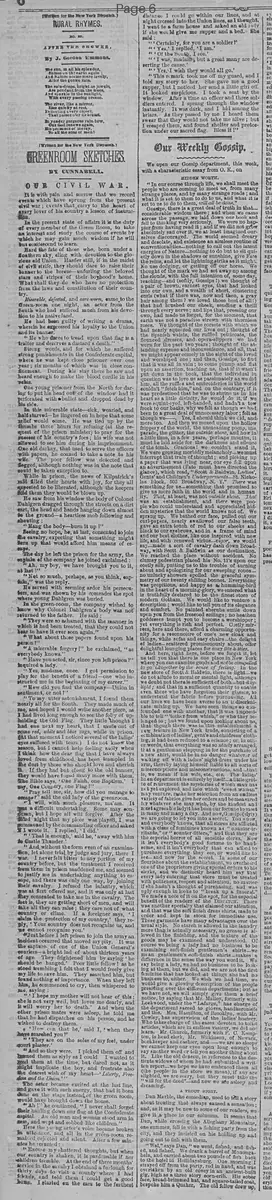
GREENROOM SKETCHES.
BY CUNNABELL.
OUR CIVIL WAR.
It is with pain and sorrow that we record events which have sprung from the present civil war; events that carry to the heart of every lover of his country a lesson of instruction.
In the present state of affairs it is the duty of every member of the Green Room, to take an interest and study the course of events by which he may gain much wisdom if he will but condescend to learn.
Hard the fate of those who, born under a southern sky, cling with devotion to the glorious old Union. Harder still, if in the midst of civil strife, they should dare to raise their banner to the breeze - unfurling the beloved stars and stripes of their boyhood's home.
What shall they do who have no protection from the laws and constitution of their country.
Miserable, dejected, and care-worn, came to the Green-room one night, an actor from the South who had suffered much from his devotion to his native land.
He had been guilty of writing a drama, wherein he expressed his loyalty to the Union and its banner.
"He who dares to tread upon that flag is a traitor and deserves a dastard's death."
Strong words, and for which he suffered strong punishments in the Confederate capital where he was kept close prisoner over one year; six months of which was in close confinement. During his stay there he saw and heard enough to make the blood curdle in his veins.
One young prisoner from the North for daring to put his head out of the window had it perforated with bullet and dropped dead by his side.
In this miserable state - sick, wearied, and half-starved - he lingered on in hope that some relief would come. He was tied up by the thumbs three hours for refusing (at the request of the prison minister) to pray for the success of his country's foes; his wife was not allowed to see him during his imprisonment.
One old darkey, that used to serve the officers with papers, he coaxed to take a note to his wife. The poor fellow was detected and flogged, although nothing was in the note that could be taken exception to.
While in prison, the news of Kilpatrick's raid filled their hearts with joy, for they all expected to be liberated, although the keepers told them they would be blown up.
He saw from his window the body of Colonel Dahlgren dragged through the streets on a dirt cart, the head and hands hanging down almost to the ground - a heartless mob following and shouting:
"Hang the body - burn it up!"
Seeing no hope, he, at last, consented to join the cavalry, expecting that something might turn up that would afford him means of escape.
The day he left the prison for the army, the captain of the company he joined exclaimed:
"Ah, my boy, we have brought you to it, at last!"
"Not so much, perhaps, as you think, cap. tain," was the reply.
He served with seeming ardor his persecutors, and was shown by his comrades the spot where young Dahlgren was buried.
In the green-room, the company wished to know why Colonel Dahlgren's body was not returned to the father. He said:
"They were so ashamed with the manner in which it had been treated, that they could not bear to have it ever seen again."
What about those papers found upon his person?
"A miserable forgery!" he exclaimed, "as everybody knows."
Have you acted, sir, since you left prison? inquired a lady.
Yes, madame, once. I got permission to play for the benefit of a friend - one who instructed me in the beginning of my career.
"How did you find the company - Union in sentiment, or not?"
"To my utter astonishment, I found them nearly all for the South. They made much of me, and hoped I would write another piece, as I had lived long enough to see the folly of upholding the Old Flag. They little thought I had one next my heart, that I made out of some red, white and blue rags, while in prison."
(At that moment I noticed several of the ladies' eyes suffused with tears.) I do not know the reason, but I cannot help feeling sadly when I think how the dear flag that I have always loved from childhood, has been trampled in the dust by those who should love and cherish it. If they had but clung to the old banner, they would have found many more with them.
The Bible says, 'One Faith, one Baptism.' I say, 'One Country, one Flag!'
Pray tell me, sir, how did you manage to escape? said the old lady of the greenroom.
I will, with much pleasure, ma'am. It was a difficult undertaking. Some may condemn, but I hope all will forgive. After the third night that my piece was played, I was summoned by the commanding officer and asked if I wrote it. I replied, 'I did.'
"That is enough,' said he, 'away with him to Castle Thunder.'
"And without the form even of an examination, let alone trial by judge and jury, there I was. I never felt bitter to any portion of my country before, but the treatment I received from them in prison maddened me, and seemed to justify me in undertaking anything to escape, and there was only one way, by joining their cavalry. I refused the infantry, which was at first offered me, and it was only at last they consented to take me in the cavalry. The fact is, they are getting short of men, and will take all they can raise; they care not of what country or clime. If a foreigner says, 'I claim the protection of my country,' they reply, 'Your country does not recognize us, and we cannot recognize you.'
Just before I left prison to join the army an incident occurred that moved my pity. It was the capture of one of the Union General's couriers - a bright lad of about thirteen years of age. They frightened him by saying 'he should be hanged.' Poor little fellow! as he stood trembling I felt that I would freely give my life to save him. They searched him, but found nothing of importance. When they left him, he commenced to cry, then whispered to me, saying:
"I hope my mother will not hear of this; she is not very well, but loves me dearly, and it will worry her to death." And when the other prison mates were asleep, he told me that he had dispatches on his person, and he wished to destroy them.
"How can that be,' said I, 'when they have searched you?"
"They are on the soles of my feet, under court plaster."
And so they were. I picked them off and burned them as slyly as I could. I wanted to read them at the time, but dared not, as it might implicate the boy, and frustrate also the dearest wish of my heart - Liberty, Freedom and the Union."
The actor became excited at the last line, and gave it with such energy, that had it been done on the stage instead of the green room, would have brought down the house.
"Ah!" he continued, "I never shall forget their hauling down our flag at the Confederate capital. An old man and woman stood arm in arm, and wept and sobbed like children."
Here the young actor's voice became broken in utterance, and all in the green-room remained dejected and silent. After a few minutes he resumed:
"Excuse my shattered thoughts, but when our country is shaken, it is pardonable if her children tremble. At the end of three months' service in the cavalry I obtained a furlough for thirty days to visit a county where I had friends, and told them I could get a good horse, I started on the cars to the furthest distance I could go within our lines, and at night crossed into the Union lines, as I thought.
I went to a farm house and asked an old lady if she would give me supper and a bed. She said:
"Certainly, for you are a soldier?"
"Yes," I replied, "I am."
"Of the South, I see."
"I was, madam; but a great many are deserting the cause."
"Yes. I wish they would all go."
This remark took me off my guard, and I told my story to her. She gave me a good supper, but I noticed her send a little girl off. It looked suspicious. I took a seat by the window. After a time an officer and three soldiers entered. I sprang through the window instantly. It was dark, and I hid among the briars. As they passed by me I heard them swear that they would not take me alive; but I escaped them, and found shelter and protection under our sacred flag. Bless it!"
BY CUNNABELL.
OUR CIVIL WAR.
It is with pain and sorrow that we record events which have sprung from the present civil war; events that carry to the heart of every lover of his country a lesson of instruction.
In the present state of affairs it is the duty of every member of the Green Room, to take an interest and study the course of events by which he may gain much wisdom if he will but condescend to learn.
Hard the fate of those who, born under a southern sky, cling with devotion to the glorious old Union. Harder still, if in the midst of civil strife, they should dare to raise their banner to the breeze - unfurling the beloved stars and stripes of their boyhood's home.
What shall they do who have no protection from the laws and constitution of their country.
Miserable, dejected, and care-worn, came to the Green-room one night, an actor from the South who had suffered much from his devotion to his native land.
He had been guilty of writing a drama, wherein he expressed his loyalty to the Union and its banner.
"He who dares to tread upon that flag is a traitor and deserves a dastard's death."
Strong words, and for which he suffered strong punishments in the Confederate capital where he was kept close prisoner over one year; six months of which was in close confinement. During his stay there he saw and heard enough to make the blood curdle in his veins.
One young prisoner from the North for daring to put his head out of the window had it perforated with bullet and dropped dead by his side.
In this miserable state - sick, wearied, and half-starved - he lingered on in hope that some relief would come. He was tied up by the thumbs three hours for refusing (at the request of the prison minister) to pray for the success of his country's foes; his wife was not allowed to see him during his imprisonment.
One old darkey, that used to serve the officers with papers, he coaxed to take a note to his wife. The poor fellow was detected and flogged, although nothing was in the note that could be taken exception to.
While in prison, the news of Kilpatrick's raid filled their hearts with joy, for they all expected to be liberated, although the keepers told them they would be blown up.
He saw from his window the body of Colonel Dahlgren dragged through the streets on a dirt cart, the head and hands hanging down almost to the ground - a heartless mob following and shouting:
"Hang the body - burn it up!"
Seeing no hope, he, at last, consented to join the cavalry, expecting that something might turn up that would afford him means of escape.
The day he left the prison for the army, the captain of the company he joined exclaimed:
"Ah, my boy, we have brought you to it, at last!"
"Not so much, perhaps, as you think, cap. tain," was the reply.
He served with seeming ardor his persecutors, and was shown by his comrades the spot where young Dahlgren was buried.
In the green-room, the company wished to know why Colonel Dahlgren's body was not returned to the father. He said:
"They were so ashamed with the manner in which it had been treated, that they could not bear to have it ever seen again."
What about those papers found upon his person?
"A miserable forgery!" he exclaimed, "as everybody knows."
Have you acted, sir, since you left prison? inquired a lady.
Yes, madame, once. I got permission to play for the benefit of a friend - one who instructed me in the beginning of my career.
"How did you find the company - Union in sentiment, or not?"
"To my utter astonishment, I found them nearly all for the South. They made much of me, and hoped I would write another piece, as I had lived long enough to see the folly of upholding the Old Flag. They little thought I had one next my heart, that I made out of some red, white and blue rags, while in prison."
(At that moment I noticed several of the ladies' eyes suffused with tears.) I do not know the reason, but I cannot help feeling sadly when I think how the dear flag that I have always loved from childhood, has been trampled in the dust by those who should love and cherish it. If they had but clung to the old banner, they would have found many more with them.
The Bible says, 'One Faith, one Baptism.' I say, 'One Country, one Flag!'
Pray tell me, sir, how did you manage to escape? said the old lady of the greenroom.
I will, with much pleasure, ma'am. It was a difficult undertaking. Some may condemn, but I hope all will forgive. After the third night that my piece was played, I was summoned by the commanding officer and asked if I wrote it. I replied, 'I did.'
"That is enough,' said he, 'away with him to Castle Thunder.'
"And without the form even of an examination, let alone trial by judge and jury, there I was. I never felt bitter to any portion of my country before, but the treatment I received from them in prison maddened me, and seemed to justify me in undertaking anything to escape, and there was only one way, by joining their cavalry. I refused the infantry, which was at first offered me, and it was only at last they consented to take me in the cavalry. The fact is, they are getting short of men, and will take all they can raise; they care not of what country or clime. If a foreigner says, 'I claim the protection of my country,' they reply, 'Your country does not recognize us, and we cannot recognize you.'
Just before I left prison to join the army an incident occurred that moved my pity. It was the capture of one of the Union General's couriers - a bright lad of about thirteen years of age. They frightened him by saying 'he should be hanged.' Poor little fellow! as he stood trembling I felt that I would freely give my life to save him. They searched him, but found nothing of importance. When they left him, he commenced to cry, then whispered to me, saying:
"I hope my mother will not hear of this; she is not very well, but loves me dearly, and it will worry her to death." And when the other prison mates were asleep, he told me that he had dispatches on his person, and he wished to destroy them.
"How can that be,' said I, 'when they have searched you?"
"They are on the soles of my feet, under court plaster."
And so they were. I picked them off and burned them as slyly as I could. I wanted to read them at the time, but dared not, as it might implicate the boy, and frustrate also the dearest wish of my heart - Liberty, Freedom and the Union."
The actor became excited at the last line, and gave it with such energy, that had it been done on the stage instead of the green room, would have brought down the house.
"Ah!" he continued, "I never shall forget their hauling down our flag at the Confederate capital. An old man and woman stood arm in arm, and wept and sobbed like children."
Here the young actor's voice became broken in utterance, and all in the green-room remained dejected and silent. After a few minutes he resumed:
"Excuse my shattered thoughts, but when our country is shaken, it is pardonable if her children tremble. At the end of three months' service in the cavalry I obtained a furlough for thirty days to visit a county where I had friends, and told them I could get a good horse, I started on the cars to the furthest distance I could go within our lines, and at night crossed into the Union lines, as I thought.
I went to a farm house and asked an old lady if she would give me supper and a bed. She said:
"Certainly, for you are a soldier?"
"Yes," I replied, "I am."
"Of the South, I see."
"I was, madam; but a great many are deserting the cause."
"Yes. I wish they would all go."
This remark took me off my guard, and I told my story to her. She gave me a good supper, but I noticed her send a little girl off. It looked suspicious. I took a seat by the window. After a time an officer and three soldiers entered. I sprang through the window instantly. It was dark, and I hid among the briars. As they passed by me I heard them swear that they would not take me alive; but I escaped them, and found shelter and protection under our sacred flag. Bless it!"
What sub-type of article is it?
Biography
Historical Event
Personal Triumph
What themes does it cover?
Misfortune
Bravery Heroism
Survival
What keywords are associated?
Civil War
Union Loyalty
Confederate Imprisonment
Dahlgren Raid
Escape To Union
Southern Actor
What entities or persons were involved?
The Actor
Colonel Dahlgren
Where did it happen?
Confederate Capital, Green Room, Union Lines
Story Details
Key Persons
The Actor
Colonel Dahlgren
Location
Confederate Capital, Green Room, Union Lines
Event Date
During The Present Civil War
Story Details
A Southern actor loyal to the Union is imprisoned in the Confederate capital for writing a pro-Union drama, endures harsh treatment, joins the cavalry to escape, and deserts to Union lines after a furlough.