Thank you for visiting SNEWPapers!
Sign up free
The Hillsborough Recorder
Hillsboro, Orange County, North Carolina
What is this article about?
A private letter from Naples dated Oct. 25 describes a major eruption of Mount Vesuvius starting Monday night, with immense fire, lava streams towards Portici and Resina, evacuations, heavy smoke, dust falls, and considerable damage, though no casualties reported.
Clipping
OCR Quality
Full Text
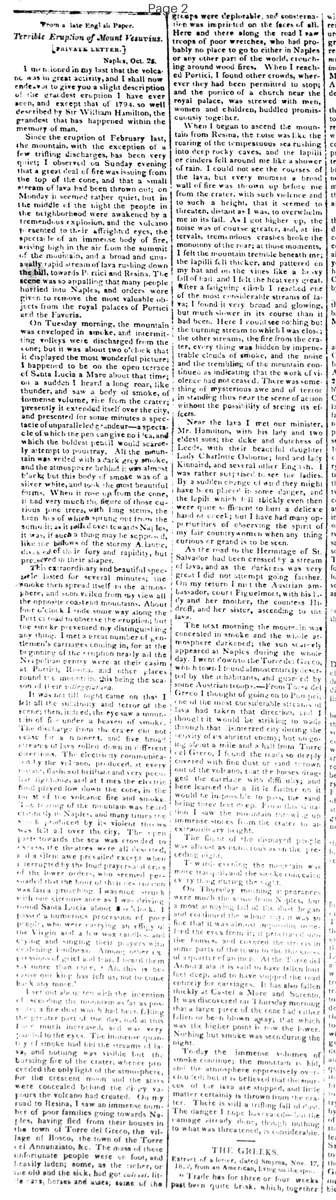
Terrible Eruption of Mount Vesuvius.
PRIVATE LETTER.
Naples, Oct. 25.
I mentioned in my last that the volcano was in great activity, and I shall now endeavor to give you a slight description of the grandest eruption I have ever seen, and except that of 1794, so well described by Sir William Hamilton, the grandest that has happened within the memory of man.
Since the eruption of February last, the mountain, with the exception of a few trifling discharges, has been very quiet; I observed on Sunday evening that a great deal of fire was issuing from the top of the cone, and that a small stream of lava had been thrown out; on Monday it seemed rather quiet, but in the middle of the night the people in the neighborhood were awakened by a tremendous explosion, and the volcano presented to their affrighted eyes, the spectacle of an immense body of fire, arising high in the air from the summit of the mountain, and a broad and unusually rapid stream of lava rushing down the hill, towards Portici and Resina. The scene was so appalling that many people hurried into Naples, and orders were given to remove the most valuable objects from the royal palaces of Portici and the Favorita.
On Tuesday morning, the mountain was enveloped in smoke, and intermitting volleys were discharged from the cone; but it was about two o'clock that it displayed the most wonderful picture: I happened to be on the open terrace of Santa Lucia a Mare about that time; on a sudden I heard a long roar, like thunder, and saw a body of smoke, of immense volume, rise from the crater; presently it extended itself over the city, and presented for some minutes a spectacle of unparalleled grandeur—a spectacle of which the pen can give no idea, and which the boldest pencil would scarcely attempt to portray. All the mountain was veiled with a dark grey smoke, and the atmosphere behind it was almost black but this body of smoke was of a silver white, and took the most beautiful forms. When it rose up from the cone, it had very much the figure of those curious pine trees, with long stems, the branches of which sprung out from the summit; as it rolled over towards Naples, it was, if such a thing may be supposed, like the billows of the stormy Atlantic, divested of their fury and rapidity, but preserved in their shapes.
This extraordinary and beautiful spectacle lasted for several minutes; the smoke then spread itself in the atmosphere, and soon veiled from my view all the opposite coast and mountains. About four o'clock I rode some way along the Portici road to observe the eruption; but the smoke prevented my distinguishing any thing. I met a great number of gentlemen's carriages coming in, for at the beginning of the motion nearly all the Neapolitan gentry were at their casinos at Portici, Resina, and other places round the mountain, this being the season of their villeggiatura.
It was not till night came on that I felt all the sublimity and terror of the scene; then, indeed, the eye saw a mountain of fire under a heaven of smoke. The discharge from the crater did not cease for a moment, and five broad streams of lava rolled down in different directions. The electricity communicated by the volcano, produced, at every flash, so brilliant and very peculiar lightning, and at times the electric fluid played low down the cone, in the midst of the volcanic fire and smoke. The roar of the mountain was heard distinctly in Naples, and many times the shock produced by its violent throws was felt all over the city. The part towards the sea was crowded to excess, the theatres were all deserted, and a silent awe prevailed except when interrupted by the loud prayers and cries of the lower orders, who seemed persuaded that the hour of their destruction was fast approaching I was much struck with one circumstance as I was driving round Santa Lucia about 8 o'clock. I passed a numerous procession of poor people, who were carrying an effigy of the Virgin and a few wax candles, and crying and singing their prayers with deafening loudness. Among other expressions of grief and fear, I heard them say more than once, 'Ah, this is because our king has left us, not to come back any more.'
I set out about ten with the intention of ascending the mountain as far as possible: a fire dust which had been falling the greater part of the day, had at this hour much increased, and was very painful to the eyes. The immense quantity of smoke had hid the streams of lava, and nothing was visible but the bursting fire of the crater, whence proceeded the only light of the atmosphere, for the crescent moon and the stars were concealed behind the dirty vapors the volcano had created. On my road to Resina, I saw an immense number of poor families going towards Naples, having fled from their houses in the town of Torre del Greco, the village of Bosco, the town of the Torre del Annunziato, &c. The mass of these unfortunate people were on foot, and heavily laden; some, as the richer, or the old and the sick, had got cars, little carts, horses and asses; some of the grape were deplorable, and consternation was imprinted on the faces of all. Here and there along the road I saw troops of poor wretches, who had probably no place to go to either in Naples or any other part of the world, crouching around wood fires. When I reached Portici, I found other crowds, wherever they had been permitted to stop; and the portico of a church near the royal palace, was strewed with men, women and children, huddled promiscuously together.
When I began to ascend the mountain from Resina, the noise was like the roaring of the tempestuous sea rushing into deep rocky caves, and the lapilli or cinders fell around me like a shower of rain. I could not see the courses of the lava, but every moment a broad wall of fire was thrown up before me from the crater, with such violence and to such a height, that it seemed to threaten, distant as I was, to overwhelm me in its fall. And as I got higher up, the noise was of course greater, and, at intervals, tremendous crashes broke the monotony of the roar; at those moments, I felt the mountain tremble beneath me: the lapilli fell thicker, and pattered on my hat and on the vines like a heavy fall of hail, and I felt the heat very great. After a fatiguing climb I reached the foot of the most considerable stream of lava; I found it very broad and glowing, but much slower in its course than it had been. Here I could see nothing but the burning stream to which I was close; the other streams, the fire from the crater, every thing was hidden by impenetrable clouds of smoke, and the noise and the trembling of the mountain continued as indicating that the work of violence had not ceased. There was something of mysterious awe and of terror in standing thus near the scene of action without the possibility of seeing its effects.
Near the lava I met our minister, Mr. Hamilton, with his lady and two eldest sons; the duke and duchess of Leeds, with their beautiful daughter Lady Charlotte Osborne: lord and lady Kinnaird, and several other English. I was rather surprised to see the ladies. By a sudden change of wind they might have been placed in some danger, and the lapilli which fell thickly even then were quite sufficient to hurt a delicate hand or cheek: but I have had many opportunities of observing the spirit of my fair countrywomen when any thing curious or grand is to be seen.
As the road to the Hermitage of St. Salvador had been crossed by a stream of lava, and as the darkness was very great I did not attempt going farther. On my return I met the Austrian ambassador, count Figueimont, with his lady and her mother, the countess Illdrof, and her sister, ascending to the lava.
The next morning the mountain was concealed in smoke and the whole atmosphere darkened; the sun scarcely appeared at Naples during the whole day. I went down to the Torre del Greco, which town I found almost entirely deserted by the inhabitants, and guarded by some Austrian troops.—From Torre del Greco I thought of going on to Pompeii; one of the most considerable streams of lava had taken that direction, and I thought it would be striking to wade through that disinterred city during the activity of its ancient enemy; but on going about a mile and a half from Torre del Greco, I found the roads so deeply covered with fine dust or sand thrown out of the volcano, that the horses dragged the carriage with difficulty; and here learned that a little farther on it would be impossible to pass, the sand being three feet deep. From this situation I saw the mountain throwing up immense stones from the crater to an extraordinary height.
The flight of the dismayed people was almost as tremendous as on the preceding night. The wind veering, the mountain was more tranquil, and the smoke concealed every thing during the night.
On Thursday morning appearances were much the same from Naples, but a most annoying fall of the dust began and continued the whole day. It was so fine that it was almost impossible to keep the eyes from it: it penetrated into the houses, and covered the streets in some parts of the town to the thickness of a quarter of an inch. At the Torre del Annunziata it is said to have fallen four feet deep, and to have stopped the road entirely for carriages. It has also fallen thickly at Castel a Mare and Sorrento.
It was discovered on Thursday morning that a large piece of the cone had either fallen or been blown away; that which was the higher point I saw the lower. Nothing but smoke was seen during the night.
To-day the immense volumes of smoke continue: the mountain is hid, and the atmosphere oppressively overclouded; but it is believed that the sources of the lava are stopped, and little matter certainly is thrown from the crater. There is still a trifling fall of dust. The danger I hope has ceased—but the damage already done, though nothing to what was threatened, is considerable.
What sub-type of article is it?
What keywords are associated?
What entities or persons were involved?
Where did it happen?
Foreign News Details
Primary Location
Naples
Event Date
Oct. 25
Key Persons
Outcome
considerable damage done; lava sources stopped; no casualties reported; evacuations from portici, resina, torre del greco, and surrounding areas; heavy dust fall blocking roads.
Event Details
Mount Vesuvius erupted starting Monday night with tremendous explosions, immense fire, and rapid lava streams towards Portici and Resina, prompting evacuations and removal of valuables from royal palaces. Tuesday featured massive smoke clouds, volleys from the cone, and spectacular displays visible from Naples. Night brought continuous crater discharges, five lava streams, volcanic lightning, roars, and tremors felt in the city. Witnesses ascended near lava flows amid falling lapilli and heat. By Thursday, a cone piece was missing, dust fell heavily, but lava ceased and danger passed.