Thank you for visiting SNEWPapers!
Sign up free
Letter to Editor
November 24, 1792
The Kentucky Gazette
Lexington, Fayette County, Kentucky
What is this article about?
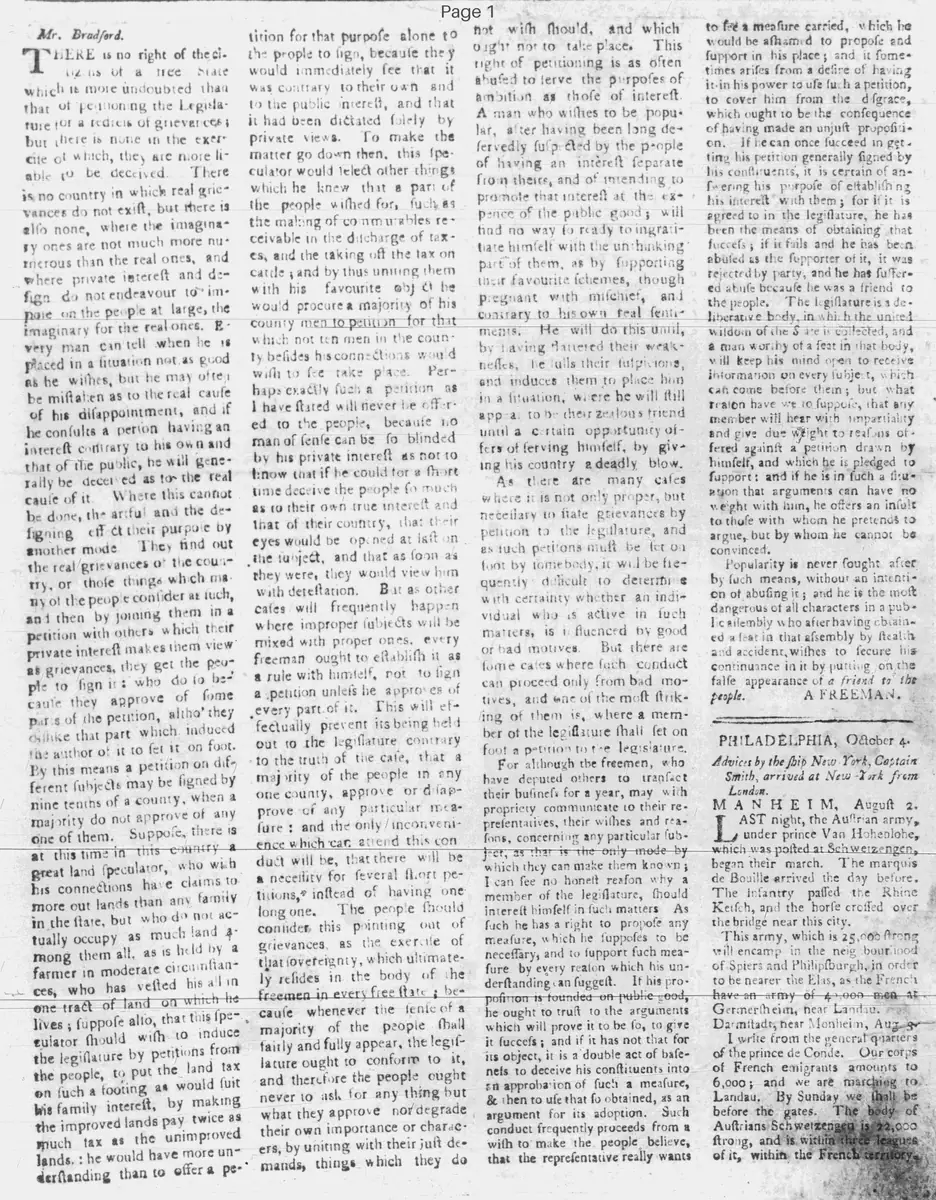
A Freeman advises against signing petitions unless one approves every part, to avoid deception by private interests mixing real and imaginary grievances. He criticizes land speculators and legislators who manipulate petitions for personal gain, emphasizing the right of petitioning as an exercise of sovereignty.
Clipping
OCR Quality
92%
Excellent
Full Text
Mr. Bradford.
THERE is no right of this which is more undoubted than that of petitioning the Legislature for a redress of grievances; but there is none in the exercise of which, they are more liable to be deceived. There is no country in which real grievances do not exist. but where is also none, where the imaginary ones are not much more numerous than the real ones, and where private interest and design do not endeavour to impose on the people at large, the imaginary for the real ones. Every man can tell when he is placed in a situation not as good as he wishes. but he may often be mistaken as to the real cause of his disappointment, and if he consults a person having an interest contrary to his own and that of the public, he will generally be deceived as to the real cause of it Where this cannot be done, the artful and the designing effect their purpose by another mode They find out the real grievances of the country, or those things which many of the people consider as such, and then by joining them in a petition with others which their private interest makes them view as grievances, they get the people to sign it : who do so because they approve of some parts of the petition, altho' they dislike that part which induced the author of it to set it on foot. By this means a petition on different subjects may be signed by nine tenths of a county, when a majority do not approve of any one of them. Suppose, there is at this time in this country a great land speculator, who with his connections have claims to more out lands than any family in the state, but who do not actually occupy as much land as a farmer in moderate circumstances among them all. as is held by a single tract of land on which he lives : suppose also, that this speculator should wish to induce the people, to put the land tax on such a footing as would suit his family interest, by making the improved lands pay twice as much tax as the unimproved lands. : he would have more understanding than to offer a petition for that purpose alone to the people to sign, because they would immediately see that it was contrary to their own and to the public interest.and that it had been dictated solely by private views. To make the matter go down then. this speculator would select other things which he knew that a part of the people wished for, such as the making of commodities receivable in the discharge of taxes, and the taking off the tax on cattle ; and by thus uniting them with his favourite object he would procure a majority of his county men to petition for that which not ten men in the county besides his connections would wish to take place. Perhaps exactly such a petition as I have stated will never be offered to the people. because no man of sense can be so blinded by his private interest as not to know that if he could for a short time deceive the people so much as to their own true interest and that of their country, that their eyes would be opened at last on the subject, and that as soon as they were, they would view him with detestation. But as other cases will frequently happen where improper subjects will be mixed with proper ones, every freeman ought to establish it as a rule with himself. not to sign a petition unless he approves of every part of it. This will effectually prevent its being held out to the legislature contrary to the truth of the case, that a majority of the people in any one county, approve or disapprove of any particular measure : and the only inconvenience which can attend this conduct will be. that there will be a necessity for several short petitions.* instead of having one long one. The people should consider this pointing out of grievances, as the exercise of that sovereignty, which ultimately resides in the body of the freemen in every free state : because whenever the sense of a majority of the people shall fairly and fully appear, the legislature ought to conform to it, and therefore the people ought never to ask for any thing but what they approve nor degrade their own importance or characters, by uniting with their just demands, things which they do not wish should and which ought not to take place. This right of petitioning is as often abused to serve the purposes of ambition as those of interest. A man who wishes to be popular. after having been long deservedly suspected by the people of having an interest separate from theirs, and of intending to promote that interest at the expense of the public good; will find no way so ready to ingratiate himself with the unthinking part of them, as by supporting their favourite schemes, though pregnant with mischief. and contrary to his own real sentiments. He will do this until, by having flattered their weaknesses, he lulls their suspicions. and induces them to place him in a situation, where he will still appear to be their zealous friend until a certain opportunity offers of serving himself, by giving his country a deadly blow. As there are many cases where it is not only proper, but necessary to state grievances by petition to the legislature, and as such petitions must be set on foot by somebody, it will be frequently difficult to determine with certainty whether an individual who is active in such matters, is influenced by good or bad motives. But there are some cases where such conduct can proceed only from bad motives, and one of the most striking of them is. where a member of the legislature shall set on foot a petition to the legislature. For although the freemen, who have deputed others to transact their business for a year, may with propriety communicate to their representatives, their wishes and reasons, concerning any particular subject, as that is the only mode by which they can make them known : I can see no honest reason why a member of the legislature,should interest himself in such matters As such he has a right to propose any measure, which he supposes to be necessary, and to support such measure by every reason which his understanding can suggest. If his proposition is founded on public good. he ought to trust to the arguments which will prove it to be so, to give it success : and if it has not that for its object, it is a double act of baseness to deceive his constituents into an approbation of such a measure. and then to use that so obtained, as an argument for its adoption. Such conduct frequently proceeds from a wish to make the people believe, that the representative really wants to see a measure carried. which he would be ashamed to propose and support in his place; and it sometimes arises from a desire of having it in his power to use such a petition, to cover him from the disgrace, which ought to be the consequence of having made an unjust proposition. if he can once succeed in getting his petition generally signed by his constituents, it is certain of answering his purpose of establishing his interest with them; for if it is agreed to in the legislature, he has been the means of obtaining that success : if it fails and he has been abused as the supporter of it, it was rejected by party, and he has suffered abuse because he was a friend to the people. The legislature is a deliberative body. in which the united wisdom of the State is collected. and a man worthy of a seat in that body. will keep his mind open to receive information on every subject. which can come before them; but what reason have we to suppose, that any member will hear with impartiality and give due weight to reasons offered against a petition drawn by himself, and which he is pledged to support: and if he is in such a situation that arguments can have no weight with him. he offers an insult to those with whom he pretends to argue, but by whom he cannot be convinced. Popularity is never sought after by such means, without an intention of abusing it : and he is the most dangerous of all characters in a public assembly who after having obtained a seat in that assembly by stealth and accident, wishes to secure his continuance in it by putting on the false appearance of a friend to the people.
A FREEMAN.
THERE is no right of this which is more undoubted than that of petitioning the Legislature for a redress of grievances; but there is none in the exercise of which, they are more liable to be deceived. There is no country in which real grievances do not exist. but where is also none, where the imaginary ones are not much more numerous than the real ones, and where private interest and design do not endeavour to impose on the people at large, the imaginary for the real ones. Every man can tell when he is placed in a situation not as good as he wishes. but he may often be mistaken as to the real cause of his disappointment, and if he consults a person having an interest contrary to his own and that of the public, he will generally be deceived as to the real cause of it Where this cannot be done, the artful and the designing effect their purpose by another mode They find out the real grievances of the country, or those things which many of the people consider as such, and then by joining them in a petition with others which their private interest makes them view as grievances, they get the people to sign it : who do so because they approve of some parts of the petition, altho' they dislike that part which induced the author of it to set it on foot. By this means a petition on different subjects may be signed by nine tenths of a county, when a majority do not approve of any one of them. Suppose, there is at this time in this country a great land speculator, who with his connections have claims to more out lands than any family in the state, but who do not actually occupy as much land as a farmer in moderate circumstances among them all. as is held by a single tract of land on which he lives : suppose also, that this speculator should wish to induce the people, to put the land tax on such a footing as would suit his family interest, by making the improved lands pay twice as much tax as the unimproved lands. : he would have more understanding than to offer a petition for that purpose alone to the people to sign, because they would immediately see that it was contrary to their own and to the public interest.and that it had been dictated solely by private views. To make the matter go down then. this speculator would select other things which he knew that a part of the people wished for, such as the making of commodities receivable in the discharge of taxes, and the taking off the tax on cattle ; and by thus uniting them with his favourite object he would procure a majority of his county men to petition for that which not ten men in the county besides his connections would wish to take place. Perhaps exactly such a petition as I have stated will never be offered to the people. because no man of sense can be so blinded by his private interest as not to know that if he could for a short time deceive the people so much as to their own true interest and that of their country, that their eyes would be opened at last on the subject, and that as soon as they were, they would view him with detestation. But as other cases will frequently happen where improper subjects will be mixed with proper ones, every freeman ought to establish it as a rule with himself. not to sign a petition unless he approves of every part of it. This will effectually prevent its being held out to the legislature contrary to the truth of the case, that a majority of the people in any one county, approve or disapprove of any particular measure : and the only inconvenience which can attend this conduct will be. that there will be a necessity for several short petitions.* instead of having one long one. The people should consider this pointing out of grievances, as the exercise of that sovereignty, which ultimately resides in the body of the freemen in every free state : because whenever the sense of a majority of the people shall fairly and fully appear, the legislature ought to conform to it, and therefore the people ought never to ask for any thing but what they approve nor degrade their own importance or characters, by uniting with their just demands, things which they do not wish should and which ought not to take place. This right of petitioning is as often abused to serve the purposes of ambition as those of interest. A man who wishes to be popular. after having been long deservedly suspected by the people of having an interest separate from theirs, and of intending to promote that interest at the expense of the public good; will find no way so ready to ingratiate himself with the unthinking part of them, as by supporting their favourite schemes, though pregnant with mischief. and contrary to his own real sentiments. He will do this until, by having flattered their weaknesses, he lulls their suspicions. and induces them to place him in a situation, where he will still appear to be their zealous friend until a certain opportunity offers of serving himself, by giving his country a deadly blow. As there are many cases where it is not only proper, but necessary to state grievances by petition to the legislature, and as such petitions must be set on foot by somebody, it will be frequently difficult to determine with certainty whether an individual who is active in such matters, is influenced by good or bad motives. But there are some cases where such conduct can proceed only from bad motives, and one of the most striking of them is. where a member of the legislature shall set on foot a petition to the legislature. For although the freemen, who have deputed others to transact their business for a year, may with propriety communicate to their representatives, their wishes and reasons, concerning any particular subject, as that is the only mode by which they can make them known : I can see no honest reason why a member of the legislature,should interest himself in such matters As such he has a right to propose any measure, which he supposes to be necessary, and to support such measure by every reason which his understanding can suggest. If his proposition is founded on public good. he ought to trust to the arguments which will prove it to be so, to give it success : and if it has not that for its object, it is a double act of baseness to deceive his constituents into an approbation of such a measure. and then to use that so obtained, as an argument for its adoption. Such conduct frequently proceeds from a wish to make the people believe, that the representative really wants to see a measure carried. which he would be ashamed to propose and support in his place; and it sometimes arises from a desire of having it in his power to use such a petition, to cover him from the disgrace, which ought to be the consequence of having made an unjust proposition. if he can once succeed in getting his petition generally signed by his constituents, it is certain of answering his purpose of establishing his interest with them; for if it is agreed to in the legislature, he has been the means of obtaining that success : if it fails and he has been abused as the supporter of it, it was rejected by party, and he has suffered abuse because he was a friend to the people. The legislature is a deliberative body. in which the united wisdom of the State is collected. and a man worthy of a seat in that body. will keep his mind open to receive information on every subject. which can come before them; but what reason have we to suppose, that any member will hear with impartiality and give due weight to reasons offered against a petition drawn by himself, and which he is pledged to support: and if he is in such a situation that arguments can have no weight with him. he offers an insult to those with whom he pretends to argue, but by whom he cannot be convinced. Popularity is never sought after by such means, without an intention of abusing it : and he is the most dangerous of all characters in a public assembly who after having obtained a seat in that assembly by stealth and accident, wishes to secure his continuance in it by putting on the false appearance of a friend to the people.
A FREEMAN.
What sub-type of article is it?
Persuasive
Political
Reflective
What themes does it cover?
Politics
Constitutional Rights
Morality
What keywords are associated?
Petitioning
Grievances
Private Interest
Legislature
Land Tax
Public Good
Freeman
Deception
What entities or persons were involved?
A Freeman.
Mr. Bradford.
Letter to Editor Details
Author
A Freeman.
Recipient
Mr. Bradford.
Main Argument
freemen should only sign petitions they fully approve to prevent deception by private interests mixing real and imaginary grievances; legislators should not initiate petitions but propose measures directly in the assembly.
Notable Details
Example Of Land Speculator Mixing Tax Relief On Commodities And Cattle With Favoring Unimproved Lands
Criticism Of Legislators Using Petitions To Feign Public Support For Self Serving Measures