Thank you for visiting SNEWPapers!
Sign up free
Editorial
July 13, 1912
The Winslow Mail
Winslow, Navajo County, Arizona
What is this article about?
This editorial argues that advertising by local merchants demonstrates good faith, efficiency, and success, building public trust and encouraging purchases. It cites the Keokuk Gate City and advises studying goods before advertising. Signed by Jed Scarboro.
Clipping
OCR Quality
98%
Excellent
Full Text
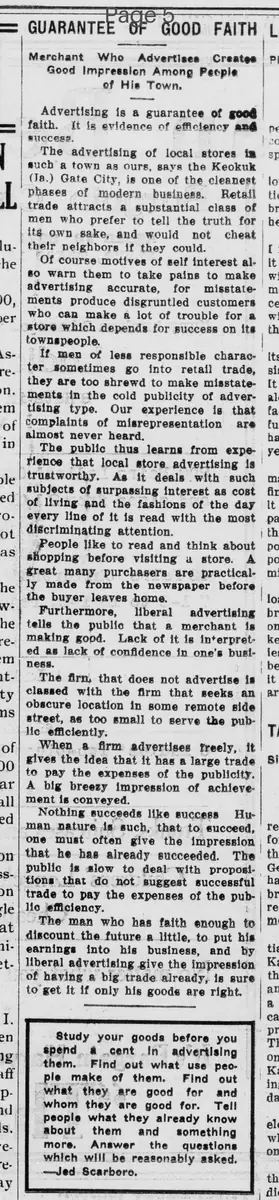
GUARANTEE
Or Merchant Who Advertises Creates Good Impression Among People of His Town.
Advertising is a guarantee of good faith. It is evidence of efficiency and success.
The advertising of local stores is such a town as ours, says the Keokuk (Iowa) Gate City, is one of the cleanest phases of modern business. Retail trade attracts a substantial class of men who prefer to tell the truth for its own sake, and would not cheat their neighbors if they could.
Of course motives of self interest also warn them to take pains to make advertising accurate, for misstatements produce disgruntled customers who can make a lot of trouble for a store which depends for success on its townspeople.
If men of less responsible character sometimes go into retail trade, they are too shrewd to make misstatements in the cold publicity of advertising type. Our experience is that complaints of misrepresentation are almost never heard.
The public thus learns from experience that local store advertising is trustworthy. As it deals with such subjects of surpassing interest as cost of living and the fashions of the day every line of it is read with the most discriminating attention.
People like to read and think about shopping before visiting a store. A great many purchases are practically made from the newspaper before the buyer leaves home.
Furthermore, liberal advertising tells the public that a merchant is making good. Lack of it is interpreted as lack of confidence in one's business.
The firm that does not advertise is classed with the firm that seeks an obscure location in some remote side street, as too small to serve the public efficiently.
When a firm advertises freely, it gives the idea that it has a large trade to pay the expenses of the publicity. A big breezy impression of achievement is conveyed.
Nothing succeeds like success. Human nature is such, that to succeed, one must often give the impression that he has already succeeded. The public is slow to deal with propositions that do not suggest successful trade to pay the expenses of the publicity efficiency.
The man who has faith enough to discount the future a little, to put his earnings into his business, and by liberal advertising give the impression of having a big trade already, is sure to get it if only his goods are right.
Study your goods before you spend a cent in advertising them. Find out what use people make of them. Find out what they are good for and whom they are good for. Tell people what they already know about them and something more. Answer the questions which will be reasonably asked.
—Jed Scarboro.
Or Merchant Who Advertises Creates Good Impression Among People of His Town.
Advertising is a guarantee of good faith. It is evidence of efficiency and success.
The advertising of local stores is such a town as ours, says the Keokuk (Iowa) Gate City, is one of the cleanest phases of modern business. Retail trade attracts a substantial class of men who prefer to tell the truth for its own sake, and would not cheat their neighbors if they could.
Of course motives of self interest also warn them to take pains to make advertising accurate, for misstatements produce disgruntled customers who can make a lot of trouble for a store which depends for success on its townspeople.
If men of less responsible character sometimes go into retail trade, they are too shrewd to make misstatements in the cold publicity of advertising type. Our experience is that complaints of misrepresentation are almost never heard.
The public thus learns from experience that local store advertising is trustworthy. As it deals with such subjects of surpassing interest as cost of living and the fashions of the day every line of it is read with the most discriminating attention.
People like to read and think about shopping before visiting a store. A great many purchases are practically made from the newspaper before the buyer leaves home.
Furthermore, liberal advertising tells the public that a merchant is making good. Lack of it is interpreted as lack of confidence in one's business.
The firm that does not advertise is classed with the firm that seeks an obscure location in some remote side street, as too small to serve the public efficiently.
When a firm advertises freely, it gives the idea that it has a large trade to pay the expenses of the publicity. A big breezy impression of achievement is conveyed.
Nothing succeeds like success. Human nature is such, that to succeed, one must often give the impression that he has already succeeded. The public is slow to deal with propositions that do not suggest successful trade to pay the expenses of the publicity efficiency.
The man who has faith enough to discount the future a little, to put his earnings into his business, and by liberal advertising give the impression of having a big trade already, is sure to get it if only his goods are right.
Study your goods before you spend a cent in advertising them. Find out what use people make of them. Find out what they are good for and whom they are good for. Tell people what they already know about them and something more. Answer the questions which will be reasonably asked.
—Jed Scarboro.
What sub-type of article is it?
Trade Or Commerce
What keywords are associated?
Advertising
Local Merchants
Business Success
Retail Trade
Public Trust
What entities or persons were involved?
Keokuk (Iowa) Gate City
Jed Scarboro
Editorial Details
Primary Topic
Benefits Of Local Merchant Advertising
Stance / Tone
Supportive Of Advertising As A Sign Of Trustworthiness And Success
Key Figures
Keokuk (Iowa) Gate City
Jed Scarboro
Key Arguments
Advertising Is A Guarantee Of Good Faith And Evidence Of Efficiency And Success
Local Store Advertising Is Trustworthy And Attracts Truthful Merchants
Misstatements In Advertising Lead To Trouble With Customers
Public Reads Advertising Closely For Cost Of Living And Fashions
Liberal Advertising Signals A Successful Business
Non Advertising Firms Are Seen As Lacking Confidence Or Efficiency
To Succeed, Merchants Must Project Success Through Advertising
Study Goods Thoroughly Before Advertising To Answer Public Questions