Thank you for visiting SNEWPapers!
Sign up free
National Gazette
Philadelphia, Philadelphia County, Pennsylvania
What is this article about?
A subscriber requests Mr. Freneau to republish an article from the Independent Gazeteer advocating for a US bill of rights to protect liberties, referencing the French Declaration of the Rights of Man and critiquing federal laws like funding systems, banks, and excises as violations of natural rights.
Merged-components note: Continuation of a single letter to the editor discussing the need for a bill of rights, with sequential reading order. The first component includes a short editorial concluding note on the prior Fishery Bill debate, likely due to parsing adjacency, but the dominant content is the letter.
Clipping
OCR Quality
Full Text
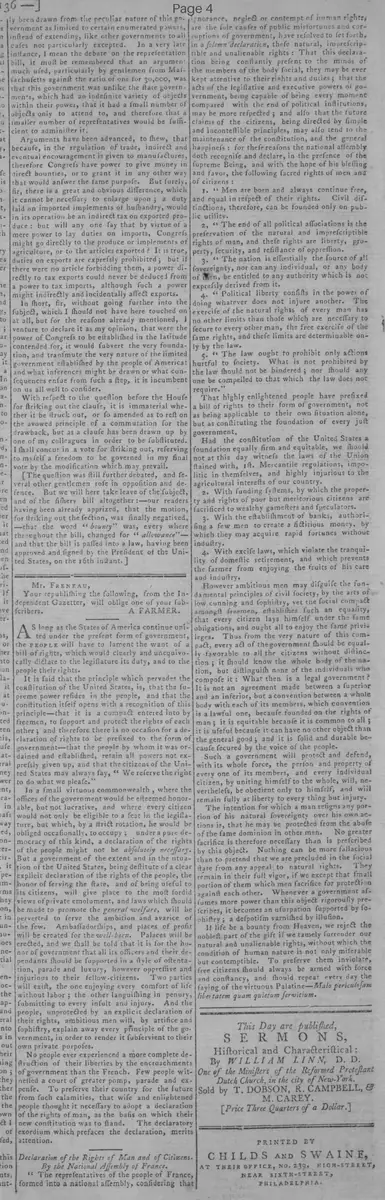
Mr. Freneau,
Your republishing the following, from the Independent Gazeteer, will oblige one of your subscribers.
A FARMER.
As long as the States of America continue united under the present form of government, the PEOPLE will have to lament the want of a bill of rights, which would clearly and unequivocally dictate to the legislature its duty, and to the people their rights.
It is said that the principle which pervades the constitution of the United States, is, that the supreme power resides in the people, and that the constitution itself opens with a recognition of this principle—that it is a compact entered into by freemen, to support and protect the rights of each other; and therefore there is no occasion for a declaration of rights to be prefixed to the form of government—that the people by whom it was ordained and established, retain all powers not expressly given up, and that the citizens of the United States may always say, "We reserve the right to do what we please."
In a small virtuous commonwealth, where the offices of the government would be esteemed honorable, but not lucrative, and where every citizen would not only be eligible to a seat in the legislature, but which, by a strict rotation, he would be obliged occasionally, to occupy; under a pure democracy of this kind, a declaration of the rights of the people might not be absolutely necessary.
But a government of the extent and in the situation of the United States, being destitute of a clear explicit declaration of the rights of the people, the honor of serving the state, and of being useful to its citizens, will give place to the most sordid views of private emolument, and laws which should be made to promote the general welfare, will be perverted to serve the ambition and avarice of the few. Embassies, and places of profit will be created for the well-born. Palaces will be erected, and we shall be told that it is for the honor of government that all its officers and their dependants should be supported in a style of ostentation, parade and luxury, however oppressive and injurious to their fellow-citizens. Two parties will exist, the one enjoying every comfort of life without labor; the other languishing in penury, submitting to every insult and injury. And the people, unprotected by an explicit declaration of their rights, ambitious men will, by artifice and sophistry, explain away every principle of the government, in order to render it subservient to their own private purposes.
No people ever experienced a more complete destruction of their liberties by the encroachments of government than the French. Few people witnessed a court of greater pomp, parade and expense. To preserve their country for the future from such calamities, that wise and enlightened people thought it necessary to adopt a declaration of the rights of man, as the basis on which their new constitution was to stand. The declaratory exordium which prefaces the declaration, merits attention.
Declaration of the Rights of Man and of Citizens.
By the National Assembly of France.
"The representatives of the people of France, formed into a national assembly, considering that ignorance, neglect or contempt of human rights, are the sole causes of public misfortunes and corruptions of government, have resolved to set forth, in a solemn declaration, these natural, imprescriptible and unalienable rights: That this declaration being constantly present to the minds of the members of the body social, they may be ever kept attentive to their rights and duties; that the acts of the legislative and executive powers of government, being capable of being every moment compared with the end of political institutions, may be more respected; and also that the future claims of the citizens, being directed by simple and incontestable principles, may also tend to the maintenance of the constitution, and the general happiness: for these reasons the national assembly doth recognize and declare, in the presence of the supreme Being, and with the hope of his blessing and favor, the following sacred rights of men and of citizens:
I. "Men are born and always continue free, and equal in respect of their rights. Civil distinctions, therefore, can be founded only on public utility.
2. "The end of all political associations is the preservation of the natural and imprescriptible rights of man, and these rights are liberty, property, security, and resistance of oppression.
3. "The nation is essentially the source of all sovereignty, nor can any individual, or any body of men, be entitled to any authority which is not expressly derived from it.
4. "Political liberty consists in the power of doing whatever does not injure another. The exercise of the natural rights of every man has no other limits than those which are necessary to secure to every other man, the free exercise of the same rights, and these limits are determinable only by the law.
5. "The law ought to prohibit only actions hurtful to society. What is not prohibited by the law should not be hindered; nor should any one be compelled to that which the law does not require."
That highly enlightened people have prefixed a bill of rights to their form of government, not as being applicable to their own situation alone, but as constituting the foundation of every just government.
Had the constitution of the United States a foundation equally firm and equitable, we should not at this day witness the laws of the Union tainted with,
1. Mercantile regulations, impolitic in themselves, and highly injurious to the agricultural interests of our country.
2. With funding systems, by which the property and rights of poor but meritorious citizens are sacrificed to wealthy gamblers and speculators.
3. With the establishment of banks, authorizing a few men to create a fictitious money, by which they may acquire rapid fortunes without industry.
4. With excise laws, which violate the tranquility of domestic retirement, and which prevents the farmer from enjoying the fruits of his care and industry.
However ambitious men may disguise the fundamental principles of civil society, by the arts of low cunning and sophistry, yet the social compact amongst freemen, establishes such an equality, that every citizen lays himself under the same obligations, and ought all to enjoy the same privileges. Thus from the very nature of this compact, every act of the government should be equally favorable to all the citizens without distinction; it should know the whole body of the nation, but distinguish none of the individuals who compose it: What then is a legal government?
It is not an agreement made between a superior and an inferior, but a convention between a whole body with each of its members, which convention is a lawful one, because founded on the rights of man; it is equitable because it is common to all; it is useful because it can have no other object than the general good; and it is solid and durable because secured by the voice of the people.
Such a government will protect and defend, with its whole force, the person and property of every one of its members, and every individual citizen, by uniting himself to the whole, will, nevertheless, be obedient only to himself, and will remain fully at liberty to every thing but injury.
The intention for which a man resigns any portion of his natural sovereignty over his own actions is, that he may be protected from the abuse of the same dominion in other men. No greater sacrifice is therefore necessary than is prescribed by this object. Nothing can be more fallacious than to pretend that we are precluded in the social state from any appeal: to natural rights. They remain in their full vigor, if we except that small portion of them which men sacrifice for protection against each other. Whenever a government assumes more power than this object rigorously prescribes, it becomes an usurpation supported by sophistry; a despotism varnished by illusion.
If life be a bounty from Heaven, we reject the noblest part of the gift if we tamely surrender our natural and unalienable rights, without which the condition of human nature is not only miserable but contemptible. To preserve them inviolate, free citizens should always be armed with force and constancy, and should repeat every day the saying of the virtuous Palatine—'Malo periculosam libertatem quam quietum servitium.'
What sub-type of article is it?
What themes does it cover?
What keywords are associated?
What entities or persons were involved?
Letter to Editor Details
Author
A Farmer
Recipient
Mr. Freneau
Main Argument
the united states lacks a bill of rights, leaving people's liberties vulnerable to government overreach and corruption; a clear declaration of rights, like france's, is essential to protect natural rights and ensure equitable governance.
Notable Details