Thank you for visiting SNEWPapers!
Sign up free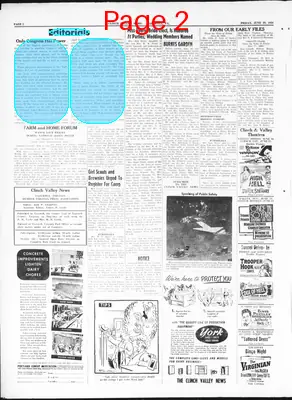
Editorial
June 20, 1958
Clinch Valley News
Tazewell, Jeffersonville, Tazewell County, Virginia
What is this article about?
The editorial urges Congress to amend the Taft-Hartley Act to address union abuses: banning organizational picketing by non-employees, prohibiting secondary boycotts affecting neutral parties like retailers, and filling jurisdictional voids in labor disputes to provide legal relief from coercion.
Clipping
OCR Quality
98%
Excellent
Full Text
Editorials
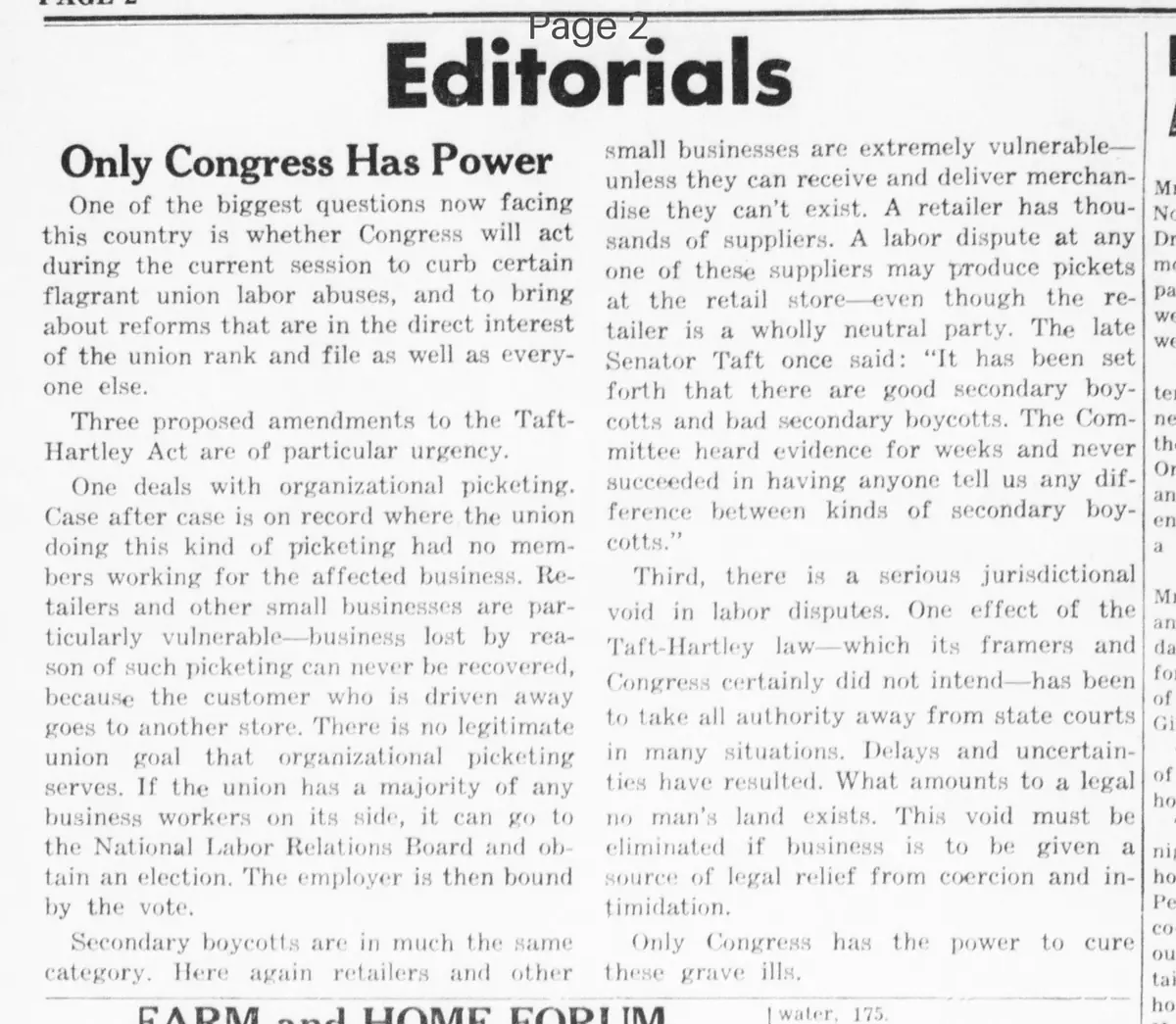
Only Congress Has Power
One of the biggest questions now facing this country is whether Congress will act during the current session to curb certain flagrant union labor abuses, and to bring about reforms that are in the direct interest of the union rank and file as well as everyone else.
Three proposed amendments to the Taft-Hartley Act are of particular urgency. One deals with organizational picketing. Case after case is on record where the union doing this kind of picketing had no members working for the affected business. Retailers and other small businesses are particularly vulnerable—business lost by reason of such picketing can never be recovered, because the customer who is driven away goes to another store. There is no legitimate union goal that organizational picketing serves. If the union has a majority of any business workers on its side, it can go to the National Labor Relations Board and obtain an election. The employer is then bound by the vote.
Secondary boycotts are in much the same category. Here again retailers and other small businesses are extremely vulnerable—unless they can receive and deliver merchandise they can't exist. A retailer has thousands of suppliers. A labor dispute at any one of these suppliers may produce pickets at the retail store—even though the retailer is a wholly neutral party. The late Senator Taft once said: "It has been set forth that there are good secondary boycotts and bad secondary boycotts. The Committee heard evidence for weeks and never succeeded in having anyone tell us any difference between kinds of secondary boycotts."
Third, there is a serious jurisdictional void in labor disputes. One effect of the Taft-Hartley law—which its framers and Congress certainly did not intend—has been to take all authority away from state courts in many situations. Delays and uncertainties have resulted. What amounts to a legal no man's land exists. This void must be eliminated if business is to be given a source of legal relief from coercion and intimidation.
Only Congress has the power to cure these grave ills.
Only Congress Has Power
One of the biggest questions now facing this country is whether Congress will act during the current session to curb certain flagrant union labor abuses, and to bring about reforms that are in the direct interest of the union rank and file as well as everyone else.
Three proposed amendments to the Taft-Hartley Act are of particular urgency. One deals with organizational picketing. Case after case is on record where the union doing this kind of picketing had no members working for the affected business. Retailers and other small businesses are particularly vulnerable—business lost by reason of such picketing can never be recovered, because the customer who is driven away goes to another store. There is no legitimate union goal that organizational picketing serves. If the union has a majority of any business workers on its side, it can go to the National Labor Relations Board and obtain an election. The employer is then bound by the vote.
Secondary boycotts are in much the same category. Here again retailers and other small businesses are extremely vulnerable—unless they can receive and deliver merchandise they can't exist. A retailer has thousands of suppliers. A labor dispute at any one of these suppliers may produce pickets at the retail store—even though the retailer is a wholly neutral party. The late Senator Taft once said: "It has been set forth that there are good secondary boycotts and bad secondary boycotts. The Committee heard evidence for weeks and never succeeded in having anyone tell us any difference between kinds of secondary boycotts."
Third, there is a serious jurisdictional void in labor disputes. One effect of the Taft-Hartley law—which its framers and Congress certainly did not intend—has been to take all authority away from state courts in many situations. Delays and uncertainties have resulted. What amounts to a legal no man's land exists. This void must be eliminated if business is to be given a source of legal relief from coercion and intimidation.
Only Congress has the power to cure these grave ills.
What sub-type of article is it?
Labor
Legal Reform
What keywords are associated?
Taft Hartley Act
Organizational Picketing
Secondary Boycotts
Labor Reforms
Jurisdictional Void
Congressional Action
Union Abuses
What entities or persons were involved?
Congress
Taft Hartley Act
Senator Taft
National Labor Relations Board
Unions
Retailers
Small Businesses
Editorial Details
Primary Topic
Amendments To Taft Hartley Act To Curb Union Abuses
Stance / Tone
Urging Congressional Action Against Union Practices
Key Figures
Congress
Taft Hartley Act
Senator Taft
National Labor Relations Board
Unions
Retailers
Small Businesses
Key Arguments
Organizational Picketing By Unions Without Members In The Business Harms Small Businesses Without Serving Legitimate Goals; Elections Via Nlrb Are The Proper Alternative.
Secondary Boycotts Target Neutral Retailers Over Supplier Disputes, Threatening Their Survival; No Distinction Between Good And Bad Boycotts Exists.
Taft Hartley Created Unintended Jurisdictional Voids Removing State Court Authority, Causing Delays; Must Be Fixed For Legal Relief From Coercion.
Only Congress Can Enact These Reforms Benefiting Unions And The Public.