Thank you for visiting SNEWPapers!
Sign up free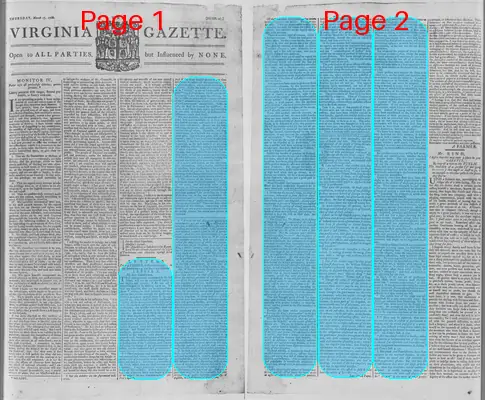
The Virginia Gazette
Williamsburg, Virginia
What is this article about?
In Letter X, a Pennsylvania Farmer argues against submitting to the recent British parliamentary act, warning it grants ministers unchecked power to tax and appoint officials in the colonies, drawing dire parallels to Ireland's exploitation through pensions and revenue misuse, urging unified resistance to protect liberty.
Merged-components note: Continuation of 'Letters from a Farmer in Pennsylvania, Letter X', a political treatise against British parliamentary acts; originally labeled editorial but fits as a published reader letter.
Clippings
1 of 2
OCR Quality
Full Text
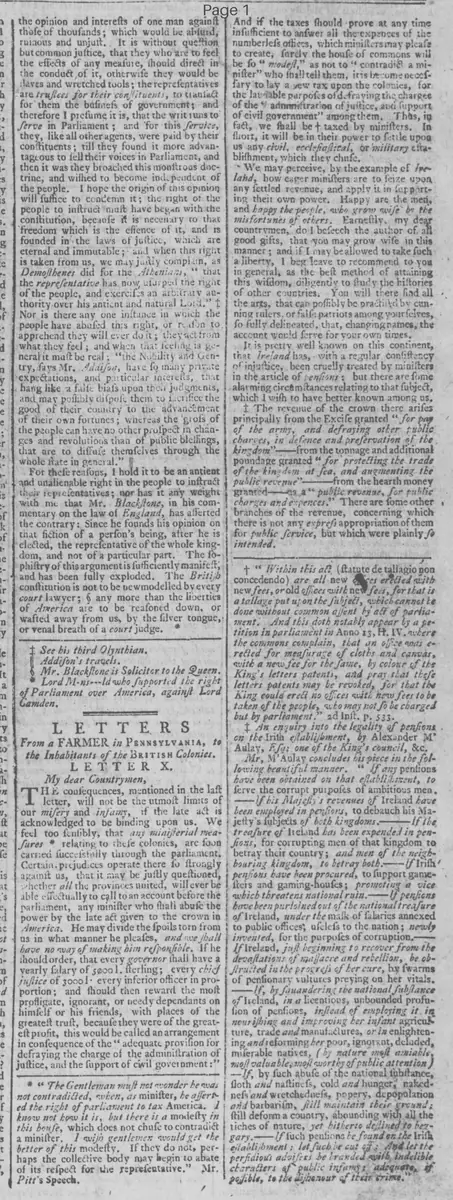
From a FARMER in Pennsylvania, to
the Inhabitants of the British Colonies.
LETTER X.
THE
My dear Countrymen,
our misery and infamy, if the late act is acknowledged to be binding upon us. We feel too sensibly, that any ministerial measures * relating to these colonies, are soon carried successfully through the parliament. Certain prejudices operate there so strongly against us, that it may be justly questioned, whether all the provinces united, will ever be able to call to an account before the parliament, any minister who shall abuse the power by the late act given to the crown in America. He may divide the spoils torn from us in what manner he pleases, and we shall have no way of making him responsible. If he should order, that every governor shall have a yearly salary of 500l. sterling; every chief justice of 3000l: every inferior officer in proportion; and should then reward the most profligate, ignorant, or needy dependants on himself or his friends, with places of the greatest trust, because they were of the greatest profit, this would be called an arrangement in consequence of the "adequate provision for defraying the charge of the administration of justice, and the support of civil government:"
* see The Gentleman must not wonder he was not contradicted. when, as minister, he asserted the right of parliament to tax America. I know not how it is, but there is a modesty in this house, which does not chuse to contradict a minister. I wish gentlemen would get the better of this modesty. If they do not, perhaps the collective body may begin to abate of its respect for the representative." Mr. Pitt's Speech.
And if the taxes should prove at any time insufficient to answer all the expences of the numberless offices, which ministers may please to create, hardly the house of commons will be so "modest," as not to "contradict mi-nister" who shall tell them, it is become necessary to lay a new tax upon the colonies, for the laudable purposes of defraying the charges of the 'administration of justice, and support of civil government" among them. Thus, in fact, we shall be taxed by ministers. In short, it will be in their power to settle upon us any civil, ecclesiastical, or military establishment, which they chuse.
We may perceive, by the example of Ireland, how eager ministers are to seize upon any settled revenue, and apply it in supporting their own power. Happy are the men, and happy the people, who grow wise by the misfortunes of others. Earnestly, my dear countrymen, do I beseech the author of all good gifts, that you may grow wise in this manner; and if I may be allowed to take such a liberty, I beg leave to recommend to you in general, as the best method of attaining this wisdom, diligently to study the histories of other countries. You will there find all the arts, that can possibly be practised by cunning rulers, or false patriots among yourselves, so fully delineated, that, changing names, the account would serve for your own times.
It is pretty well known on this continent, that Ireland has, with a regular consistency of injustice, been cruelly treated by ministers in the article of pensions: but there are some alarming circumstances relating to that subject, which I wish to have better known among us.
I The revenue of the crown there arises principally from the Excise granted "for pay of the army, and defraying other public charges, in defence and preservation of the kingdom" from the tonnage and additional poundage granted "for protecting the trade of the kingdom at sea, and augmenting the public revenue" -from the hearth money granted as a "public revenue, or public charges and expences." There are some other branches of the revenue, concerning which there is not any express appropriation of them for public service, but which were plainly intended.
"Within this act (statute de tallagio non concedendo) are all new asses erected with new fees, or old offices with new fees, for that is a tallage put upon the subject, which cannot be done without common assent by act of parliament. And this doth notably appear by a petition in parliament in Anno 13, H. IV. where the commons complain, that an office was erected for measurage of cloths and canvas, with a new fee for the same, by colour of the King's letters patents, and pray that these letters patents may be revoked, for that the King could erect no offices with new fees to be taken of the people, who may not so be charged but by parliament." 2d Inst. p. 533.
I An enquiry into the legality of pensions on the Irish establishment, by Alexander M'Aulay, Esq; one of the King's council, &c.
Mr. M'Aulay concludes his piece in the following beautiful manner. "If any pensions have been obtained on that establishment, to serve the corrupt purposes of ambitious men. —If his Majesty's revenues of Ireland have been employed in pensions, to debauch his Majesty's subjects of both kingdoms. If the treasure of Ireland has been expended in pensions, for corrupting men of that kingdom to betray their country; and men of the neighbouring kingdom, to betray both.—If Irish pensions have been procured, to support gamesters and gaming-houses; promoting a vice which threatens national ruin.—If pensions have been purloined out of the national treasure of Ireland, under the mask of salaries annexed to public offices, useless to the nation; newly invented, for the purposes of corruption. If Ireland, just beginning to recover from the devastations of massacre and rebellion, be obstructed in the progress of her cure, by swarms of pensionary vultures preying on her vitals. -If, by Squandering the national substance of Ireland, in a licentious, unbounded profusion of pensions, instead of employing it in nourishing and improving her infant agriculture, trade and manufactures, or in enlightening and reforming her poor, ignorant, deluded, miserable natives, (by nature most amiable, most valuable, most worthy of public attention) --If, by such abuse of the national substance, sloth and nastiness, cold and hunger, nakedness and wretchedness, popery, depopulation and barbarism, still maintain their ground; still deform a country, abounding with all the riches of nature, yet hitherto destined to beggary.—If such pensions be found on the Irish establishment; let such be cut off: And let the perfidious advisers be branded with indelible characters of public infamy; adequate, if possible, to the dishonour of their crime."
Of these branches of the revenue the crown
is only trustee for the public. They are una-
lien able. They are inapplicable to any other
purposes, but those for which they were esta-
blished; and therefore are not legally charge-
able with pensions.
There is another kind of revenue, which is
a private revenue. This is not limited to any
public uses; but the crown has the same pro-
perty in it, that any person has in his estate.
This does not amount, at the most, to Fifteen
Thousand Pounds a year, probably not to
Seven, and is the only revenue, that can be
legally charged with pensions.
If ministers were accustomed to regard the
rights or happiness of the people, the pensions
in Ireland would not exceed the sum just
mentioned: But long since have they exceeded
that limit: and in December 1765, a motion
was made in the house of commons in that
kingdom, to address his Majesty on the great
increase of pensions on the Irish establishment,
amounting to the sum of 158,685l. in the
last two years.
Attempts have been made to gloss over these
gross encroachments, by this specious argu-
ment—"That expending a competent part
of the public revenue in pensions, from a prin-
ciple of charity or generosity, adds to the
dignity of the crown; and is therefore useful
to the public." To give this argument any
weight, it must appear, that the pensions
proceed from charity or generosity only
and that it adds to the dignity of the crown,
to act directly contrary to law.
From this conduct towards Ireland, in
open violation of law, we may easily foresee
what we may expect, when a minister will
have the whole revenue of America in his own
hands, to be disposed of at his own pleasure:
For all the monies raised by the late act are
to be applied by virtue of warrants under
the sign manual, countersigned by the high
treasurer, or any three of the commissioners
of the treasury." The "Residue" indeed is
to be paid into the receipt of the exchequer,
and to be disposed of by parliament." So
that a minister will have nothing to do, but
to take care, that there shall be no "residue,"
and he is superior to all controul.
Besides the burden of pensions in Ireland,
which have enormously increased within these
few years, almost all the offices in that poor
kingdom, have been, since the commencement
of the present century, and now are bestowed
upon strangers. For though the merit of
persons born there, justly raises them to places
of high trust when they go abroad, as all
Europe can witness, yet he is an uncommonly
lucky Irishman, who can get a good post in
his native country.
When I consider the ill manner in which that
land has been uniformly depressed for so
many years past, with this pernicious particu-
lar, In Charles the Second's time, the house of
commons, influenced by some factious dema-
gogues, were resolved to prohibit the importa-
tion of Irish cattle into England. Among other
arguments in favour of Ireland it was insisted
—"That by cutting off almost entirely the
trade between the kingdoms, all the natural
bands of union were dissolved, and nothing re-
mained to keep the Irish in their duty, but
force and violence."
"The King (says Mr. Hume, in his history
of England) was so convinced of the justice
of these reasons that he used all his interest
to oppose the bill, and he openly declared, that
he could not give his assent to it with a safe
conscience. But the commons were resolute
in their purpose."
"And the spirit of
TYRANNY, of which nations are as susceptible
as individuals, had animated the English
extremely to exert their superiority over their
dependent state. No affair could be conducted
with greater violence than this by the commons.
They even went so far in the preamble of the
bill, as to declare the importation of Irish cat-
tle to be a nuisance. By this expression they
gave scope to their passion, and at the same
time barred the King's prerogative, by which
he might think himself entitled to dispense with
a law, so full of injustice and bad policy. The
lords expunged the word, but as the King was
sensible that no Supply would be given by the
commons, unless they were gratified in all
their prejudices, he was obliged both to employ
his interest with the peers, to make the bill
pass, and to give the royal assent to it. He
could not, however, forbear expressing his
displeasure, at the jealousy entertained against
him, and at the intention which the commons
discovered, of retrenching his prerogative.
This law brought great distress for some
time upon Ireland, but it has occasioned their
applying with greater industry to manufac-
tures, and has proved in the issue beneficial to
that kingdom.
Perhaps the same reason occasioned the
"barring the King's prerogative" in the late
act suspending the legislation of New-York.
This we may be assured of, that we are as
dear to his Majesty, as the people of Great
Britain are. We are his subjects as well as
they, and as faithful subjects: and his Ma-
jesty has given too many, too constant proofs
of his piety and virtue, for any man to think
it possible, that such a prince can make any
unjust distinction between such subjects. It
makes no difference to his Majesty, whether
Supplies are raised in Great-Britain, or Ame-
rica; but it makes some difference to the com-
mons of that kingdom.
To speak plainly, as becomes an honest man
on such important occasions, all our misfor-
tunes are owing to a lust of power in men of
abilities and influence. This prompts them to
seek popularity by expedients profitable to
themselves, though ever so destructive to their
country.
Such is the accursed nature of lavless am-
bition, and yet—What heart but melts at the
sight! Such false, detestable patriots,
ularity, of their parliament continuing as
long as the crown pleases, I am astonished to
observe such a love of liberty still animating
that loyal and generous nation; and nothing
can raise higher my idea of the integrity and
public spirit of a people, who have pre-
served the sacred fire of freedom from being
extinguished, though the altar on which it
burnt, has been overturned.
In the same manner shall we unquestionably
be treated, as soon as the late taxes laid upon
us, shall make posts in the "government,"
and the administration of justice here.
worth the attention of persons of influence in
Great-Britain. We know enough already
to satisfy us of this truth. But this will not be
the worst part of our case.
The principals in all great offices will reside
in England, making some paltry allowance to
deputies for doing the business here.—Let any
man consider what an exhausting drain this must
be upon us, when ministers are possessed of
the power of affixing what salaries they please
to posts, and he must be convinced how de-
structive the late act will be. The injured
kingdom lately mentioned, can tell us the
mischiefs of absentees: and we may perceive
already the same disposition taking place with
us. The government of New-York has been
exercised by a deputy. That of Virginia is
now held so: and we know of a number of
secretaryships, collector ships, and other offices
held in the same manner.
True it is, that if the people of Great-
Britain were not too much blinded by the
passions, that have been artfully excited in
their breasts, against their dutiful children the
colonists, these considerations would be near-
ly as alarming to them as to us. The influ-
ence of the crown was thought by wise men,
many years ago, too great, by reason of the
multitude of pensions and places bestowed by
it. These have been vastly increased since t,
in every nation, have led their blind, confiding
country, shouting their applauses, into the
jaws of shame and ruin. May the wisdom
and goodness of the people of Great-Britain,
save them from the usual fate of nations.
mentem mortalia tangunt."
The last Irish parliament continued 33
years, during all the late King's reign. The
present parliament there has continued from
the beginning of this reign, and probably will
continue till this reign ends.
I am informed, that within these few
years, a petition was presented to the house
of commons, setting forth, "that herrings
were imported into Ireland from some foreign
parts of the north so cheap, as to discourage
the British herring fishery, and therefore pray-
ing that some remedy might be applied in that
behalf by parliament."
That upon this petition, the house came to
a resolution, to impose a duty of two shillings
sterling on every barrel of foreign herrings
imported into Ireland; but afterwards dropt
the affair, for fear of engaging in a dispute
with Ireland about the right of taxing her.
So much higher was the opinion, which
the house entertained of the spirit of Ireland,
than of that of these colonies.
I find, in the last English papers, that the
resolution and firmness with which the people
of Ireland have lately asserted their freedom,
have been so alarming in Great-Britain,
that the Lord Lieutenant, in his speech on
the 20th of last October, "recommended to
that parliament, that such provision may be
made for securing the judges in the enjoy-
ment of their offices and appointments, du-
ring their good behaviour, as shall be thought
most expedient."
What an important concession is thus ob-
tained, by making demands becoming free-
men, with a courage and perseverance be-
coming freemen!
t One of the reasons urged by that great
and honest statesman, Sir William Temple,
to Charles the Second, in his famous remon-
strance, to dissuade him from aiming at ar-
bitrary power, was, that the King "had
few offices to bestow." Hume's hist. of Eng.
"Though the wings of prerogative have
been clipped, the influence of the crown is
greater than ever it was in any period of
our history. For when we consider in how
many boroughs the government has the votes
at command; when we consider the vast body
of persons employed in the collection of the
revenue, in every part of the kingdom, the
inconceivable number of placemen, and can-
didates for places in the customs, in the ex-
cise, in the post office, in the dock-yards, in
the ordnance, in the salt office, in the stamps,
in the navy and victualling offices, and in a
variety of other departments; when we con-
sider again the extensive influence of the mo-
ey corporations, subscription jobbers and
contractors, the endless dependencies created
by the obligations conferred on the bulk of
the gentlemen's families throughout the king-
dom, who have relations preferred in our
navy and numerous standing army; when I
say, we consider how wide, how binding a
dependence on the crown is created by the
above enumerated particulars, and the great,
the enormous weight and influence which the
crown derives from this extensive dependence
upon its favour and power, any lord in
waiting, any lord of the bed-chamber, any
man may be appointed minister."
A doctrine to this effect is said to have
been the advice of L--- H--i--.
Late News Paper.
and perhaps it would be no difficult matter to
prove that the people have decreased.
Surely therefore, those who wish the welfare
of their country, ought seriously to reflect,
what may be the consequence of such a new
creation of offices, in the disposal of the crown.
The army, the administration of justice, and
the civil government here, with such salaries
as the crown shall please to annex, will extend
ministerial influence as much beyond its for-
mer bounds, as the late war did the British
domains.
But whatever the people of Great-Britain
may think on this occasion, I hope the people
of these colonies will unanimously join in this
sentiment, that the late act of parliament is
injurious to their liberty, and that this senti-
ment will unite them in a firm opposition to it,
in the same manner as the dread of the stamp-
act did.
Some persons may imagine the sums to be
raised by it, are but small, and therefore may
be inclined to acquiesce under it. A conduct
more dangerous to freedom, as before has
been observed, can never be adopted. No-
thing is wanted at home, but a precedent,
the force of which shall be established, by the
tacit submission of the colonies. With what
zeal was the statute erecting the post-office.
and another relating to the recovery of debts
in America, urged and tortured, as precedents
in support of the stamp-act, tho' wholly
inapplicable. If the parliament succeeds in
this attempt, other statutes will impose other
duties. Instead of taxing ourselves, as we
have been accustomed to do, from the first
settlement of these provinces, all our usual
taxes will be converted into parliamentary
taxes on our importations; and thus the
parliament will levy upon us such sums of
money as they choose to take, without any
other limitation, than their pleasure.
We know how much labour and care have
been bestowed by these colonies, in laying
taxes in such a manner, that they should be
most easy to the people, by being laid on the
proper articles; most equal, by being pro-
portioned to every man's circumstances; and
cheapest, by the method directed for collecting
them.
But parliamentary taxes will be laid on us,
without any consideration, whether there is
any easier mode. The only point regarded
will be, the certainty of levying the taxes,
and not the convenience of the people on
whom they are to be levied: and therefore all
statutes on this head will be such as will be
most likely, according to the favourite phrase,
"to execute themselves."
Taxes in every free state have been, and
ought to be, as exactly proportioned as is
possible to the abilities of those who are to pay
them. They cannot otherwise be just. Even
a Hottentot would comprehend the unreason-
ableness of making a poor man pay as much
for "defending" the property of a rich man,
as the rich man pays himself.
Let any person look into the late act of parlia-
ment, and he will immediately perceive, that
the immense estates of Lord Fairfax, Lord B!
Baltimore, and our proprietaries, which are
amongst his Majesty's other "dominions" to
be "defended, protected and secured" by the
act, will not pay a single farthing for the
duties thereby imposed, except Lord Fair-
fas wants some of his windows glazed: Lord
Baltimore and our proprietaries are quite
secure, as they live in England.
I mention these particular cases, as striking
instances how far the late act is a deviation
from that principle of justice, which has so
constantly distinguished our own laws on this
continent, and ought to be regarded in all
laws.
The third consideration with our continental
assemblies in laying taxes, has been the me-
thod of collecting them. This has been done
by a few officers, under the inspection of the
respective assemblies, with moderate allow-
ances. No more was raised from the subject
than was used for the intended purposes. But
by the late act, a minister may appoint as
many officers as he pleases for collecting the
taxes; may assign them what Salaries he
thinks "adequate:" and they are subject to
no inspection but his own.
In short, if the late act of parliament
takes effect, these colonies must dwindle
down into "common corporations," as their
enemies, in the debates concerning the repeal
of the stamp-act, strenuously insisted they were;
and it seems not improbable that some future
historian may thus record our fall.
"The eighth year of this reign was dis-
tinguished by a very memorable event, the
American colonies then submitting, for the
FIRST time, to be taxed by the British par-
liament. An attempt of this kind had been
made about two years before, but was defeat-
ed by the vigorous exertions of the several
* "Here may be observed, that when
any ancient law or custom of parliament is
broken, and the crown possessed of a prece-
dent, how difficult a thing it is to restore the
subject again to his former freedom and safe-
ty." 2d. Coke's Inst. p. 529.
"It is not almost credible to foresee, when
any maxim or fundamental law of this realm
is altered (as elsewhere hath been observed)
what dangerous inconveniencies do follow."
4th Coke's Inst. p. 41.
In Maryland and Pennsylvania have been
engaged in the warmest disputes, in order
to obtain an equal and just taxation of
their proprietors estates: But this late act
of parliament does more for those proprie-
tors, than they themselves would venture to
demand. It totally exempts them from
taxation—tho' their vast estates are to
be "Secured" by the taxes of other people.
What sub-type of article is it?
What themes does it cover?
What keywords are associated?
What entities or persons were involved?
Letter to Editor Details
Author
A Farmer In Pennsylvania
Recipient
The Inhabitants Of The British Colonies
Main Argument
acknowledging the late act as binding will lead to misery and infamy, enabling ministers to tax and control the colonies unchecked, as seen in ireland's exploitation; colonists must resist to preserve liberty.
Notable Details
- quotes mr. pitt's speech on parliamentary modesty
- references to irish revenue and pensions from m'aulay
- cites hume's history of england on irish cattle ban
- discusses exemptions for proprietors like lord fairfax and lord baltimore