Thank you for visiting SNEWPapers!
Sign up free
Editorial
February 10, 1786
Fowle's New Hampshire Gazette And General Advertiser
Portsmouth, Rockingham County, New Hampshire
What is this article about?
Editorial contrasts Mr. Williams's views on sugar colonies crisis with Lord Sheffield's arguments against a treaty with American states, advocating retention of British navigation laws to protect commerce and West Indian interests without concessions.
Clipping
OCR Quality
98%
Excellent
Full Text
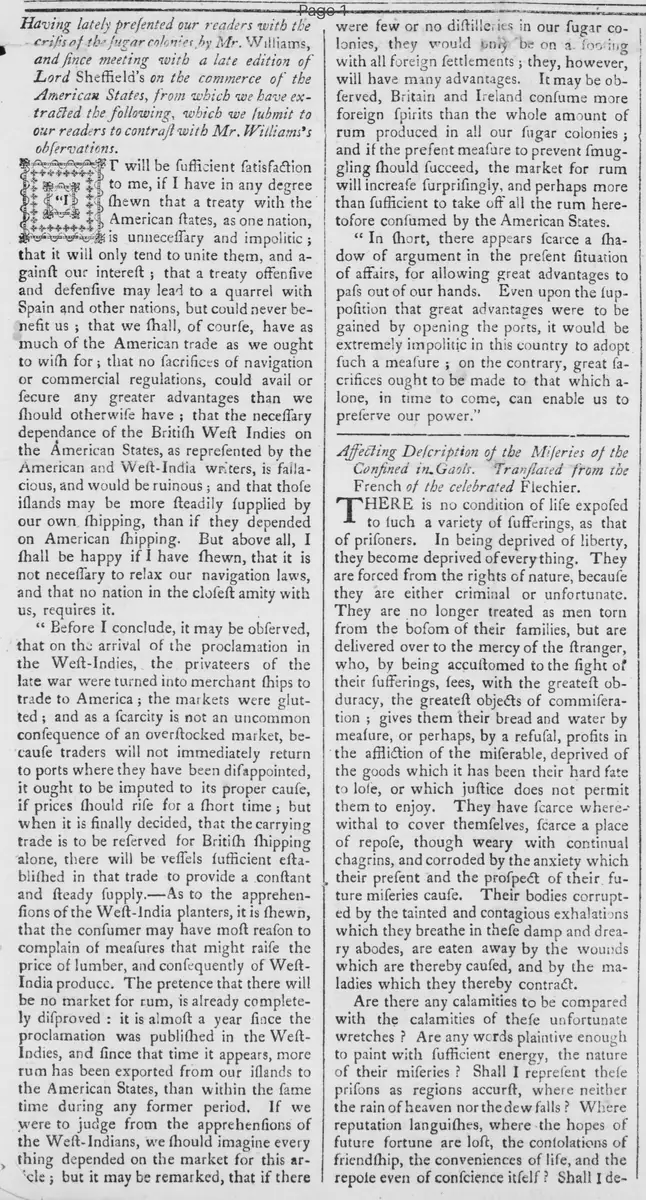
Having lately presented our readers with the crisis of the sugar colonies by Mr. Williams, and since meeting with a late edition of Lord Sheffield's on the commerce of the American States, from which we have extracted the following, which we submit to our readers to contrast with Mr. Williams's observations.
I will be sufficient satisfaction to me, if I have in any degree shewn that a treaty with the American states, as one nation, is unnecessary and impolitic; that it will only tend to unite them, and against our interest; that a treaty offensive and defensive may lead to a quarrel with Spain and other nations, but could never benefit us; that we shall, of course, have as much of the American trade as we ought to wish for; that no sacrifices of navigation or commercial regulations, could avail or secure any greater advantages than we should otherwise have; that the necessary dependence of the British Wet Indies on the American States, as represented by the American and West-India writers, is fallacious, and would be ruinous; and that those islands may be more steadily supplied by our own shipping, than if they depended on American shipping.
But above all, I shall be happy if I have shewn, that it is not necessary to relax our navigation laws, and that no nation in the closest amity with us, requires it.
Before I conclude, it may be observed, that on the arrival of the proclamation in the West-Indies, the privateers of the late war were turned into merchant ships to trade to America; the markets were glutted; and as a scarcity is not an uncommon consequence of an overstocked market, because traders will not immediately return to ports where they have been disappointed, it ought to be imputed to its proper cause, if prices should rise for a short time; but when it is finally decided, that the carrying trade is to be reserved for British shipping alone, there will be vessels sufficient established in that trade to provide a constant and steady supply.--As to the apprehensions of the West-India planters, it is shewn, that the consumer may have most reason to complain of measures that might raise the price of lumber, and consequently of West-India produce. The pretence that there will be no market for rum, is already completely disproved: it is almost a year since the proclamation was published in the West-Indies, and since that time it appears, more rum has been exported from our islands to the American States, than within the same time during any former period. If we were to judge from the apprehensions of the West-Indians, we should imagine every thing depended on the market for this article; but it may be remarked, that if there were few or no distilleries in our sugar colonies, they would barely be on a footing with all foreign settlements; they, however, will have many advantages. It may be observed, Britain and Ireland consume more foreign spirits than the whole amount of rum produced in all our sugar colonies; and if the present measure to prevent smuggling should succeed, the market for rum will increase surprisingly, and perhaps more than sufficient to take off all the rum heretofore consumed by the American States.
In short, there appears scarce a shadow of argument in the present situation of affairs, for allowing great advantages to pass out of our hands. Even upon the supposition that great advantages were to be gained by opening the ports, it would be extremely impolitic in this country to adopt such a measure; on the contrary, great sacrifices ought to be made to that which alone, in time to come, can enable us to preserve our power.
I will be sufficient satisfaction to me, if I have in any degree shewn that a treaty with the American states, as one nation, is unnecessary and impolitic; that it will only tend to unite them, and against our interest; that a treaty offensive and defensive may lead to a quarrel with Spain and other nations, but could never benefit us; that we shall, of course, have as much of the American trade as we ought to wish for; that no sacrifices of navigation or commercial regulations, could avail or secure any greater advantages than we should otherwise have; that the necessary dependence of the British Wet Indies on the American States, as represented by the American and West-India writers, is fallacious, and would be ruinous; and that those islands may be more steadily supplied by our own shipping, than if they depended on American shipping.
But above all, I shall be happy if I have shewn, that it is not necessary to relax our navigation laws, and that no nation in the closest amity with us, requires it.
Before I conclude, it may be observed, that on the arrival of the proclamation in the West-Indies, the privateers of the late war were turned into merchant ships to trade to America; the markets were glutted; and as a scarcity is not an uncommon consequence of an overstocked market, because traders will not immediately return to ports where they have been disappointed, it ought to be imputed to its proper cause, if prices should rise for a short time; but when it is finally decided, that the carrying trade is to be reserved for British shipping alone, there will be vessels sufficient established in that trade to provide a constant and steady supply.--As to the apprehensions of the West-India planters, it is shewn, that the consumer may have most reason to complain of measures that might raise the price of lumber, and consequently of West-India produce. The pretence that there will be no market for rum, is already completely disproved: it is almost a year since the proclamation was published in the West-Indies, and since that time it appears, more rum has been exported from our islands to the American States, than within the same time during any former period. If we were to judge from the apprehensions of the West-Indians, we should imagine every thing depended on the market for this article; but it may be remarked, that if there were few or no distilleries in our sugar colonies, they would barely be on a footing with all foreign settlements; they, however, will have many advantages. It may be observed, Britain and Ireland consume more foreign spirits than the whole amount of rum produced in all our sugar colonies; and if the present measure to prevent smuggling should succeed, the market for rum will increase surprisingly, and perhaps more than sufficient to take off all the rum heretofore consumed by the American States.
In short, there appears scarce a shadow of argument in the present situation of affairs, for allowing great advantages to pass out of our hands. Even upon the supposition that great advantages were to be gained by opening the ports, it would be extremely impolitic in this country to adopt such a measure; on the contrary, great sacrifices ought to be made to that which alone, in time to come, can enable us to preserve our power.
What sub-type of article is it?
Trade Or Commerce
Economic Policy
Foreign Affairs
What keywords are associated?
Navigation Laws
American Trade
West Indies
Rum Market
British Shipping
Commercial Regulations
Sugar Colonies
What entities or persons were involved?
Lord Sheffield
Mr. Williams
American States
British West Indies
Spain
Editorial Details
Primary Topic
Opposition To Treaty With American States And Relaxation Of Navigation Laws
Stance / Tone
Advocacy For Maintaining British Commercial Interests And Navigation Laws
Key Figures
Lord Sheffield
Mr. Williams
American States
British West Indies
Spain
Key Arguments
Treaty With American States Unnecessary And Impolitic, Tending To Unite Them Against British Interests
Offensive And Defensive Treaty Could Lead To Quarrels With Spain And Others Without Benefiting Britain
Britain Will Naturally Obtain Desired American Trade Without Sacrifices In Navigation Or Commercial Regulations
Dependence Of British West Indies On American States Is Fallacious And Ruinous; Islands Better Supplied By British Shipping
No Need To Relax Navigation Laws, As No Allied Nation Requires It
Market Gluts From Post War Privateers Turned Merchants Explain Temporary Scarcities, Not Policy Failures
Rum Market To America Has Increased Despite Proclamation; Anti Smuggling Measures Will Expand It Further
No Argument For Conceding Advantages; Impolitic To Open Ports Even If Beneficial