Thank you for visiting SNEWPapers!
Sign up free
The National Intelligencer And Washington Advertiser
Washington, District Of Columbia
What is this article about?
In this fourth installment, 'Epaminondas' advocates for a unified federal government for the Territory of Columbia, emphasizing separation from Virginia and Maryland, a territorial legislature, governor, and courts to manage local affairs efficiently. It critiques the committee's bill and proposes alternatives, including appendices with sample legislation. Dated December 23, 1800, City of Washington.
Merged-components note: Continuation of the editorial 'CONSIDERATIONS On the Government of the Territory of COLUMBIA. No. IV.' across pages 1 and 2, including appendices and bill text; original label of second component changed from 'notice' to 'editorial' as it is part of the same opinion piece.
Clippings
1 of 2
OCR Quality
Full Text
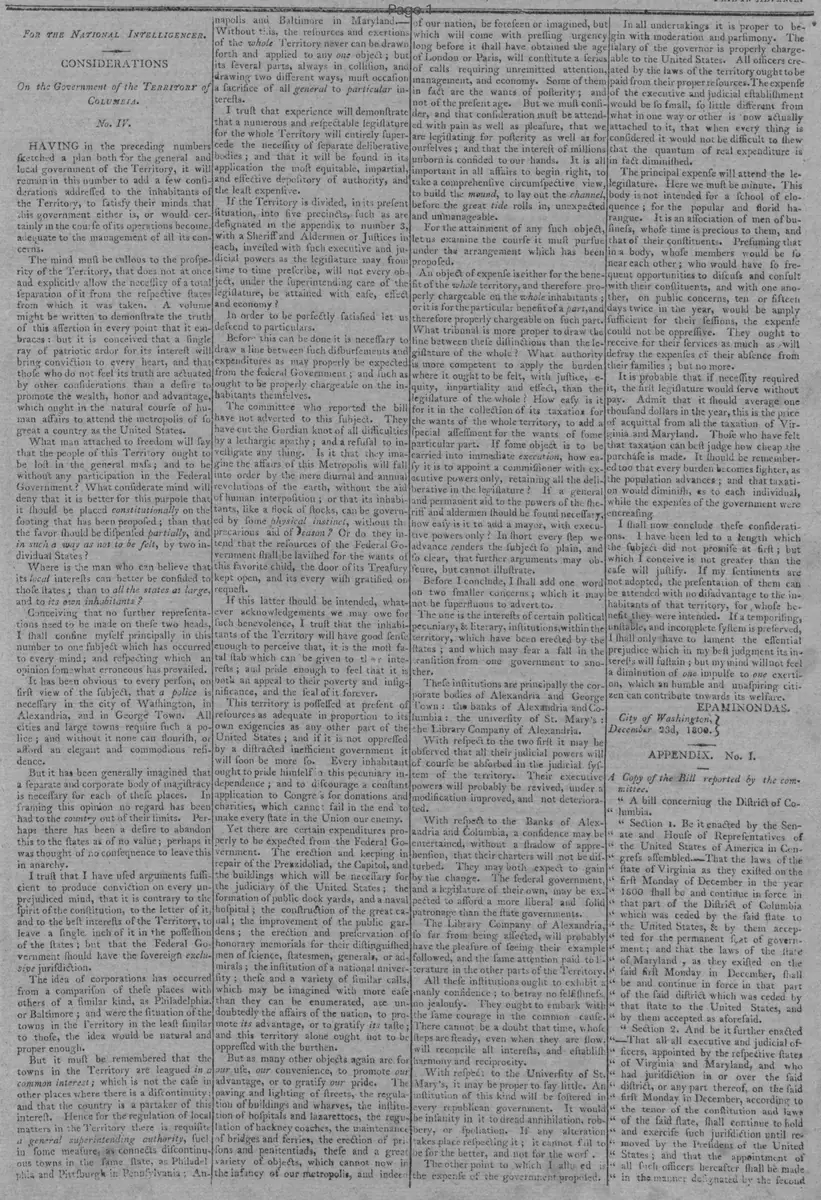
CONSIDERATIONS
On the Government of the Territory of COLUMBIA.
No. IV.
HAVING in the preceding numbers sketched a plan both for the general and local government of the Territory, it will remain in this number to add a few considerations addressed to the inhabitants of the Territory, to satisfy their minds that this government either is, or would certainly in the course of its operations become, adequate to the management of all its concerns.
The mind must be callous to the prosperity of the Territory, that does not at once and explicitly allow the necessity of a total separation of it from the respective states from which it was taken. A volume might be written to demonstrate the truth of this assertion in every point that it embraces: but it is conceived that a single ray of patriotic ardor for its interest will bring conviction to every heart, and that those who do not feel its truth are actuated by other considerations than a desire to promote the wealth, honor and advantage, which ought in the natural course of human affairs to attend the metropolis of so great a country as the United States.
What man attached to freedom will say that the people of this Territory ought to be lost in the general mass; and to be without any participation in the Federal Government? What considerate mind will deny that it is better for this purpose that it should be placed constitutionally on the footing that has been proposed; than that the favor should be dispensed partially, and in such a way as not to be felt, by two individual States?
Where is the man who can believe that its local interests can better be confided to those states; than to all the states at large, and to its own inhabitants?
Conceiving that no further representations need to be made on these two heads, I shall confine myself principally in this number to one subject which has occurred to every mind; and respecting which an opinion somewhat erroneous has prevailed.
It has been obvious to every person, on first view of the subject, that a police is necessary in the city of Washington, in Alexandria, and in George Town. All cities and large towns require such a police; and without it none can flourish, or afford an elegant and commodious residence.
But it has been generally imagined that a separate and corporate body of magistracy is necessary for each of these places. In framing this opinion no regard has been had to the country out of their limits. Perhaps there has been a desire to abandon this to the states as of no value; perhaps it was thought of no consequence to leave this in anarchy.
I trust that I have used arguments sufficient to produce conviction on every unprejudiced mind, that it is contrary to the spirit of the constitution, to the letter of it, and to the best interests of the Territory, to leave a single inch of it in the possession of the states; but that the Federal Government should have the sovereign exclusive jurisdiction.
The idea of corporations has occurred from a comparison of these places with others of a similar kind, as Philadelphia or Baltimore; and were the situation of the towns in the Territory in the least similar to those, the idea would be natural and proper enough.
But it must be remembered that the towns in the Territory are leagued in a common interest; which is not the case in other places where there is a discontinuity: and that the country is a partaker of this interest. Hence for the regulation of local matters in the Territory there is requisite a general superintending authority, such in some measure, as connects discontinuous towns in the same state, as Philadelphia and Pittsburgh in Pennsylvania; Annapolis and Baltimore in Maryland.
Without this, the resources and exertions of the whole Territory never can be drawn forth and applied to any one object; but its several parts, always in collision, and drawing two different ways, must occasion a sacrifice of all general to particular interests.
I trust that experience will demonstrate that a numerous and respectable legislature for the whole Territory will entirely supersede the necessity of separate deliberative bodies; and that it will be found in its application the most equitable, impartial, and effective depository of authority, and the least expensive.
If the Territory is divided, in its present situation, into five precincts, such as are designated in the appendix to number 3, with a Sheriff and Aldermen or Justices in each, invested with such executive and judicial powers as the legislature may from time to time prescribe, will not every object, under the superintending care of the legislature, be attained with ease, effect and economy?
In order to be perfectly satisfied let us descend to particulars.
Before this can be done it is necessary to draw a line between such disbursements and expenditures as may properly be expected from the federal Government; and such as ought to be properly chargeable on the inhabitants themselves.
The committee who reported the bill have not adverted to this subject. They have cut the Gordian knot of all difficulties by a lethargic apathy; and a refusal to investigate any thing. Is it that they imagine the affairs of this Metropolis will fall into order by the mere diurnal and annual revolutions of the earth, without the aid of human interposition: or that its inhabitants, like a flock of sheep, can be governed by some physical instinct, without the precarious aid of Reason? Or do they intend that the resources of the Federal Government shall be lavished for the wants of this favorite child, the door of its Treasury kept open, and its every wish gratified on request.
If this latter should be intended, whatever acknowledgements we may owe for such benevolence, I trust that the inhabitants of the Territory will have good sense enough to perceive that, it is the most fatal stab which can be given to their interests; and pride enough to feel that it is both an appeal to their poverty and insignificance, and the seal of it forever.
This territory is possessed at present of resources as adequate in proportion to its own exigencies as any other part of the United States; and if it is not oppressed by a distracted inefficient government it will soon be more so. Every inhabitant ought to pride himself on this pecuniary independence; and to discourage a constant application to Congress for donations and charities, which cannot fail in the end to make every state in the Union our enemy.
Yet there are certain expenditures properly to be expected from the Federal Government. The erection and keeping in repair of the Presidential, the Capitol, and the buildings which will be necessary for the judiciary of the United States; the formation of public dock yards, and a naval hospital; the construction of the great canal; the improvement of the public gardens; the erection and preservation of honorary memorials for their distinguished men of science, statesmen, generals, or admirals; the institution of a national university; these and a variety of similar calls, which may be imagined with more ease than they can be enumerated, are undoubtedly the affairs of the nation, to promote its advantage, or to gratify its taste; and this territory alone ought not to be oppressed with the burthen.
But as many other objects again are for our use, our convenience, to promote our advantage, or to gratify our pride. The paving and lighting of streets, the regulation of buildings and wharves, the institution of hospitals and lazarettoes, the regulation of hackney coaches, the maintenance of bridges and ferries, the erection of prisons and penitentiaries, these and a great variety of objects, which cannot now in the infancy of our metropolis, and indeed of our nation, be foreseen or imagined, but which will come with pressing urgency long before it shall have obtained the age of London or Paris, will constitute a series of calls requiring unremitted attention, management, and economy. Some of them in fact are the wants of posterity; and not of the present age. But we must consider, and that consideration must be attended with pain as well as pleasure, that we are legislating for posterity as well as for ourselves; and that the interest of millions unborn is confided to our hands. It is all important in all affairs to begin right, to take a comprehensive circumpective view, to build the mound, to lay out the channel, before the great tide rolls in, unexpected and unmanageable.
For the attainment of any such object, let us examine the course it must pursue under the arrangement which has been proposed.
An object of expense is either for the benefit of the whole territory, and therefore properly chargeable on the whole inhabitants; or it is for the particular benefit of a part, and therefore properly chargeable on such part.
What tribunal is more proper to draw the line between these distinctions than the legislature of the whole? What authority is more competent to apply the burden where it ought to be felt, with justice, equity, impartiality and effect, than the legislature of the whole? How easy is it for it in the collection of its taxation for the wants of the whole territory, to add a special assessment for the wants of some particular part. If some object is to be carried into immediate execution, how easy it is to appoint a commissioner with executive powers only, retaining all the deliberative in the legislature? If a general and permanent aid to the powers of the sheriff and aldermen should be found necessary, how easy is it to add a mayor, with executive powers only? In short every step we advance renders the subject so plain, and so clear, that further arguments may obscure, but cannot illustrate.
Before I conclude, I shall add one word on two smaller concerns; which it may not be superfluous to advert to.
The one is the interests of certain political, pecuniary, & literary, institutions, within the territory, which have been erected by the states; and which may fear a fall in the transition from one government to another.
These institutions are principally the corporate bodies of Alexandria and George Town: the banks of Alexandria and Columbia: the university of St. Mary's: the Library Company of Alexandria.
With respect to the two first it may be observed that all their judicial powers will of course be absorbed in the judicial system of the territory. Their executive powers will probably be revived, under a modification improved, and not deteriorated.
With respect to the Banks of Alexandria and Columbia, a confidence may be entertained, without a shadow of apprehension, that their charters will not be disturbed. They may both expect to gain by the change. The federal government, and a legislature of their own, may be expected to afford a more liberal and solid patronage than the state governments.
The Library Company of Alexandria, so far from being affected, will probably have the pleasure of seeing their example followed, and the same attention paid to literature in the other parts of the Territory.
All these institutions ought to exhibit a manly confidence; to betray no selfishness, no jealousy. They ought to embark with the same courage in this common cause.
There cannot be a doubt that time, whose steps are steady, even when they are slow, will reconcile all interests, and establish harmony and reciprocity.
With respect to the University of St. Mary's, it may be proper to say little. An institution of this kind will be fostered in every republican government. It would be insanity in it to dread annihilation, robbery, or spoliation. If any alteration takes place respecting it; it cannot fail to be for the better, and not for the worse.
The other point to which I alluded is the expense of the government proposed.
In all undertakings it is proper to begin with moderation and parsimony. The salary of the governor is properly chargeable to the United States. All officers created by the laws of the territory ought to be paid from their proper resources. The expense of the executive and judicial establishment would be so small, so little different from what in one way or other is now actually attached to it, that when every thing is considered it would not be difficult to show that the quantum of real expenditure is in fact diminished.
The principal expense will attend the legislature. Here we must be minute. This body is not intended for a school of eloquence; for the popular and sordid harangue. It is an association of men of business, whose time is precious to them, and that of their constituents. Presuming that in a body, whose members would be so near each other; who would have so frequent opportunities to discuss and consult with their constituents, and with one another, on public concerns, ten or fifteen days twice in the year, would be amply sufficient for their sessions, the expense could not be oppressive. They ought to receive for their services as much as will defray the expenses of their absence from their families; but no more.
It is probable that if necessity required it, the first legislature would serve without pay. Admit that it should average one thousand dollars in the year, this is the price of acquittal from all the taxation of Virginia and Maryland. Those who have felt that taxation can best judge how cheap the purchase is made. It should be remembered too that every burden becomes lighter, as the population advances; and that taxation would diminish, as to each individual, while the expenses of the government were increasing.
I shall now conclude these considerations. I have been led to a length which the subject did not promise at first; but which I conceive is not greater than the case will justify. If my sentiments are not adopted, the presentation of them can be attended with no disadvantage to the inhabitants of that territory, for whose benefit they were intended. If a temporizing, unstable, and incomplete system is preserved, I shall only have to lament the essential prejudice which in my best judgment its interests will sustain; but my mind will not feel a diminution of one impulse to one exertion, which an humble and unassuming citizen can contribute towards its welfare.
EPAMINONDAS.
City of Washington,
December 23d, 1800.
APPENDIX. No. I.
A Copy of the Bill reported by the committee.
A bill concerning the District of Columbia.
Section 1. Be it enacted by the Senate and House of Representatives of the United States of America in Congress assembled. That the laws of the state of Virginia as they existed on the first Monday of December in the year 1800 shall be and continue in force in that part of the District of Columbia which was ceded by the said state to the United States, & by them accepted for the permanent seat of government; and that the laws of the state of Maryland, as they existed on the said first Monday in December, shall be and continue in force in that part of the said district which was ceded by that state to the United States, and by them accepted as aforesaid.
Section 2. And be it further enacted That all executive and judicial officers, appointed by the respective state of Virginia and Maryland, and who had jurisdiction in or over the said district, or any part thereof, on the said first Monday in December, according to the tenor of the constitution and laws of the said state, shall continue to hold and exercise such jurisdiction until removed by the President of the United States; and that the appointment of all such officers hereafter shall be made in the manner designated by the second Section of the second article of the constitution of the United States.
Section 3. And be it further enacted, That nothing in this act contained shall in any wise alter, impeach or impair the rights granted by or derived from the acts of incorporation of Alexandria and George-Town, or any other body corporate or politic within the said district.
Extract from the Act of Congress of July 16th 1790.
Provided that the operation of the laws of the State within such District shall not be affected by this acceptance, until the time fixed for the removal of the government thereto, and until Congress shall otherwise by law provide.
APPENDIX No. II.
Form of a resolution proposing an amendment to the Constitution.
Resolved that the following be recommended to the Legislatures of the several states as an Article in addition to, and amendment of the Constitution of the United States.
ARTICLE.
The Territory of Columbia shall be entitled to one Senator in the Senate of the United States: and to a number of members in the House of Representatives proportionate to its population. Before it shall have attained a population sufficient to entitle it to one representative it shall be entitled to a member, who shall have the right to deliberate and receive pay, but not to vote. It shall also be entitled to one elector for a President and Vice President of the United States, until it shall have attained a sufficient population to entitle it to one representative; and then it shall be entitled to an additional elector for every representative.
APPENDIX, No. III.
[Form of an act, which if it should, in the outline, meet the approbation of any Senator, or Representative, is recommended to be adopted by him, its faults corrected, and an attempt made to substitute it for the bill reported by the committee.]
An Act to establish a government for the Territory of Columbia.
Sec. 1. Be it enacted, &c. That there shall be within the Territory of Columbia a Legislature, which shall be composed of a Senate and Assembly. The Senate shall consist of sixteen, and the Assembly of forty, members, as soon as the Territory shall contain thirty thousand inhabitants; and previous to such period of one half of those numbers respectively. The Senate shall be divided at its first meeting into four classes. The seats of one of which shall expire annually and the Assembly shall be chosen annually. The legislature shall hold two stated sessions in every year, on the first Monday in June, and the first Monday in December. No person shall be a Senator or Assemblyman who shall not be at the time of his election twenty-one years of age, a citizen of the United States of America, and in good faith a resident within the Territory of Columbia if a Senator, and within that precinct thereof or which he shall be elected if a member of Assembly. No person shall be a Senator or Assemblyman who shall hold any office, legislative, executive, or judicial, diplomatic or consular, under the United States; or any office, legislative, executive, or judicial under any state; or any office, executive, or judicial under the Territory. Each house shall elect its own Speaker, and be the judge of the returns and qualifications of its own members.
Sec. 2. And be it further enacted, That there shall be a governor of the Territory of Columbia, who shall be nominated by the President of the United States, and by and with the advice and consent of the Senate of the United States appointed and commissioned by him. The governor shall hold his office during the pleasure of the President of the United States for the time being. No person shall be governor, who shall not be at the time of his appointment twenty-one years of age, a citizen of the United States of America, and in good faith a resident within the Territory of Columbia. The governor shall be incapable during his continuance in office of holding any other office or appointment under the United States, any individual State, or the Territory of Columbia. He shall nominate, and by and with the advice and consent of the Senate of the Territory shall appoint and commission, all executive and judicial officers under the Territory; and shall be commander in chief of the militia thereof: and he shall receive from the treasury of the United States, as a compensation for his services, an annual salary of two hundred dollars, payable quarterly.
Sec. 3. And be it further enacted, That every bill passed by the Senate and Assembly before it become a law, and every order, resolution or vote to which the concurrence of both houses shall be necessary before it take effect, shall be presented to the governor. If he approve he shall sign it; but if not he shall return it with his objections in writing within ten days to the Assembly; and if he shall keep the same ten days without his returning it, or if after such return it shall be re-passed by two thirds of both houses, it shall be a law and take effect.
Sec. 4. And be it further enacted, That the legislature shall have power to lay and collect taxes within the said Territory, not being excises, imposts on goods, wares and merchandizes, or duties on the tonnage of ships or vessels; and generally to pass all laws which shall be needful for the government and police of the said Territory, or any part thereof, not contravening the constitution of the United States, any treaty made or to be made with any foreign nation, or any law passed or to be passed by the Congress of the United States: but all laws made and passed in the said Territory shall be repealable by the Congress of the United States, and the Congress of the United States may at any time make or prescribe any law or regulation within the said Territory, any law or regulation made in the same notwithstanding.
Sec. 5. And be it further enacted, That there shall be a court of justice for the said territory, which shall be termed the General Court, and which shall possess original common law and equity jurisdiction in all cases whatsoever, subject to appeal from the judgments thereof in all cases, both on the law, and on the fact, to the supreme court of the United States, under such regulations as may be provided; and that there shall be a limited number of aldermen or justices in such parts of the said territory as the legislature thereof shall prescribe, who shall have power to render judgments in all controversies where the debt or damage shall not exceed one hundred dollars, and to be attended by a jury of six freeholders for the trial of fact and ascertainment of damage; provided that appeals shall lie from such judgments, in all cases whatsoever, both on the law, and on the fact, to the General Court of the Territory, under such regulations as may be provided.
Sec. 6. And be it further enacted, That all the public ground lying and being in the city of Washington, and bounded as follows, to wit, beginning at the intersection of South E street and South Capitol street, and running thence along South E street to its intersection with East First-street, thence down East First-street till it is diagonally opposite to the south-west corner of square seven hundred and thirty-six, thence at right angles with East First-street eastwardly to the intersection of East Second-street and the South-Carolina Avenue, thence along the South-Carolina Avenue to its intersection with East Third-street, thence down East Third-street to its intersection with the Virginia Avenue, thence along the Virginia Avenue to its intersection with East Second-street, and thence along South H street to its intersection with West One Half street, thence along West One Half-street to its intersection with the Virginia Avenue, thence along the Virginia Avenue to its intersection with South Capitol-street, and thence along South Capitol-street to the beginning, shall be vested in the legislature of the Territory of Columbia, and shall be and remain forever to the use of the said Territory, for the erection of public buildings, and all be the permanent seat of the government of the said Territory.
Sec. 7. And be it further enacted that for the purpose of giving immediate effect to this government a governor shall be appointed as soon as may be after the passing of this act; and the governor as soon as may be after his appointment shall appoint and commission a proper person to be sheriff, for a precinct which shall be termed Washington Precinct, and shall be composed of the City of Washington, another for a precinct which shall be termed Alexandria Precinct, and shall be composed of the town of Alexandria, another for a precinct which shall be termed George-Town Precinct, and shall be composed of the corporate limits of George-Town, another for a precinct which shall be termed North Precinct, and shall be composed of so much of the Territory of Columbia, lying North and East of the Potomac, as shall not be included in Washington and George-Town Precincts, and another for a precinct which shall be termed South Precinct, and shall be composed of so much of the Territory of Columbia, lying South and West of the Potomac, as shall not be included in Alexandria Precinct. On the fourth Monday in April, in the year one thousand eight hundred and one, each of the said sheriffs shall hold an election within his precinct for senators and assembly-men. The election for Washington Precinct shall be held at the house of William Tunnicliff in the city of Washington, for Alexandria Precinct at the house of Peter Heiskill in the town of Alexandria, for George-Town Precinct at the house of George Semmes in George-Town, for North Precinct at the House of Boyd, and for South Precinct at the house of Clement Sewall. The polls shall be opened at noon on the said day, and shall be closed at sunset on the succeeding day. Every male person, of the age of twenty one years, being a citizen of the United States of America, and in good faith a resident within the precinct in which he offers to poll, shall be entitled to vote. If the sheriff does not know or believe any person offering to poll to be qualified, he is hereby empowered to administer to such person an oath or affirmation in the following
United States, and the Congress of the United States may at any time make or prescribe any law or regulation within the said Territory, any law or regulation made in the same notwithstanding.
Sec. 5. And be it further enacted, That there shall be a court of justice for the said territory, which shall be termed the General Court, and which shall possess original common law and equity jurisdiction in all cases whatsoever, subject to appeal from the judgments thereof in all cases, both on the law, and on the fact, to the supreme court of the United States, under such regulations as may be provided; and that there shall be a limited number of aldermen or justices in such parts of the said territory as the legislature thereof shall prescribe, who shall have power to render judgments in all controversies where the debt or damage shall not exceed one hundred dollars, and to be attended by a jury of six freeholders for the trial of fact and ascertainment of damage; provided that appeals shall lie from such judgments, in all cases whatsoever, both on the law, and on the fact, to the General Court of the Territory, under such regulations as may be provided. On paper written or printed, which shall contain the names of eight persons of the age of twenty-one years, being citizens of the United States of America, and in good faith resident within the Territory of Columbia, to be senators for the said Territory, and such ticket shall be endorsed with the name of the voter. Every voter shall also deliver to the sheriff a like ticket endorsed containing the names in Washington Precinct of four, in Alexandria Precinct of five, in George-Town Precinct of four, in North Precinct of three, and in South Precinct of four, persons, being of the age of twenty-one years, citizens of the United States of America, and in good faith resident within the said precincts respectively. The sheriff shall as soon as may be after the closing of the polls cause he votes, and shall certify to the governor the number of votes for each person, and shall return with the said certificates all the original tickets, and the persons having the greater number of votes shall be senators and assembly men of the said territory until the thirtieth day of December which shall be in the year one thousand eight hundred and one, and thence to the general annual election which shall be provided for in and for the said territory. The Governor or shall convene the legislature on the first Monday in June in the year one thousand eight hundred and one, and shall deliver to each house the certificates and tickets of its own members. Such session shall be held in the Capitol in the City of Washington, and the Governor is hereby empowered to take such measures for the preservation of the chambers and furniture thereof as he shall deem expedient. The legislature shall afterwards, and until convenient buildings are provided on the ground appropriated to the territory, meet at such place or places within the City of Washington as they shall deem expedient.
Sec. 8. And be it further enacted that no tax imposed by the laws of Virginia, or the state of Maryland, on persons or property within the territory of Columbia, and becoming due after the first Monday in December one thousand eight hundred, shall be collected or take effect within the said territory; provided nevertheless, that the proper officers of either state shall have full power to collect all taxes and public dues which shall have become due previous to the first Monday in December one thousand eight hundred, in the same manner as they might have done previous to the passing of this act.
Sec. 9. And be it further enacted that the powers and duties of the commissioners appointed under the act of congress, entitled "An Act for establishing the temporary and permanent seat of the government of the United States, passed on the sixteenth day of July in the year one thousand seven hundred and ninety, shall cease and determine on the first Monday in April in the year one thousand eight hundred and one; and the said commissioners and every other person or persons, on or before the said day shall deliver to the Secretary of the Treasury of the United States for the time being all records, books, documents and public papers, or property of any kind whatever in their possession, relative to the City of Washington or the territory of Columbia. The said secretary shall retain in his possession all the said records, documents or papers which evidence the rights of the United States to any ground or public buildings within the City of Washington or the Territory of Columbia. The property (veron?) is vested in the United States; and all accounts and vouchers relative to the lands and shall deliver all other records, books, documents and papers to the Governor of the Territory of Columbia on or before the first Monday in June in the year one thousand eight hundred and one, and the said Governor shall on that day, or as soon as may be thereafter deliver the same to the Assembly of the territory. The Secretary of the Treasury of the United States for the time being shall be custos and curator of all the property of the United States in the City of Washington and the territory of Columbia; and shall manage and transact all pecuniary concerns relative to the said property under the direction of the President of the United States for the time being.
What sub-type of article is it?
What keywords are associated?
What entities or persons were involved?
Editorial Details
Primary Topic
Government Structure For The Territory Of Columbia
Stance / Tone
Advocacy For Unified Federal Jurisdiction And Territorial Legislature
Key Figures
Key Arguments