Thank you for visiting SNEWPapers!
Sign up free
Richmond Enquirer
Richmond, Richmond County, Virginia
What is this article about?
US editorial condemns French newspaper's inflammatory suggestions amid Franco-American treaty dispute, including potential slave incitement. Discusses ongoing tensions over debt payment, Jackson's upcoming message, and hopes for peaceful resolution with honor. (248 characters)
Clipping
OCR Quality
Full Text
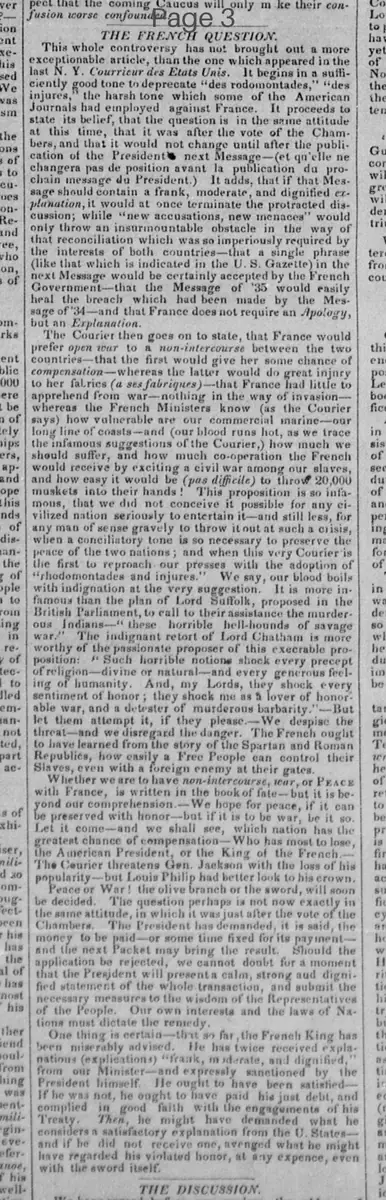
This whole controversy has not brought out a more
exceptionable article, than the one which appeared in the
last N. Y. Courier des Etats Unis. It begins in a sufficiently good tone to deprecate "des rodomontades," "des
injures," the harsh tone which some of the American
Journals had employed against France. It proceeds to
state its belief, that the question is in the same attitude
at this time, that it was after the vote of the Chambers, and that it would not change until after the publication of the President next Message-(et qu'elle ne
changera pas de position avant la publication du prochain message du President.) It adds, that if that Message should contain a frank, moderate, and dignified explanation, it would at once terminate the protracted discussion; while "new accusations, new menaces" would
only throw an insurmountable obstacle in the way of
that reconciliation which was so imperiously required by
the interests of both countries-that a single phrase
(like that which is indicated in the U. S. Gazette) in the
next Message would be certainly accepted by the French
Government-that the Message of '35 would easily
heal the breach which had been made by the Message
of '34—and that France does not require an Apology
but an Explanation.
The Courier then goes on to state, that France would
prefer open war to a non-intercourse between the two
countries—that the first would give her some chance of
compensation—whereas the latter would do great injury
to her fabrics (a ses fabriques)-that France had little to
apprehend from war-nothing in the way of invasion-
whereas the French Ministers know (as the Courier
says) how vulnerable are our commercial marine-our
long line of coasts-and (our blood runs hot, as we trace
the infamous suggestions of the Courier.) how much we
should suffer, and how much co-operation the French
would receive by exciting a civil war among our slaves,
and how easy it would be (pas difficile) to throw 20,000
muskets into their hands!" This proposition is so infamous, that we did not conceive it possible for any civilized nation seriously to entertain it—and still less, for
any man of sense gravely to throw it out at such a crisis,
when a conciliatory tone is so necessary to preserve the
peace of the two nations; and when this very Courier is
the first to reproach our presses with the adoption of
"rhodomontades and injures." We say, our blood boils
with indignation at the very suggestion. It is more infamous than the plan of Lord Suffolk, proposed in the
British Parliament, to call to their assistance the murderous Indians—"these horrible hell-hounds of savage
war." "The indignant retort of Lord Chatham is more
worthy of the passionate proposer of this execrable proposition: "Such horrible notions shock every precept
of religion—divine or natural—and every generous feeling of humanity. And, my Lords, they shock every
sentiment of honor; they shock me as a lover of honorable war, and a detester of murderous barbarity."-But
let them attempt it, if they please.-We despise the
threat-and we disregard the danger. The French ought
to have learned from the story of the Spartan and Roman
Republics, how easily a Free People can control their
Slaves, even with a foreign enemy at their gates.
Whether we are to have non-intercourse, war, or Peace
with France, is written in the book of fate-but it is beyond our comprehension.—We hope for peace, if it can
be preserved with honor—but if it is to be war, be it so.
Let it come—and we shall see, which nation has the
greatest chance of compensation—Who has most to lose,
the American President, or the King of the French-
The Courier threatens Gen. Jackson with the loss of his
popularity—but Louis Philip had better look to his crown.
Peace or War ! the olive branch or the sword, will soon
be decided. The question perhaps is not now exactly in
the same attitude, in which it was just after the vote of the Chambers. The President has demanded, it is said, the
money to be paid-or some time fixed for its payment-
and the next Packet may bring the result. Should the
application be rejected, we cannot doubt for a moment
that the President will present a calm, strong and dignified statement of the whole transaction, and submit the
necessary measures to the wisdom of the Representatives
of the People. Our own interests and the laws of Nations must dictate the remedy.
One thing is certain-that so far, the French King has
been miserably advised. He has twice received explanations (explications) "frank, moderate, and dignified,"
from our Minister—and expressly sanctioned by the
President himself He ought to have been satisfied-
If he was not, he ought to have paid his just debt, and
complied in good faith with the engagements of his
Treaty. Then, he might have demanded what he
considers a satisfactory explanation from the U. States—
and if he did not receive one, avenged what he might
have regarded his violated honor, at any expense, even
with the sword itself.
What sub-type of article is it?
What keywords are associated?
What entities or persons were involved?
Where did it happen?
Foreign News Details
Primary Location
France
Key Persons
Outcome
ongoing diplomatic tension; potential for non-intercourse, war, or peace; french king advised poorly; us demands payment or explanation.
Event Details
Article criticizes a piece in the N.Y. Courier des Etats Unis for suggesting France prefers open war over non-intercourse and hints at inciting slave revolt in US with 20,000 muskets. Condemns this as infamous. Discusses US-France controversy over treaty debt, President's messages of 1834 and 1835, French Chambers' vote. Hopes for honorable peace; if war, US ready. French king received explanations but failed to pay debt.