Thank you for visiting SNEWPapers!
Sign up free
Randolph Enterprise
Beverly, Randolph County, West Virginia
What is this article about?
A visitor's account of traveling to the Rich Mountain battlefield in West Virginia, detailing the July 11, 1861 Civil War engagement where Union forces under McClellan defeated Confederates led by Pegram and Garnett, securing a key mountain pass.
Merged-components note: Continuation of the historical article on the Battle of Rich Mountain.
Clipping
OCR Quality
Full Text
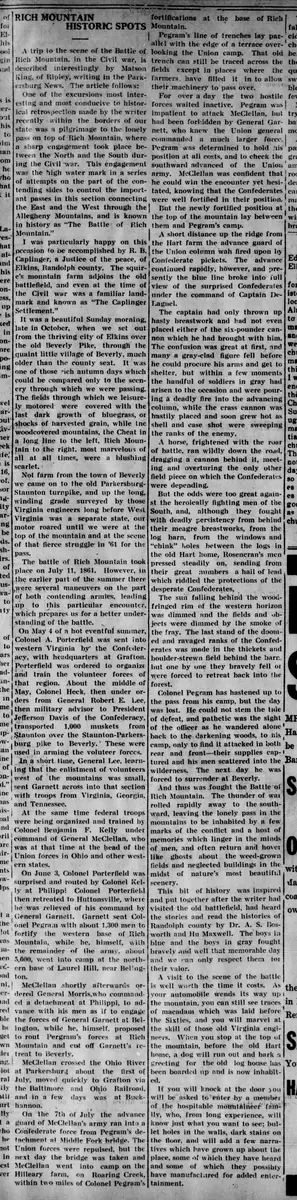
A trip to the scene of the Battle of Rich Mountain in the Civil war, is described interestingly by Matson King, of Ripley, writing in the Parkersburg News. The article follows:
One of the excursions most interesting and most conducive to historical retrospection made by the writer recently within the borders of our state was a pilgrimage to the lonely pass on top of Rich Mountain, where a sharp engagement took place between the North and the South during the Civil war. This engagement was the high water mark in a series of attempts on the part of the contending sides to control the important passes in this section connecting the East and the West through the Allegheny Mountains, and is known in history as "The Battle of Rich Mountain."
I was particularly happy on this occasion to be accompanied by R. B. Caplinger, a Justice of the peace, of Elkins, Randolph county. The squire's mountain farm adjoins the old battlefield, and even at the time of the Civil war was a familiar landmark and known as "The Caplinger Settlement."
It was a beautiful Sunday morning, late in October, when we set out from the thriving city of Elkins over the old Beverly Pike, through the quaint little village of Beverly, much older than the county seat. It was one of those rich autumn days which could be compared only to the scenery through which we were passing. The fields through which we leisurely motored were covered with the last dark growth of bluegrass, or shocks of harvested grain, while the woodcovered mountains, the Cheat in a long line to the left, Rich Mountain to the right, most marvelous of all at all times, were a blushing scarlet.
Not far from the town of Beverly we came on to the old Parkersburg-Staunton turnpike, and up the long, winding grade surveyed by those Virginia engineers long before West Virginia was a separate state, our motor roared until we were at the top of the mountain and at the scene of that fierce struggle in '61 for the pass.
The battle of Rich Mountain took place on July 11, 1861. However, in the earlier part of the summer there were several maneuvers on the part of both contending armies, leading up to this particular encounter, which prepares us for a better understanding of the battle.
On May 4 of a hot eventful summer, Colonel A. Porterfield was sent into western Virginia by the Confederacy, with headquarters at Grafton. Porterfield was ordered to organize and train the volunteer forces of that region. About the middle of May, Colonel Heck, then under orders from General Robert E. Lee, then military advisor to President Jefferson Davis of the Confederacy, transported 1,000 muskets from Staunton over the Staunton-Parkersburg pike to Beverly. These were used in arming the volunteer forces. In a short time, General Lee, learning that the enlistment of volunteers west of the mountains was small, sent Garnett across into that section with troops from Virginia, Georgia, and Tennessee.
At the same time federal troops were being organized and trained by Colonel Benjamin F. Kelly under command of General McClellan, who was at that time at the head of the Union forces in Ohio and other western states.
On June 3, Colonel Porterfield was surprised and routed by Colonel Kelly at Philippi: Colonel Porterfield then retreated to Huttonsville, where he was relieved of his command by General Garnett. Garnett sent Colonel Pegram with about 1,300 men to fortify the western base of Rich Mountain, while he, himself, with the remainder of the army, about 5,000, went into camp at the northern base of Laurel Hill, near Belington.
McClellan shortly afterwards ordered General Morris, who commanded a detachment at Philippi, to advance with his men as if to engage the forces of General Garnett at Belington, while he, himself, proposed to rout Pegram's forces at Rich Mountain and cut off Garnett's retreat to Beverly.
McClellan crossed the Ohio River at Parkersburg about the first of July, moved quickly to Grafton via the Baltimore and Ohio Railroad and in a few days was at Buckhannon.
On the 7th of July the advance guard of McClellan's army ran into a Confederate force from Pegram's detachment at Middle Fork bridge. The Union forces were repulsed, but the next day the bridge was taken and McClellan went into camp on the Hilleary farm, on Roaring Creek, within two miles of Colonel Pegram's fortifications at the base of Rich Mountain.
Pegram's line of trenches lay parallel with the edge of a terrace overlooking the Union camp. That old trench can still be traced across the fields except in places where the farmers have filled it in to allow their machinery to pass over.
For over a day the two hostile forces waited inactive. Pegram was impatient to attack McClellan, but had been forbidden by General Garnett, who knew the Union general commanded a much larger force. Pegram was determined to hold his position at all costs, and to check the southward advance of the Union army. McClellan was confident that he could win the encounter yet hesitated, knowing that the Confederates were well fortified in their position. But the newly fortified position at the top of the mountain lay between them and Pegram's camp.
A short distance up the ridge from the Hart farm the advance guard of the Union column was fired upon by Confederate pickets. The advance continued rapidly, however, and presently the blue line broke into full view of the surprised Confederates under the command of Captain De Lagnel.
The captain had only thrown up hasty breastwork and had not even placed either of the six-pounder cannon which he had brought with him. The confusion was great at first, and many a gray-clad figure fell before he could procure his arms and get to shelter, but within a few moments the handful of soldiers in gray had arisen to the occasion and were pouring a deadly fire into the advancing column, while the brass cannon was hastily placed and soon grew hot as shell and case shot were sweeping the ranks of the enemy.
A horse, frightened with the roar of battle, ran wildly down the road, dragging a cannon behind it, meeting and overturning the only other field piece on which the Confederates were depending.
But the odds were too great against the heroically fighting men of the South, and, although they fought with deadly consistency from behind their meagre breastworks, from the log barn, from the windows and "chink" holes between the logs in the old Hart home, Rosecran's men pressed steadily on, sending from their great numbers a hail of lead which riddled the protections of the desperate Confederates.
The sun falling behind the wood-fringed rim of the western horizon was dimmed and the fields and objects were dimmed by the smoke of the fray. The last stand of the doomed and ravaged ranks of the Confederates was made in the thickets and boulder-strewn field behind the barn, but one by one they bravely fell or were forced to retreat back into the forest.
Colonel Pegram has hastened up to the pass from his camp, but the day was lost. He could not stem the tide of defeat, and pathetic was the sight of the officer as he wandered alone back to the darkening woods, to his camp, only to find it attacked in both rear and front-their supplies captured and his men scattered into the wilderness. The next day he was forced to surrender at Beverly.
And thus was fought the Battle of Rich Mountain. The thunder of war rolled rapidly away to the southward, leaving the lonely pass in the mountains to be inhabited by a few marks of the conflict and a host of memories which linger in the minds of men, and often return and hover like ghosts about the weed-grown fields and neglected buildings in the midst of nature's most beautiful scenery.
This bit of history was inspired and put together after the writer had visited the old battlefield, had heard the stories and read the histories of Randolph county by Dr. A. S. Bosworth and Hu Maxwell. The boys in blue and the boys in gray fought bravely and well that memorable day and we can only respect them for their valor.
A visit to the scene of the battle is well worth the time it costs. As your automobile wends its way up the mountain, you can still see traces of macadam which was laid before the Sixties, and you will marvel at the skill of those old Virginia engineers. When you stop at the top of the mountain, before the old Hart home, a dog will run out and bark a greeting for the old log house has been boarded up and is now inhabited.
If you will knock at the door you will be asked to enter by a member of the hospitable mountaineer family, who, from long experience, will know just what you want to see: bullet holes in the walls, dark stains on the floor, and will add a few narratives which have grown up about the place, some of which they have heard and some of which they possibly have manufactured for added entertainment.
Your host will then, if it is in the fall of the year, offer you a jug of cider and, perhaps, sell you a bag of chestnuts or a jug of molasses and before you leave he will lead you to the spring close by and you may quench your thirst from the selfsame sweet cold water which was such a blessing on that far-off day to the fevered and dying soldiers.
Many stories are told by the country folks concerning incidents of the battle which has made their naive mountain historic: Such as this:
After the heat of the battle had passed on that July day, a soldier in gray painfully lifted himself from among the dead and dying to a flat rock nearby, where, the pallor of death shading his countenance, he carved his name upon the rock. You may see it there now (J. P. Powell), the final testimony of a man who wished it to be known that he died bravely.
What sub-type of article is it?
What themes does it cover?
What keywords are associated?
What entities or persons were involved?
Where did it happen?
Story Details
Key Persons
Location
Rich Mountain Pass, Allegheny Mountains, West Virginia
Event Date
July 11, 1861
Story Details
Union forces under McClellan outmaneuver and defeat Confederate troops led by Pegram at Rich Mountain pass through a flanking attack, leading to Pegram's surrender and Union control of the strategic route.