Thank you for visiting SNEWPapers!
Sign up free
The Virginian
Lynchburg, Virginia
What is this article about?
A destructive freshet on the Missouri River washed away fur trade establishments, inundated Mandan and Arickara villages, and drowned 60-70 Sioux people. Traders lost property including buffalo robes; the flood was caused by melting snow from Yellowstone and Cheyenne Rivers.
Clipping
OCR Quality
Full Text
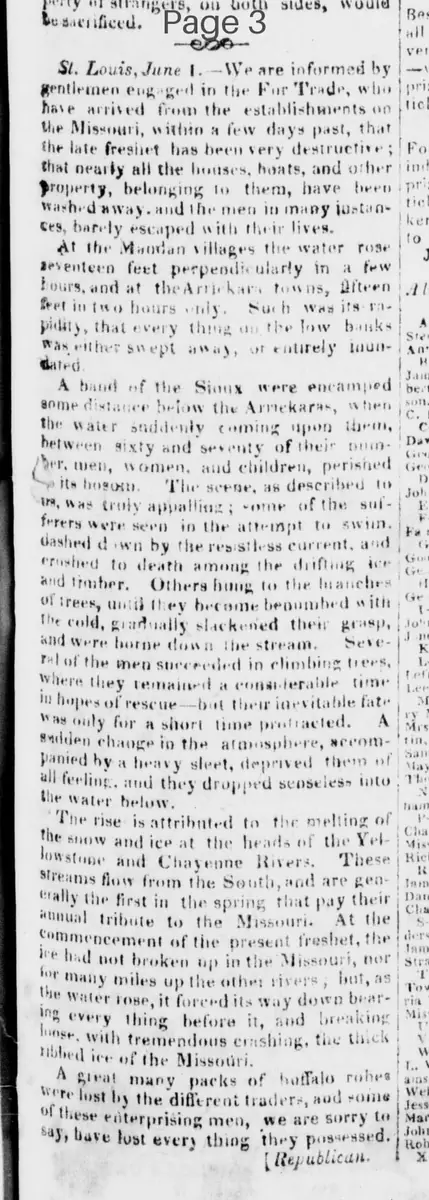
At the Mandan villages the water rose seventeen feet perpendicularly in a few hours, and at the Arickara towns, fifteen feet in two hours only. Such was its rapidity, that every thing on the low banks was either swept away, or entirely inundated.
A band of the Sioux were encamped some distance below the Arickaras, when the water suddenly coming upon them, between sixty and seventy of their number, men, women, and children, perished in its bosom. The scene, as described to us, was truly appalling; some of the sufferers were seen in the attempt to swim, dashed down by the resistless current, and crushed to death among the drifting wrecks and timber. Others hung to the branches of trees, until they became benumbed with the cold, gradually slackened their grasp, and were borne down the stream.
Several of the men succeeded in climbing trees, where they remained a considerable time in hopes of rescue—but their inevitable fate was only for a short time protracted. A sudden change in the atmosphere, accompanied by a heavy sleet, deprived them of all feeling, and they dropped senseless into the water below.
The rise is attributed to the melting of the snow and ice at the heads of the Yellowstone and Cheyenne Rivers. These streams flow from the South, and are generally the first in the spring that pay their annual tribute to the Missouri. At the commencement of the present freshet, the ice had not broken up in the Missouri, nor for many miles up the other rivers, but, as the water rose, it forced its way down bearing every thing before it, and breaking loose, with tremendous crashing, the thick embedded ice of the Missouri.
A great many packs of buffalo robes were lost by the different traders and some of these enterprising men we are sorry to say, have lost every thing they possessed.
Republican.
What sub-type of article is it?
What keywords are associated?
Where did it happen?
Domestic News Details
Primary Location
Missouri River
Event Date
Late Freshet
Outcome
between sixty and seventy sioux (men, women, and children) perished; nearly all houses, boats, and property of fur traders washed away; men barely escaped with lives; great many packs of buffalo robes lost; some traders lost everything they possessed.
Event Details
Gentlemen from fur trade establishments on the Missouri reported that the late freshet destroyed nearly all their houses, boats, and property. Water rose 17 feet at Mandan villages in a few hours and 15 feet at Arickara towns in two hours, sweeping away or inundating everything on low banks. A Sioux band encamped below Arickaras was surprised by the flood, leading to drownings amid current, wrecks, timber, cold, and sleet. The flood resulted from melting snow and ice on Yellowstone and Cheyenne Rivers, breaking Missouri ice.