Thank you for visiting SNEWPapers!
Sign up free
The Arkansas Banner
Little Rock, Pulaski County, Arkansas
What is this article about?
Senate debate on Mr. Bright's resolutions demanding specifications of charges against Democrats removed from office by President Taylor. Critics accuse Taylor of breaking pledges against proscription, instead removing Democrats indiscriminately via secret condemnations. Calls for justice and warns Democrats against Whig deception ahead of state election.
Clipping
OCR Quality
Full Text
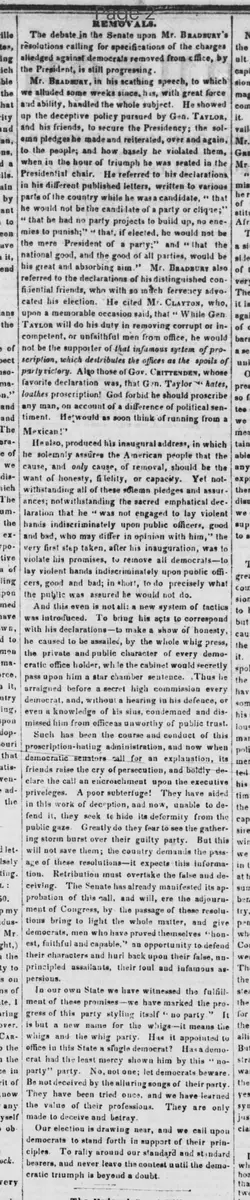
Mr. Bright, in his scathing speech, to which we alluded some weeks since, has, with great force and ability, handled the whole subject. He showed up the deceptive policy pursued by Gen. Taylor and his friends, to secure the Presidency; the solemn pledges he made and reiterated, over and again, to the people; and how basely he violated them, when in the hour of triumph he was seated in the Presidential chair. He referred to his declarations in his different published letters, written to various parts of the country while he was a candidate, "that he would not be the candidate of a party or clique;" "that he had no party projects to build up, no enemies to punish;" "that, if elected, he would not be the mere President of a party;" and "that the national good, and the good of all parties, would be his great and absorbing aim." Mr. Bright also referred to the declarations of his distinguished confidential friends, who with so much fervor advocated his election. He cited Mr. Clayton, who, upon a memorable occasion said, that "While Gen. Taylor will do his duty in removing corrupt or incompetent, or unfaithful men from office, he would not be the supporter of that infamous system of proscription, which distributes the offices as the spoils of party victory." Also those of Gov. Crittenden, whose favorite declaration was, that Gen. Taylor "loathes proscription! God forbid he should proscribe any man, on account of a difference of political sentiment. He would as soon think of running from a Mexican!"
He also, produced his inaugural address, in which he solemnly assures the American people that the cause, and only cause, of removal, should be the want of honesty, fidelity, or capacity. Yet notwithstanding all of these solemn pledges and assurances; notwithstanding the sacred emphatical declaration that he "was not engaged to lay violent hands indiscriminately upon public officers, good and bad, who may differ in opinion with him," the very first step taken, after his inauguration, was to violate his promises, to remove all democrats—to lay violent hands indiscriminately upon public officers, good and bad; in short, to do precisely what the public was assured he would not do.
And this even is not all: a new system of tactics was introduced. To bring his acts to correspond with his declarations—to make a show of honesty, he caused to be assailed, by the whole whig press, the private and public character of every democratic office holder, while the cabinet would secretly pass upon him a star chamber sentence. Thus he arraigned before a secret high commission every democrat, and, without a hearing in his defence, or even a knowledge of his sins, condemned and dismissed him from office as unworthy of public trust.
Such has been the course and conduct of this proscription-hating administration, and now when democratic senators call for an explanation, its friends raise the cry of persecution, and boldly declare the call an encroachment upon the executive privileges. A poor subterfuge! They have aided in this work of deception, and now, unable to defend it, they seek to hide its deformity from the public gaze. Greatly do they fear to see the gathering storm burst over their guilty party. But this will not save them; the country demands the passage of these resolutions—it expects this information. Retribution must overtake the false and deceiving. The Senate has already manifested its approbation of this call, and will, ere the adjournment of Congress, by the passage of these resolutions bring to light the whole matter, and give democrats, men who have proved themselves "honest, faithful and capable," an opportunity to defend their characters and hurl back upon their false, unprincipled assailants, their foul and infamous aspersions.
In our own State we have witnessed the fulfillment of these promises—we have marked the progress of this party styling itself "no party." It is but a new name for the whigs—it means the whigs and the whig party. Has it appointed to office in this State a single democrat? Has a democrat had the least mercy shown him by this "no-party" party. No, not one; let democrats beware. Be not deceived by the alluring songs of their party sycophants. They have been tried once, and we have learned the value of their professions. They are only made to deceive and betray.
Our election is drawing near, and we call upon democrats to stand forth in support of their principles. To rally around our standard and standard bearers, and never leave the contest until the democratic triumph is beyond a doubt.
What sub-type of article is it?
What themes does it cover?
What keywords are associated?
What entities or persons were involved?
Where did it happen?
Story Details
Key Persons
Location
Us Senate
Story Details
Mr. Bright's Senate speech criticizes President Taylor for violating pledges against party proscription by removing Democrats from office without cause, using secret condemnations and press attacks. Resolutions seek charges' specifications; article warns of Whig deception and urges Democratic unity for upcoming election.