Thank you for visiting SNEWPapers!
Sign up free
Kentucky Gazette
Lexington, Fayette County, Kentucky
What is this article about?
An anonymous letter from Washington City dated Dec. 24, 1820, critiques the Treasury Secretary's report on national finances, advocating treasury notes over bank loans. It analyzes congressional debates on Missouri's admission, suspecting opposition aims to impose slavery restrictions or exclude it, warning of dire consequences for Union harmony and western interests.
Clipping
OCR Quality
Full Text
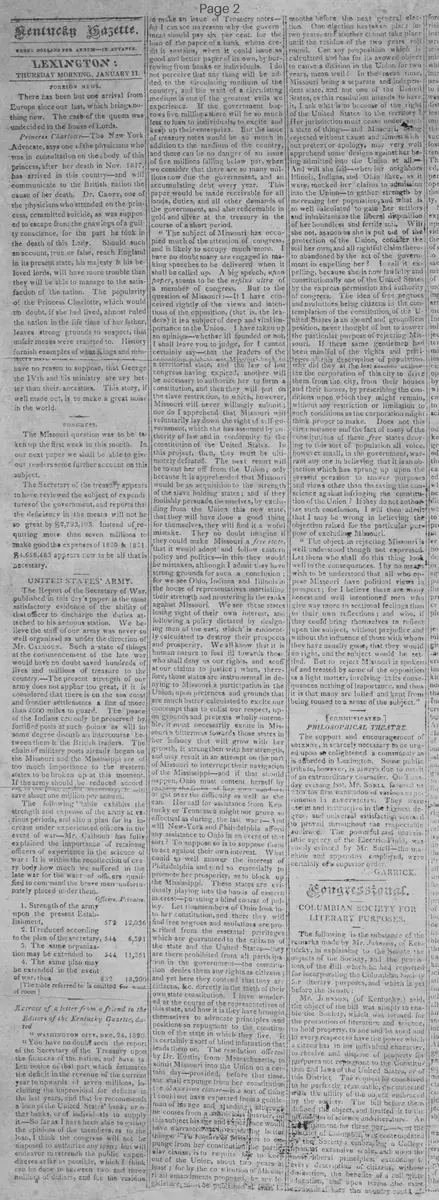
WASHINGTON CITY, DEC. 24, 1820.
You have no doubt seen the report of the Secretary of the Treasury upon the finances of the nation, and have taken notice of that part which estimates the deficit in the revenue of the current year to upwards of seven millions, including the unprovided for deficits in the last years, and that he recommends a loan of the United States' bank, or other banks, or of individuals to supply it.—So far as I have been able to gather the opinions of the members, as to the loan, I think the congress will not be disposed to authorize any loan; but will endeavor to retrench the public expenditures as far as possible, which I think can be done to between two and three millions of dollars, and for the residue to make an issue of Treasury notes—[for I can see no reason why the government should pay six per cent. for the loan of the paper of a bank whose credit it sustains, when it could issue as good and better paper of its own, by borrowing from banks or individuals. I do not perceive that any thing will be added to the circulating medium of the country, and the want of a circulating medium is one of the greatest evils we experience. If the government borrows five millions there will be so much less to loan to individuals, to excite and keep up their enterprize. But the issue of treasury notes would be so much in addition to the medium of the country, and there can be no danger of an issue of five millions falling below par, when we consider that there are so many millions now due the government, and an accumulating debt every year. This paper would be made receivable for all lands, duties, and all other demands of the government, and also redeemable in gold and silver at the treasury in the course of a short period.]
The subject of Missouri has occupied much of the attention of congress, and is likely to occupy much more. I have no doubt many are engaged in making speeches to be delivered when it shall be called up. A big speech, upon paper, seems to be the ne plus ultra of a member of congress. But to the question of Missouri:—If I have conceived rightly of the views and intentions of the opposition, (that is, the leaders) it is a subject of deep and vital importance to the Union. I have taken up an opinion—whether ill founded or not, I shall leave you to judge, for I cannot certainly say—that the leaders of the opposition wish to get Missouri back to a territorial state, and the law of last congress having expired, another will be necessary to authorize her to form a constitution, and then they will put on the slave restriction, to which, however, Missouri will never willingly submit; nor do I apprehend that Missouri will voluntarily lay down the right of self-government, which she has assumed by authority of law and in conformity to the constitution of the United States. In this project, then, they must be ultimately defeated. The next resort will be to cut her off from the Union; only because it is apprehended that Missouri would be an acquisition to the strength of the slave holding states; and if they foolishly persuade themselves, by excluding from the Union this new state, that they will have done a good thing for themselves, they will find it a woeful mistake. They no doubt imagine if they could make Missouri a free state, that it would adopt and follow eastern policy and politics—in this they would be mistaken, although I admit they have strong grounds for such a conclusion; for we see Ohio, Indiana and Illinois in the house of representatives marshalling their strength and mustering in the ranks against Missouri. We see these states losing sight of their own interest, and following a policy dictated by designing men of the east, which is eminently calculated to destroy their prospects and prosperity. We all know that it is human nature to feel ill towards those who shall deny us our rights, and scoff at our claims to justice; when, therefore, those states are instrumental in denying to Missouri a participation in the Union, upon pretences and grounds that are much better calculated to excite our contempt than to enlist our respect, upon grounds and pretexts wholly untenable, it must necessarily excite in Missouri a bitterness towards those states in her infancy that will grow with her growth, & strengthen with her strength, and may result in an attempt on the part of Missouri to interrupt their navigation of the Mississippi—and if that should happen, Ohio must content herself by reaping the fruit of her own conduct, or get over the difficulty as well as she can. Her call for assistance from Kentucky or Tennessee might not prove so effectual as during the last war: And will New-York and Philadelphia afford any assistance to Ohio in an event of that sort? To suppose so is to suppose them to act against their own interest. What could so well answer the interest of Philadelphia and tend so essentially to promote her prosperity, as to block up the Mississippi. These states are evidently playing into the hands of eastern interest—pursuing a blind course of policy. Let the members of Ohio look into her constitution, and there they will find free negroes and mulattoes are proscribed from the essential privileges which are guaranteed to the citizens of the state and the United States—they are there prohibited from all participation in the government—the constitution denies them any rights as citizens; and yet here they contend that they are citizens, &c. directly in the teeth of their own state constitution. I have wondered at the course of the representatives of this state, and how it is they have brought themselves to advocate principles and positions so repugnant to the constitution of the state in which they live. It is certainly a sort of blind infatuation that leads them on. The resolution offered by Dr. Eustis, from Massachusetts, to admit Missouri into the Union on a certain day—provided, before that time, she shall expunge from her constitution the obnoxious clause—is a sort of thing I could not have expected from a gentleman of his age and standing; although he comes from a suspicious quarter, on this subject his age and experience would have warranted any expecting better things. To require of Missouri to expunge from her constitution the particular clause, is to require her to keep out of the Union, about two years at least; for by the constitution of Missouri all amendments proposed, by any legislature must have two years before the next general election. One election has taken place for two years, and another cannot take place until the residue of the two years roll round. Can any proposition which is calculated and has for its avowed object to cause a division in the Union for two years, mean well? In the mean time, Missouri being a separate and independent state, and not one of the United States, as this resolution intends to have it, I ask what is to become of the right of the United States to the territory? Her jurisdiction must cease under such a state of things—and Missouri, being rejected without cause and almost without pretext or apology, may very well apprehend some designs against her being admitted into the Union at all.—And will she fail—when her neighbors Illinois, Indiana, and Ohio have, as it were, mocked her claims to admission into the Union—to gather strength by increasing her population, and what is so well calculated to gain her settlers and inhabitants as the liberal disposition of her boundless and fertile soil. Will she not, as soon as she is put out of the protection of the Union, consider the soil her own, and all rightful claim thereto abandoned by the act of the government in expelling her? I call it expelling, because she is now lawfully and constitutionally one of the United States by the express permission and authority of congress. The idea of free negroes and mulattoes being citizens in the contemplation of the constitution of the U. nited States is an absurd and groundless position, never thought of but to answer the particular purpose of rejecting Missouri. If these same gentlemen had been mindful of the rights and privileges of this description of population, why did they at the last session authorize the corporation of this city to drive them from the city, from their houses and their homes, by prescribing the conditions upon which they might remain, without any restriction or limitation to such conditions as the corporation might think proper to make. Does not this circumstance and the fact of many of the constitutions of these free states denying to this sort of population all voice however small, in the government, warrant any one in believing that it is an objection which has sprung up upon the present occasion to answer purposes and views other than the saving the conscience against infringing the constitution of the Union? If they do not authorize such conclusion, I will then admit that I may be wrong in believing the objection raised for the particular purpose of excluding Missouri.
The object in rejecting Missouri is well understood though not expressed. Let them who shall do this thing look well to the consequences. I by no means wish to be understood that all who oppose Missouri have political views in prospect; for I believe there are many honest and well intentioned men who give way more to sectional feelings than to their own reflections: and who, if they could bring themselves to reflect upon the subject, without prejudice and without the influence of those with whom they have usually gone, that they would do right, and the subject would be settled. But to reject Missouri is spoken of and treated by some of the opposition as a light matter, involving in its consequences nothing of importance, and thus it is that many are lulled and kept from being roused to a sense of the subject.
What sub-type of article is it?
What themes does it cover?
What keywords are associated?
What entities or persons were involved?
Letter to Editor Details
Author
A Friend
Recipient
Editors Of The Kentucky Gazette
Main Argument
congress should issue treasury notes instead of borrowing to cover the seven-million-dollar deficit, as it would add to the circulating medium without benefiting banks. opposition leaders seek to impose slavery restrictions on missouri or exclude it from the union, which would provoke lasting sectional animosity and harm northern interests, especially regarding mississippi navigation.
Notable Details