Thank you for visiting SNEWPapers!
Sign up free
Lincoln Telegraph
Bath, Sagadahoc County, Maine
What is this article about?
Reports from Albany detail escalating tensions in the Patroon manor disputes, with troops under Capt. Bloodgood deployed amid storms to support sheriff's evictions against insurgent tenants. Updates indicate a potential peaceful resolution, alongside historical context of the Rensselaer estate's feudal origins from 1609 grants.
Merged-components note: These components form a cohesive report on the Patroon manor troubles, including on-site updates, settlement news, and historical background on the estate.
Clipping
OCR Quality
Full Text
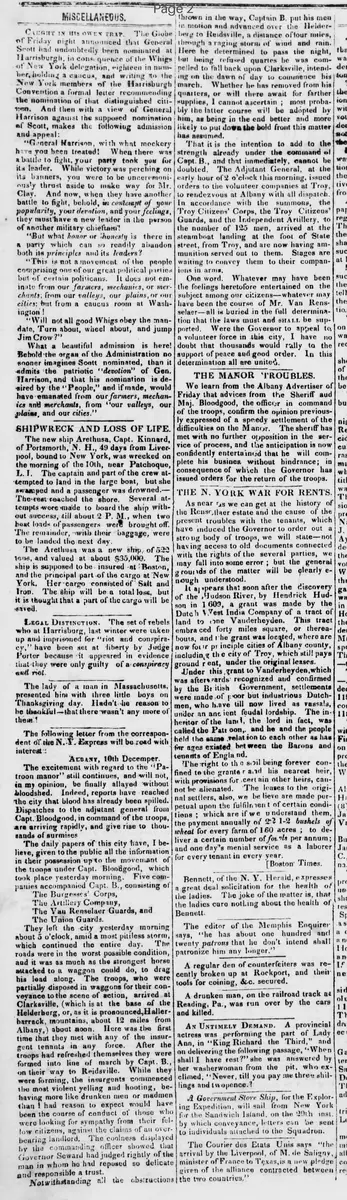
ALBANY, 10th December
The excitement with regard to the 'Patroon manor' still continues, and will not, in my opinion, be finally allayed without bloodshed. Indeed, reports have reached this city that blood has already been spilled. Dispatches to the adjutant general from Capt. Bloodgood, in command of the troops, are arriving rapidly, and give rise to thousands of surmises.
The daily papers of this city have, I believe, given to the public all the information in their possession up to the movement of the troops under Capt. Bloodgood, which took place yesterday morning. Five companies accompanied Capt. B., consisting of The Burgesses' Corps, The Artillery Company, The Van Rensselaer Guards, and The Union Guards. They left the city yesterday morning about 5 o'clock, amid a most pitiless storm, which continued the entire day. The roads were in the worst possible condition, and it was as much as the strongest horse attached to a waggon could do, to drag his load along. The troops, who were partially disposed in waggons or their conveyance to the scene of action, arrived at Clarksville (which is at the base of the Helderberg, or, as it is pronounced, Haller-barrack, mountains, about 12 miles from Albany,) about noon. Here was the first time that they met with any of the insurgent tenants in any force. After the troops had refreshed themselves they were formed into line of march by Capt. B., on their way to Reidsville. While they were forming, the insurgents commenced the most violent yelling and hooting, behaving more like drunken men or madmen than I had reason to expect would have been the course of conduct of those who were looking for sympathy from their fellow citizens, against the claims of an over-bearing landlord. The coolness displayed by the commanding officer showed that Governor Seward had judged rightly of the man in whom he had reposed so delicate and responsible a trust.
Notwithstanding all the obstructions thrown in the way, Captain B. put his men in motion and advanced over the Helderberg to Reidsville, a distance of four miles, through a raging storm of wind and rain. Here he determined to pass the night, but being refused quarters he was compelled to fall back upon Clarksville, intending on the dawn of day to commence his march. Whether he has removed from his quarters, or will there await for further supplies, I cannot ascertain: most probably the latter course will be adopted by him, as being in the end better and more likely to put down the bold front this matter has assumed.
That it is the intention to add to the strength already under the command of Capt. B., and that immediately, cannot be doubted. The Adjutant General, at the early hour of 2 o'clock this morning, issued orders to the volunteer companies at Troy, to rendezvous at Albany with all dispatch. In accordance with the summons, the Troy Citizens' Corps, the Troy Citizens' Guards, and the Independent Artillery, to the number of 125 men, arrived at the steamboat landing at the foot of State street, from Troy, and are now having ammunition served out to them. Stages are waiting to convey them to their companions in arms.
One word. Whatever may have been the feelings heretofore entertained on the subject among our citizens—whatever may have been the course of Mr. Van Rensselaer—all is buried in the full determination that the laws must and shall be supported. Were the Governor to appeal to a volunteer force in this city, I have no doubt that thousands would rally to the support of peace and good order. In this determination all are united.
THE MANOR TROUBLES.
We learn from the Albany Advertiser of Friday that advices from the Sheriff and Maj. Bloodgood, the officer in command of the troops, confirm the opinion previously expressed of a speedy settlement of the difficulties on the Manor. The sheriff has met with no further opposition in the service of process, and the anticipation is now confidently entertained that he will complete his business, without hindrance; in consequence of which the Governor has issued orders for the return of the troops.
THE N. YORK WAR FOR RENTS
As near as we can get at the history of the Rensselaer estate and the cause of the present troubles with the tenants, which have induced the Governor to order out a strong body of troops, we will state—not having access to old documents connected with the rights of the several parties, we may fall into some error; but the general grounds of the matter will be clearly enough understood.
It appears that soon after the discovery of the Hudson River, by Hendrick Hudson in 1609, a grant was made by the Dutch West India Company of a tract of land to one Vanderheyden. This tract embraced forty miles square, or thereabouts, and the grant was located, where are now four principal cities of Albany county, including the city of Troy, which still pays ground rent, under the original leases.
Under this grant to Vanderheyden, which was afterwards recognized and confirmed by the British Government, settlements were made of poor but industrious Dutchmen, who have till now lived as vassals, under an ancient feudal lordship. The inheritor of the land, the lord in fact, was called the Patroon, and he and the people held the same relation to each other as has for ages existed between the Barons and tenants of England.
The right to the soil being forever confined to the grantee and his nearest heir, with provisions for certain other heirs, cannot be alienated. The leases to the original settlers, also, we believe are made perpetual upon the fulfillment of certain conditions; which are if we understand them, the payment annually of 22 1-2 bushels of wheat for every farm of 160 acres; to deliver a certain number of fowls per annum; and one day's menial service as a laborer for every tenant in every year.
[Boston Times.]
What sub-type of article is it?
What themes does it cover?
What keywords are associated?
What entities or persons were involved?
Where did it happen?
Story Details
Key Persons
Location
Albany, Helderberg Mountains, Clarksville, Reidsville, Rensselaer Estate
Event Date
10th December
Story Details
Tensions rise in the Patroon manor over tenant disputes against landlord claims, prompting Governor Seward to deploy troops under Capt. Bloodgood amid storms to aid the sheriff's evictions. Insurgents resist, but updates suggest a peaceful resolution with troops ordered to return. Historical background traces the feudal Rensselaer estate to a 1609 Dutch grant, with perpetual leases requiring wheat, fowls, and labor.