Thank you for visiting SNEWPapers!
Sign up free
Story
June 23, 1906
East Oregonian : E.O
Pendleton, Umatilla County, Oregon
What is this article about?
Portland's wool industry is hindered by discriminatory railroad freight rates, preventing it from becoming the coast's premier market. This idles the largest wool scouring plant, ties up $50,000 in local capital, and deprives 100 men of work, as stated by leading woolbuyers.
Clipping
OCR Quality
98%
Excellent
Full Text
Portland Industry Is Handicapped by High Freight Rates.
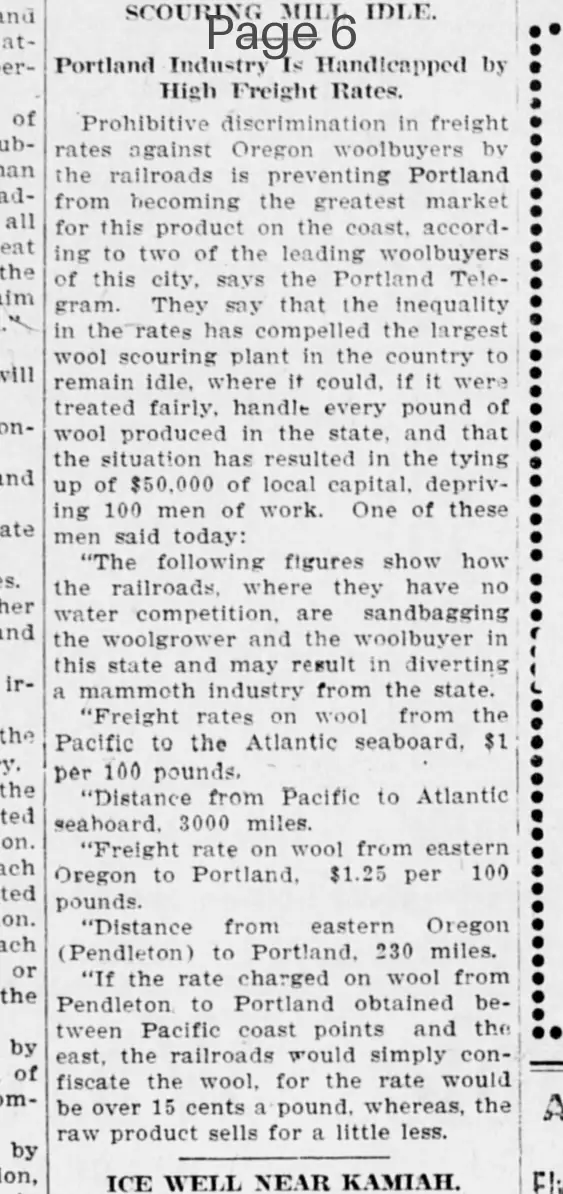
Prohibitive discrimination in freight rates against Oregon woolbuyers by the railroads is preventing Portland from becoming the greatest market for this product on the coast, according to two of the leading woolbuyers of this city, says the Portland Telegram. They say that the inequality in the rates has compelled the largest wool scouring plant in the country to remain idle, where it could, if it were treated fairly, handle every pound of wool produced in the state, and that the situation has resulted in the tying up of $50,000 of local capital, depriving 100 men of work. One of these men said today:
"The following figures show how the railroads, where they have no water competition, are sandbagging the woolgrower and the woolbuyer in this state and may result in diverting a mammoth industry from the state.
"Freight rates on wool from the Pacific to the Atlantic seaboard, $1 per 100 pounds.
"Distance from Pacific to Atlantic seaboard, 3000 miles.
"Freight rate on wool from eastern Oregon to Portland, $1.25 per 100 pounds.
"Distance from eastern Oregon (Pendleton) to Portland, 230 miles.
"If the rate charged on wool from Pendleton to Portland obtained between Pacific coast points and the east, the railroads would simply confiscate the wool, for the rate would be over 15 cents a pound, whereas, the raw product sells for a little less."
Prohibitive discrimination in freight rates against Oregon woolbuyers by the railroads is preventing Portland from becoming the greatest market for this product on the coast, according to two of the leading woolbuyers of this city, says the Portland Telegram. They say that the inequality in the rates has compelled the largest wool scouring plant in the country to remain idle, where it could, if it were treated fairly, handle every pound of wool produced in the state, and that the situation has resulted in the tying up of $50,000 of local capital, depriving 100 men of work. One of these men said today:
"The following figures show how the railroads, where they have no water competition, are sandbagging the woolgrower and the woolbuyer in this state and may result in diverting a mammoth industry from the state.
"Freight rates on wool from the Pacific to the Atlantic seaboard, $1 per 100 pounds.
"Distance from Pacific to Atlantic seaboard, 3000 miles.
"Freight rate on wool from eastern Oregon to Portland, $1.25 per 100 pounds.
"Distance from eastern Oregon (Pendleton) to Portland, 230 miles.
"If the rate charged on wool from Pendleton to Portland obtained between Pacific coast points and the east, the railroads would simply confiscate the wool, for the rate would be over 15 cents a pound, whereas, the raw product sells for a little less."
What sub-type of article is it?
Historical Event
Curiosity
What themes does it cover?
Misfortune
Justice
What keywords are associated?
Freight Rates
Wool Industry
Portland
Railroad Discrimination
Economic Handicap
Where did it happen?
Portland, Oregon; Eastern Oregon (Pendleton)
Story Details
Location
Portland, Oregon; Eastern Oregon (Pendleton)
Story Details
Discriminatory high freight rates on wool from eastern Oregon to Portland prevent the city from becoming the coast's greatest wool market, idle the largest scouring plant, tie up $50,000 in capital, and cause 100 men to lose work, as explained by local woolbuyers with comparative rate figures.