Thank you for visiting SNEWPapers!
Sign up free
The Daily News Of The Virgin Islands
Charlotte Amalie, Saint Thomas County, Virgin Islands
What is this article about?
The United Nations celebrates its 17th anniversary on October 24, 1962, marking the 1945 charter's entry into force. The article recounts UN origins from the Atlantic Charter, Dumbarton Oaks, and San Francisco conference, and discusses current challenges like Congo funding, veto power, and colonialism issues.
Clipping
OCR Quality
Full Text
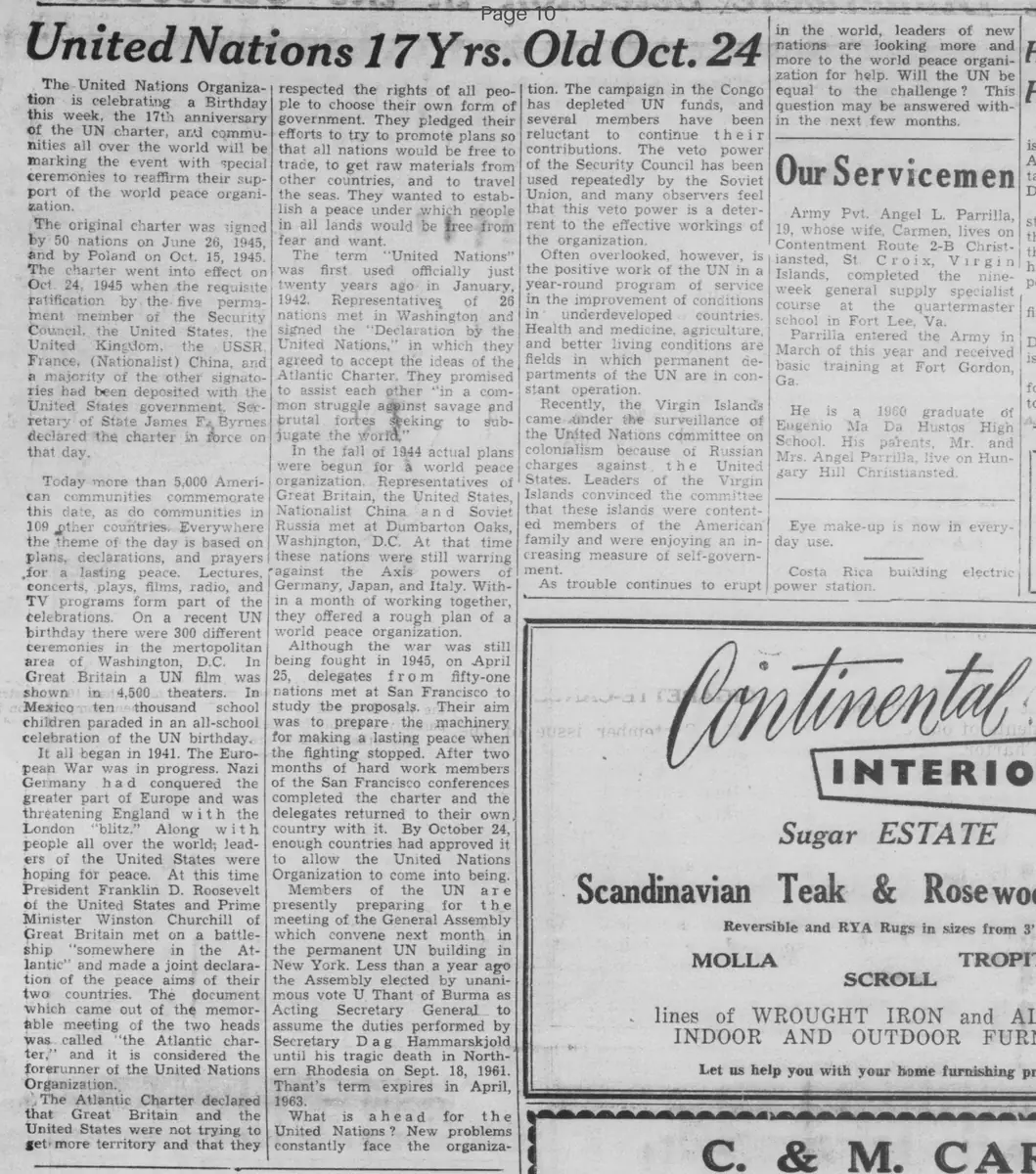
The United Nations Organization is celebrating a Birthday this week, the 17th anniversary of the UN charter, and communities all over the world will be marking the event with special ceremonies to reaffirm their support of the world peace organization.
The original charter was signed by 50 nations on June 26, 1945, and by Poland on Oct. 15, 1945. The charter went into effect on Oct 24, 1945 when the requisite ratification by the five permanent members of the Security Council: the United States, the United Kingdom, the USSR, France, (Nationalist) China, and a majority of the other signatories had been deposited with the United States government. Secretary of State James F Byrnes declared the charter in force on that day.
Today more than 5,000 American communities commemorate this date, as do communities in 109 other countries. Everywhere the theme of the day is based on plans, declarations, and prayers for a lasting peace. Lectures, concerts, plays, films, radio, and TV programs form part of the celebrations.
On a recent UN birthday there were 300 different ceremonies in the metropolitan area of Washington, D.C. In Great Britain a UN film was shown in 1,500 theaters. In Mexico ten thousand school children paraded in an all-school celebration of the UN birthday.
It all began in 1941. The European War was in progress. Nazi Germany had conquered the greater part of Europe and was threatening England with the London "blitz." Along with people all over the world, leaders of the United States were hoping for peace. At this time President Franklin D. Roosevelt of the United States and Prime Minister Winston Churchill of Great Britain met on a battleship "somewhere in the Atlantic" and made a joint declaration of the peace aims of their two countries.
The document which came out of the memorable meeting of the two heads was called "the Atlantic charter," and it is considered the forerunner of the United Nations Organization.
The Atlantic Charter declared that Great Britain and the United States were not trying to get more territory and that they respected the rights of all people to choose their own form of government. They pledged their efforts to try to promote plans so that all nations would be free to trade, to get raw materials from other countries, and to travel the seas. They wanted to establish a peace under which people in all lands would be free from fear and want.
The term "United Nations" was first used officially just twenty years ago in January, 1942. Representatives of 26 nations met in Washington and signed the "Declaration by the United Nations," in which they agreed to accept the ideas of the Atlantic Charter. They promised to assist each other "in a common struggle against savage and brutal forces seeking to subjugate the world"
In the fall of 1944 actual plans were begun for a world peace organization. Representatives of Great Britain, the United States, Nationalist China and Soviet Russia met at Dumbarton Oaks, Washington, D.C. At that time these nations were still warring against the Axis powers of Germany, Japan, and Italy. Within a month of working together, they offered a rough plan of a world peace organization.
Although the war was still being fought in 1945, on April 25, delegates from fifty-one nations met at San Francisco to study the proposals. Their aim was to prepare the machinery for making a lasting peace when the fighting stopped. After two months of hard work members of the San Francisco conference completed the charter and the delegates returned to their own country with it. By October 24, enough countries had approved it to allow the United Nations Organization to come into being.
Members of the UN are presently preparing for the meeting of the General Assembly which will convene next month in the permanent UN building in New York. Less than a year ago the Assembly elected by unanimous vote U Thant of Burma as Acting Secretary General to assume the duties performed by Secretary Dag Hammarskjold until his tragic death in Northern Rhodesia on Sept. 18, 1961. Thant's term expires in April, 1963.
What is ahead for the United Nations? New problems constantly face the organization. The campaign in the Congo has depleted UN funds, and several members have been reluctant to continue their contributions. The veto power of the Security Council has been used repeatedly by the Soviet Union, and many observers feel that this veto power is a deterrent to the effective workings of the organization.
Often overlooked, however, is the positive work of the UN in a year-round program of service in the improvement of conditions in underdeveloped countries. Health and medicine, agriculture, and better living conditions are fields in which permanent departments of the UN are in constant operation.
Recently, the Virgin Islands came under the surveillance of the United Nations committee on colonialism because of Russian charges against the United States. Leaders of the Virgin Islands convinced the committee that these islands were contented members of the American family and were enjoying an increasing measure of self-government.
As trouble continues to erupt in the world, leaders of new nations are looking more and more to the world peace organization for help. Will the UN be equal to the challenge? This question may be answered within the next few months.
What sub-type of article is it?
What keywords are associated?
What entities or persons were involved?
Where did it happen?
Foreign News Details
Primary Location
United Nations
Event Date
October 24, 1962
Key Persons
Outcome
un charter entered into force on october 24, 1945; current challenges include depleted funds from congo campaign, soviet veto usage, and colonialism scrutiny; positive ongoing work in health, agriculture, and development.
Event Details
The UN celebrates its 17th anniversary with global ceremonies. History traces from 1941 Atlantic Charter by Roosevelt and Churchill, 1942 Declaration by 26 nations, 1944 Dumbarton Oaks planning, and 1945 San Francisco conference where 51 nations drafted the charter signed by 50 on June 26 and Poland on October 15, effective October 24 after ratifications. Current preparations for General Assembly in New York; U Thant as Acting Secretary General until April 1963 following Hammarskjold's death. Issues: Congo funding, veto power; positives: aid to underdeveloped countries; recent Virgin Islands colonialism review.