Thank you for visiting SNEWPapers!
Sign up free
Independent Journal, Or, The General Advertiser
New York, New York County, New York
What is this article about?
Detailed remarks on Frederick William II, King of Prussia, covering his ascension, reforms expelling French tax farmers, support for arts and sciences, family life including two marriages and children, personal virtues, and stance on Dutch quarrels, emphasizing his peaceful approach unlike his predecessor.
Clipping
OCR Quality
Full Text
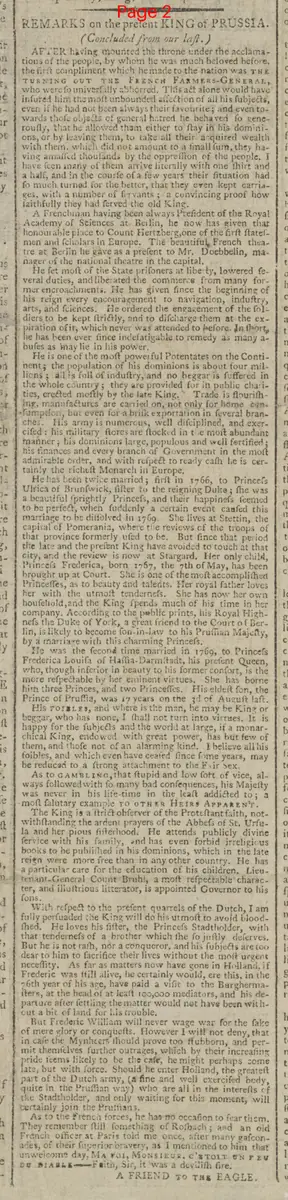
(Concluded from our last.)
AFTER having mounted the throne under the acclamations of the people, by whom he was much beloved before, the first compliment which he made to the nation was THE Turning out The FRENCH FARMERS-GENERAL, who were so universally abhorred. This act alone would have insured him the most unbounded affection of all his subjects, even if he had not been always their favourite; and even towards those objects of general hatred he behaved so generously, that he allowed them either to stay in his dominions, or by leaving them, to take all their acquired wealth with them, which did not amount to a small sum, they having amassed thousands by the oppression of the people. I have seen many of them arrive literally with one shirt and a half, and in the course of a few years their situation had so much turned for the better, that they even kept carriages, with a number of servants; a convincing proof how faithfully they had served the old King.
A Frenchman having been always President of the Royal Academy of Sciences at Berlin, he now has given that honourable place to Count Hertzberg, one of the first statesmen and scholars in Europe. The beautiful, French theatre at Berlin he gave as a present to Mr. Doebbelin, manager of the national theatre in the capital.
He set most of the State prisoners at liberty, lowered several duties, and liberated the commerce from many former encroachments. He has given since the beginning of his reign every encouragement to navigation, industry, arts, and sciences. He ordered the engagement of the soldiers to be kept strictly, and to discharge them at the expiration of it, which never was attended to before. In short, he has been ever since indefatigable to remedy as many abuses as may lie in his power.
He is one of the most powerful Potentates on the Continent; the population of his dominions is about four millions; all is full of industry, and no beggar is suffered in the whole country; they are provided for in public charities, erected mostly by the late King. Trade is flourishing, manufactures are carried on, not only for home consumption, but even for a brisk exportation in several branches. His army is numerous, well disciplined, and exercised: his military stores are stocked in the most abundant manner; his dominions large, populous and well fortified; his finances and every branch of Government in the most admirable order, and with respect to ready cash he is certainly the richest Monarch in Europe.
He has been twice married; first in 1766, to Princess Ulrica of Brunswick, sister to the reigning Duke; he was a beautiful prightly Princess, and their happiness seemed to be perfect, when suddenly a certain event caused this marriage to be dissolved in 1769. She lives at Stettin, the capital of Pomerania, where the reviews of the troops of that province formerly used to be. But since that period the late and the present King have avoided to touch at that city, and the review is now at Stargard. Her only child, Princess Frederica, born 1757, the 7th of May, has been brought up at Court. She is one of the most accomplished Princesses, as to beauty and talents. Her royal father loves her with the utmost tenderness. She has now her own household, and the King spends much of his time in her company. According to the public prints, his Royal Highness the Duke of York, a great friend to the Court of Berlin, is likely to become son-in-law to his Prussian Majesty, by a marriage with this charming Princess.
He was the second time married in 1769, to Princess Frederica Louisa of Hessen-Darmstadt, his present Queen, who, though inferior in beauty to his former consort, is the more respectable by her eminent virtues. She has borne him three Princes, and two Princesses. His eldest son, the Prince of Prussia, was 17 years on the 3d of August last.
His Foibles, and where is the man, he may be King or beggar, who has none, I shall not turn into virtues. It is happy for the subjects and the world at large, if a monarchical King, endowed with great power, has but few of them, and those not of an alarming kind. I believe all his foibles, and which even have ceased since some years, may be reduced to a strong attachment to the Fair Sex.
As to GAMBLING, that stupid and low sort of vice, always followed with so many bad consequences, his Majesty was never in his life-time in the least addicted to; a most salutary example to OTHER HEIRS APPARENT.
The King is a strict observer of the Protestant faith, notwithstanding the ardent prayers of the Abbess of St. Ursula and her pious sisterhood. He attends publicly divine service with his family, and has even forbid irreligious books to be published in his dominions, which in the late reign were more free than in any other country. He has a particular care for the education of his children. Lieutenant-General Count Bruhl, a most respectable character, and illustrious litterateur, is appointed Governor to his sons.
With respect to the present quarrels of the Dutch, I am fully persuaded the King will do his utmost to avoid bloodshed. He loves his sister, the Princess Stadtholder, with that tenderness of a brother which she so justly deserves. But he is not rash, nor a conqueror, and his subjects are too dear to him to sacrifice their lives without the most urgent necessity. As far as matters now have gone in Holland, if Frederic was still alive, he certainly would, ere this, in the 76th year of his age, have paid a visit to the Burghermasters, at the head of at least 100,000 mediators, and his departure after settling the matter would not have been without a bit of land for his trouble.
But Frederic William will never wage war for the sake of mere glory or conquests. However I will not deny, that in case the Mynheers should prove too stubborn, and permit themselves further outrages, which by their increasing pride seems likely to be the case, he might perhaps come late, but with force. Should he enter Holland, the greatest part of the Dutch army, (a fine and well exercised body, quite in the Prussian way) who are all in the interests of the Stadtholder, and only waiting for this moment, will certainly join the Prussians.
As to the French forces, he has no occasion to fear them. They remember still something of Rossbach; and an old French officer at Paris told me once, after many gasconades, of their superior bravery, as I mentioned to him that unwelcome day, Ma foi, Monsieur, c'est tout un feu d'enfer—Faith, Sir, it was a devilish fire.
A FRIEND TO THE EAGLE.
What sub-type of article is it?
What keywords are associated?
What entities or persons were involved?
Where did it happen?
Foreign News Details
Primary Location
Prussia
Key Persons
Outcome
expulsion of french farmers-general with their wealth; promotion of count hertzberg; liberation of state prisoners; lowering of duties; encouragement to navigation, industry, arts, sciences; strict soldier engagements; potential diplomatic intervention in dutch quarrels without war unless necessary.
Event Details
The article praises the new King of Prussia for expelling hated French tax farmers generously, appointing Count Hertzberg to the Academy, gifting the French theatre, freeing prisoners, reducing duties, promoting commerce and arts, maintaining a strong army and economy. Details his two marriages, children, personal virtues avoiding gambling, Protestant faith, child education under Count Bruhl, and cautious approach to Dutch conflicts favoring his sister the Princess Stadtholder, contrasting with his predecessor Frederic.