Thank you for visiting SNEWPapers!
Sign up free
Editorial
January 2, 1872
Grant County Herald
Lancaster, Grant County, Wisconsin
What is this article about?
An editorial anticipating 1872, focusing on the US presidential election and surveying political landscapes in Europe (France, Britain, Spain, Italy, Germany) and Spanish America, noting tensions and reforms while hoping for a peaceful year without major conflicts.
Clipping
OCR Quality
98%
Excellent
Full Text
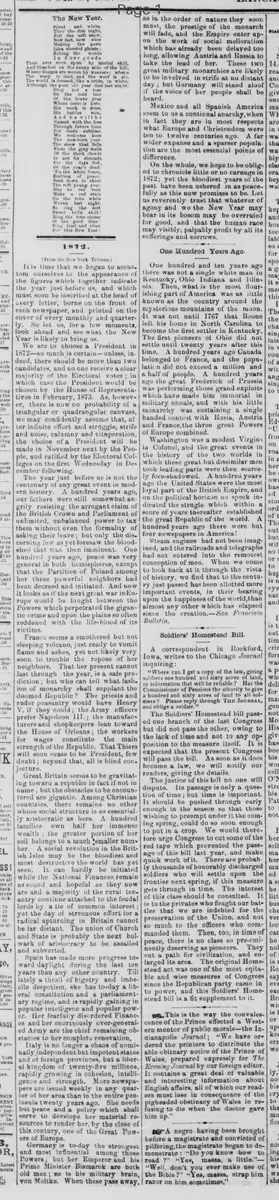
It is time that we began to accustom ourselves to the appearance of the figures which together indicate the year just before us, and which must soon be inscribed at the head of every letter, borne on the front of each newspaper, and printed on the cover of every monthly and quarterly. So let us, for a few moments, look ahead and see what the New Year is likely to bring us.
We are to choose a President in 1872—so much is certain—unless, indeed, there should be more than two candidates, and no one receive a clear majority of the Electoral votes; in which case the President would be chosen by the House of Representatives in February, 1873. As, however, there is now no probability of a triangular or quadrangular canvass, we may confidently assume that, after infinite effort and struggle, strife and noise, calumny and vituperation, the choice of a President will be made in November next by the People, and ratified by the Electoral Colleges on the first Wednesday in December following.
The year just before us is not the centenary of any great event in modern history. A hundred years ago, our fathers were still somewhat angrily resisting the arrogant claim of the British Crown and Parliament of unlimited, unbalanced power to tax them without even the formality of asking their leave; but only the discerning few as yet foresaw the bloodshed that was then imminent. One hundred years ago, peace was very general in both hemispheres, except that the Partition of Poland among her three powerful neighbors had been decreed and initiated. And now it looks as if the next great war in Europe would be fought between the Powers which perpetrated the gigantic crime and upon the plains so often reddened with the life-blood of its victims.
France seems a smothered but not sleeping volcano, just ready to vomit flame and ashes, yet not likely very soon to trouble the repose of her neighbors. That her present cannot last through the year, is a safe prediction; but who can tell what fashion of monarchy shall supplant the doomed Republic? The priests and ruder peasantry would have Henry V., if they could; the Army officers prefer Napoleon III.; the manufacturers and shopkeepers lean toward the House of Orleans; the workers for wages constitute the main strength of the Republic. That Thiers will soon cease to be President, few doubt; beyond that, all is blind conjecture.
Great Britain seems to be gravitating toward a republic in fact if not in name, but the obstacles to be encountered are gigantic. Among Christian countries, there remains no other whose social structure is so essentially aristocratic as hers. A hundred families own half her immense wealth; the greater portion of her soil belongs to a much smaller number. A social revolution in the British Isles may be the bloodiest and most destructive the world has yet seen. It can hardly be initiated while the National Finances remain as sound and hopeful as they now are, and a majority of the rural tenantry continue attached to the feudal lords by a tie of common interest; yet the day of strenuous effort for a radical upturning in Britain cannot be far distant. The union of Church and State is probably the next bulwark of aristocracy to be assailed and subverted.
Spain has made more progress toward daylight during the last ten years than any other country. Till lately a thrall of bigotry and imbecile despotism, she has to-day a liberal constitution and a parliamentary regime, and is rapidly gaining in popular intelligence and popular power. Her fearfully disordered Finances and her enormously over-manned Army are the chief remaining obstacles to her complete renovation.
Italy is no longer a chaos of nominally independent but impotent states and of foreign provinces, but a liberal kingdom of twenty-five millions, rapidly growing in cohesion, intelligence and strength. More newspapers are issued weekly in any quarter of her area than in the entire peninsula twenty years ago. She needs but peace and a policy which shall serve to develop her material resources to render her, by the close of this century, one of the Great Powers of Europe.
Germany is to-day the strongest and most influential among those Powers; but her Emperor and his Prime Minister Bismarck are both old men; so is his military brain, von Moltke. When these pass away, as in the order of nature they soon must, the prestige of the monarch will fade, and the Empire enter upon the work of social melioration which has already been delayed too long, allowing Austria and Russia to take the lead of her. These two great military monarchies are likely to be involved in strife at no distant day; but Germany will stand aloof if the voice of her people shall be heard.
Mexico and all Spanish America seem to us a continual anarchy, when in fact they are in most respects what Europe and Christendom were ten to twelve centuries ago. A far wider expanse and a sparser population are the most essential points of difference.
On the whole, we hope to be obliged to chronicle little or no carnage in 1872; yet the bloodiest years of the past have been ushered in as peacefully as this now promises to be. Let us reverently trust that whatever of agony and woe the New Year may bear in its bosom may be overruled for good, and that the human race may visibly, palpably profit by all its sufferings and sorrows.
We are to choose a President in 1872—so much is certain—unless, indeed, there should be more than two candidates, and no one receive a clear majority of the Electoral votes; in which case the President would be chosen by the House of Representatives in February, 1873. As, however, there is now no probability of a triangular or quadrangular canvass, we may confidently assume that, after infinite effort and struggle, strife and noise, calumny and vituperation, the choice of a President will be made in November next by the People, and ratified by the Electoral Colleges on the first Wednesday in December following.
The year just before us is not the centenary of any great event in modern history. A hundred years ago, our fathers were still somewhat angrily resisting the arrogant claim of the British Crown and Parliament of unlimited, unbalanced power to tax them without even the formality of asking their leave; but only the discerning few as yet foresaw the bloodshed that was then imminent. One hundred years ago, peace was very general in both hemispheres, except that the Partition of Poland among her three powerful neighbors had been decreed and initiated. And now it looks as if the next great war in Europe would be fought between the Powers which perpetrated the gigantic crime and upon the plains so often reddened with the life-blood of its victims.
France seems a smothered but not sleeping volcano, just ready to vomit flame and ashes, yet not likely very soon to trouble the repose of her neighbors. That her present cannot last through the year, is a safe prediction; but who can tell what fashion of monarchy shall supplant the doomed Republic? The priests and ruder peasantry would have Henry V., if they could; the Army officers prefer Napoleon III.; the manufacturers and shopkeepers lean toward the House of Orleans; the workers for wages constitute the main strength of the Republic. That Thiers will soon cease to be President, few doubt; beyond that, all is blind conjecture.
Great Britain seems to be gravitating toward a republic in fact if not in name, but the obstacles to be encountered are gigantic. Among Christian countries, there remains no other whose social structure is so essentially aristocratic as hers. A hundred families own half her immense wealth; the greater portion of her soil belongs to a much smaller number. A social revolution in the British Isles may be the bloodiest and most destructive the world has yet seen. It can hardly be initiated while the National Finances remain as sound and hopeful as they now are, and a majority of the rural tenantry continue attached to the feudal lords by a tie of common interest; yet the day of strenuous effort for a radical upturning in Britain cannot be far distant. The union of Church and State is probably the next bulwark of aristocracy to be assailed and subverted.
Spain has made more progress toward daylight during the last ten years than any other country. Till lately a thrall of bigotry and imbecile despotism, she has to-day a liberal constitution and a parliamentary regime, and is rapidly gaining in popular intelligence and popular power. Her fearfully disordered Finances and her enormously over-manned Army are the chief remaining obstacles to her complete renovation.
Italy is no longer a chaos of nominally independent but impotent states and of foreign provinces, but a liberal kingdom of twenty-five millions, rapidly growing in cohesion, intelligence and strength. More newspapers are issued weekly in any quarter of her area than in the entire peninsula twenty years ago. She needs but peace and a policy which shall serve to develop her material resources to render her, by the close of this century, one of the Great Powers of Europe.
Germany is to-day the strongest and most influential among those Powers; but her Emperor and his Prime Minister Bismarck are both old men; so is his military brain, von Moltke. When these pass away, as in the order of nature they soon must, the prestige of the monarch will fade, and the Empire enter upon the work of social melioration which has already been delayed too long, allowing Austria and Russia to take the lead of her. These two great military monarchies are likely to be involved in strife at no distant day; but Germany will stand aloof if the voice of her people shall be heard.
Mexico and all Spanish America seem to us a continual anarchy, when in fact they are in most respects what Europe and Christendom were ten to twelve centuries ago. A far wider expanse and a sparser population are the most essential points of difference.
On the whole, we hope to be obliged to chronicle little or no carnage in 1872; yet the bloodiest years of the past have been ushered in as peacefully as this now promises to be. Let us reverently trust that whatever of agony and woe the New Year may bear in its bosom may be overruled for good, and that the human race may visibly, palpably profit by all its sufferings and sorrows.
What sub-type of article is it?
Foreign Affairs
Partisan Politics
War Or Peace
What keywords are associated?
1872 New Year
Us Presidential Election
European Politics
France Republic
Britain Aristocracy
Spain Constitution
Italy Unification
Germany Empire
Mexico Anarchy
World Peace
What entities or persons were involved?
Us President
Electoral Colleges
British Crown And Parliament
Henry V
Napoleon Iii
House Of Orleans
Thiers
Bismarck
Von Moltke
Emperor Of Germany
Spain
Italy
Mexico
Spanish America
Editorial Details
Primary Topic
Prospects For 1872 Including Us Presidential Election And European Political Developments
Stance / Tone
Cautiously Optimistic About Global Peace And Reforms
Key Figures
Us President
Electoral Colleges
British Crown And Parliament
Henry V
Napoleon Iii
House Of Orleans
Thiers
Bismarck
Von Moltke
Emperor Of Germany
Spain
Italy
Mexico
Spanish America
Key Arguments
Us Will Elect President In November 1872 Via Popular Vote And Electoral Colleges
France's Republic Doomed, Potential Shift To Monarchy With Factions Favoring Different Candidates
Britain Gravitating Toward Republic Despite Aristocratic Structure And Obstacles
Spain Progressing With Liberal Constitution But Hindered By Finances And Army
Italy Unified And Growing As A Liberal Kingdom Needing Peace For Development
Germany Strong But Aging Leaders; Future Social Reforms And Potential Aloofness From Austria Russia Strife
Mexico And Spanish America In Anarchy Resembling Medieval Europe
Hope For Little Carnage In 1872 Despite Historical Precedents