Thank you for visiting SNEWPapers!
Sign up free
Jenks's Portland Gazette
Portland, Cumberland County, Maine
What is this article about?
Detailed account of the surrender of Mantua to Imperial General Kray on July 30, after negotiations with French commander Foisac Latour. Garrison of 5,000 allowed to return to France on parole. Includes letters from French War Minister Bernadotte and Latour's defiant response.
Merged-components note: Details of the surrender of Mantua, including the full text of the French commander's answer to the summons.
Clipping
OCR Quality
Full Text
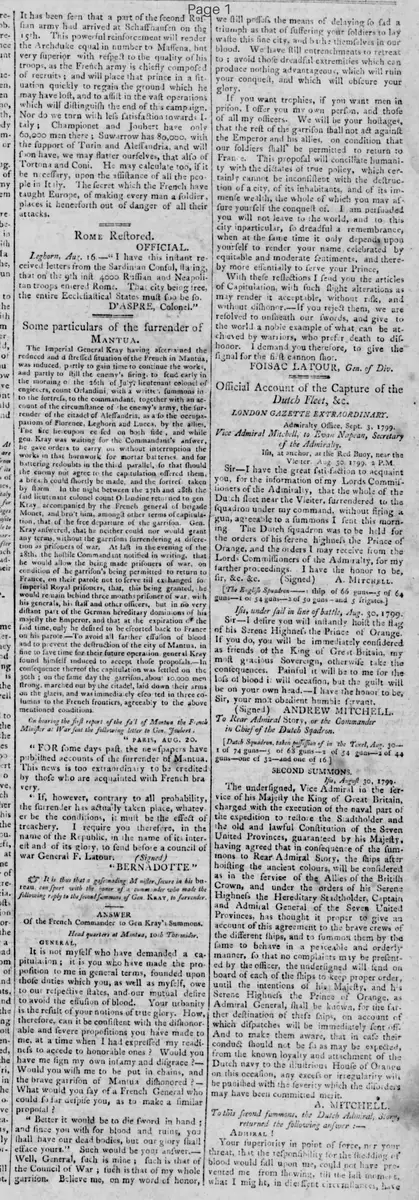
The Imperial General Kray having ascertained the reduced and distressed situation of the French in Mantua, was induced, partly to gain time to continue the works, and partly to still the enemy's firing, to send early in the morning of the 25th of July, lieutenant colonel of engineers, count Orlandini, with a written summons into the fortress, to the commandant, together with an account of the circumstance of the enemy's army, the surrender of the citadel of Alexandria, as also the occupation of Florence, Leghorn and Lucca, by the allies.
The fire hereupon ceased on both sides, and while gen. Kray was waiting for the Commandant's answer, he gave orders to carry on without interruption the works in that hornwork for mortar batteries, and for battering redoubts in the third parallel, so that should the enemy not agree to the capitulation offered them, a breach could shortly be made, and the fortress taken by storm In the night between the 27th and 28th the said lieutenant colonel count Orlandini returned to gen Kray accompanied by the French general of brigade Monet, and bro't him, amongst other terms of capitulation, that of the free departure of the garrison. Gen. Kray answered, that he neither could nor would grant any terms, without the garrisons surrendering at discretion as prisoners of war, At last in the evening of the 28th, the hostile Commandant notified in writing, that he would allow the being made prisoners of war, on condition of the garrison's being permitted to return to France, on their parole not to serve till exchanged for Imperial Royal prisoners, that, this being granted, he would remain behind three months prisoner of war, with his generals, his staff and other officers, but in no very distant part of the German hereditary dominions of his majesty the Emperor, and that at the expiration of the said time, only he desired to be escorted back to France on his parole.—To avoid all farther effusion of blood and to prevent the destruction of the city of Mantua, in fine to save time for their future operation general Kray found himself induced to accept those proposals.—In consequence thereof the capitulation was settled on the 30th ; on the same day the garrison, about 5000 men strong, marched out by the citadel, laid down their arms on the glacis, and was immediately escorted in three columns to the French frontiers, agreeably to the above mentioned conditions.
On hearing the first report of the fall of Mantua the French Minister at War sent the following letter to Gen. Joubert.
"PARIS, AUG. 20.
"FOR some days past. the newspapers have published accounts of the surrender of Mantua. This news is too extraordinary to be credited by those who are acquainted with French bravery.
If, however, contrary to all probability, the surrender has actually taken place, whatever be the conditions, it must be the effect of treachery. I require you therefore, in the name of the Republic, in the name of its interest and of its glory, to send before a council of war General F. Latour. (Signed)
"BERNADOTTE."
It is thus that a grenading Minister, secure in his bureau. can sport with the honor of a commander who made the following reply to the second summons of Gen Kray, to surrender.
ANSWER
Of the French Commander to Gen Kray's Summons.
Head quarters at Mantua, 10th Thermidor.
GENERAL,
It is not myself who have demanded a capitulation; it is you who have made the proposition to me in general terms, founded upon those duties which you, as well as myself, owe to our respective states, and.our mutual desire to avoid the effusion of blood. Your urbanity is the result of your notions of true glory. How, therefore, can it be consistent with the dishonorable and severe propositions you have made to me, at a time when I had expressed my readiness to accede to honorable ones ? Would you have me sign my own infamy and disgrace ?— Would you wish me to be put in chains, and the brave garrison of Mantua dishonored ?— What would you say of a French General who could so far despise you, as to make a similar proposal ?
"Better it would be to die sword in hand ; and since you wish for blood and ruins, you shall have our dead bodies, but our glory shall efface yours.". Such would be your answer.— Well, General. such is mine : such is that of the Council of War ; such is that of my whole garrison. Believe me, on my word of honor,
we still possess the means of delaying so sad a triumph as that of suffering your soldiers to lay waste this fine city, and bathe themselves in our blood. We have still entrenchments to retreat to ; avoid those dreadful extremities which can produce nothing advantageous, which will ruin your conquest, and which will obscure your glory.
If you want trophies, if you want men in prison, I offer you my own person, and those of all my officers. We will be your hostages, that the rest of the garrison shall not act against the Emperor and his allies, on condition that our soldiers shall be permitted to return to France. This proposal will conciliate humanity with the dictates of true policy, which certainly cannot be inconsistent with the destruction of a city, of its inhabitants, and of its immense wealth, the whole of which you may assure yourself the conquest of. I am persuaded you will not leave to the world, and to this city in particular, so dreadful a remembrance, when at the same time it only depends upon yourself to render your name, celebrated by equitable and moderate sentiments, and thereby more essentially to serve your Prince,
With these reflections I send you the articles of Capitulation, with such slight alterations as may render it acceptable, without risk, and without dishonor.—If you reject them, we are resolved to unsheath our swords, and give to the world a noble example of what can be atchieved by warriors, who prefer death to dishonor. I demand you therefore, to give the signal for the first cannon shot.
FOISAC LATOUR, Gen. of Div.
What sub-type of article is it?
What keywords are associated?
What entities or persons were involved?
Where did it happen?
Foreign News Details
Primary Location
Mantua
Event Date
25th Of July To 30th
Key Persons
Outcome
garrison of about 5000 men surrendered as prisoners of war but permitted to return to france on parole not to serve until exchanged; commandant and officers to remain prisoners for three months.
Event Details
Imperial General Kray summoned the French commandant in Mantua on July 25, leading to negotiations. After defiant responses and continued siege preparations, terms were agreed on July 30 allowing the garrison to depart on parole to avoid bloodshed and city destruction.