Thank you for visiting SNEWPapers!
Sign up free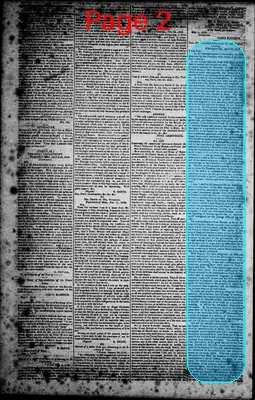
Editorial
May 9, 1810
Norfolk Gazette And Publick Ledger
Norfolk, Virginia
What is this article about?
In a 1810 circular to constituents, Rep. Swoope discusses tense US-British negotiations, regrets Senate's reproachful resolution, hopes for peace amid French aggressions, and opposes a militia bill for constitutional violations, favoring negotiation over war.
Clipping

OCR Quality
98%
Excellent
Full Text
Hon. Mr. Swoope's Circular To His Constituents.
Washington City, April 28, 1810.
Dear Sir,
At the commencement of the session, we were presented by the President with a view of our national concerns.
In our foreign relations, those with England have taken a sudden and unexpected turn. The correspondence between the secretary of state and the British envoy, in the renewal of a negotiation on which so much was expected, was conducted in a manner which excited surprize as well as indignation. In a view of the correspondence, I can only express my deep regret, that so much warmth, and so much punctilio, should have been displayed by two individuals, who by a want of common urbanity, jeopardized the interests of their respective nations, and who appeared not to estimate the importance of the trust reposed in them. The rupture which had taken place in the negotiation, created unusual sensation in the publick mind, and war with England if not a necessary result, appeared to be but too desirable to many of our leading characters. At this period, through the instrumentality of Mr. Giles, we had submitted to us from the senate, a resolution speaking in reproachful and useless terms, of the conduct of the British minister. In giving to this indecorous state paper, a negative vote, and disapproving of the policy of such a measure, I was influenced, I trust, by correct views of national honour and interest, and a due regard to the rights of a representative of the people. Why should we in our legislative capacity, undertake to hurl anathemas against an individual, who was no longer known as a functionary of his government? Why should we make a quarrel between two sensitive individuals, an object of sufficient magnitude, to call for an expression of legislative sentiment and national resentment? Besides I could not (as the resolution required) pledge the resources of the nation or a support of measures, resting upon the faith of individuals in the government, whose intrigues were covered with a veil too transparent to deceive, and whose rooted animosity towards England was as notorious, as their devotion to France was wicked. Neither would I present obstacles to a negotiation, when the President had given fresh assurances of his desire to accommodate the misunderstandings between the two governments; an event, which I believed to be still practicable without resorting to war; the last and worst alternative of nations.
I trust I shall at all times act like an American when the character of the chief magistrate of my country shall be assailed by a foreign agent; and feel equal resentment against either Great Britain or France for the infliction of wrongs unexampled in history, because history has not witnessed an era like the present. But in the present distracted state of Europe, whilst I view England as hostile to our commercial prosperity alone, and France as the enemy of our free institutions, aiming at universal conquest, I shall not with uplifted hands, invoke the lightning of Heaven against one, or manifest much indulgence for the wrongs inflicted by the other.
The late intelligence from Europe, so far as relates to England, affords room for congratulation to those whose object is peace, and the enjoyment of the fruits of honest industry. The speech of the king of England breathes a spirit of conciliation towards our nation, which courts a corresponding disposition on the part of our government, and although nothing is said of a minister being sent out, yet we entertain the hope, that our differences are in a train of adjustment, which will restore that harmony so anxiously desired, and in which both nations are so deeply interested.
With France, the other belligerent, our relations remain unchanged; and to the accumulated wrongs already inflicted by that government on the commerce of our country, recent and condemnations of American property have taken place in France, Spain and Italy. To these injuries aggravated insult has been added. In a letter addressed by the French minister to our ambassador at Paris, we are called upon in unequivocal language, to make common cause with France and her allies in their opposition to England: and on this alternative depends the restoration of the property of which our citizens have been despoiled; and the liberation of our seamen who are in confinement.
To meet any possible events growing out of our situation, the president, by a message in January recommended the renewal of the law providing for detachment of 100,000 militia, and the enlistment of 20,000 volunteers, to be ready at a moment's warning. A bill for the volunteers originated in the senate. By its provisions, bounties on enlistment were to be given, and liberty to retain the arms at the expiration of the term: this would have created an expense of a million of dollars—After considerable debate that provision was expunged; and the bill has not since been acted upon.
The bill for 100,000 militia which originated in the house of representatives, provided, that volunteers be received in lieu of drafts, who were to be encamped certain days in each year; and gave authority to the president to send them out of the limits of the United States; and involved an expense of about three millions of dollars. Considering as I do, the militia, as the great bulwark of our republic, I could not, but with extreme jealousy, view some of the features of this bill, embracing palpable violations of the constitution, and encroachments on our state rights. Wild and visionary as the project may seem, an invasion of Canada was contemplated; and to indulge this spirit of conquest, the charter which was formed by the collected wisdom of our country, and which guards our political rights, was to be invaded. As to war with Great-Britain, I considered it a remote possibility and would not consent to harass our citizens by a repetition of such vexatious calls as had nearly exhausted the patience of the country. I was moreover too well assured, that when coercion was really necessary, the publick voice would not be found deficient.
Washington City, April 28, 1810.
Dear Sir,
At the commencement of the session, we were presented by the President with a view of our national concerns.
In our foreign relations, those with England have taken a sudden and unexpected turn. The correspondence between the secretary of state and the British envoy, in the renewal of a negotiation on which so much was expected, was conducted in a manner which excited surprize as well as indignation. In a view of the correspondence, I can only express my deep regret, that so much warmth, and so much punctilio, should have been displayed by two individuals, who by a want of common urbanity, jeopardized the interests of their respective nations, and who appeared not to estimate the importance of the trust reposed in them. The rupture which had taken place in the negotiation, created unusual sensation in the publick mind, and war with England if not a necessary result, appeared to be but too desirable to many of our leading characters. At this period, through the instrumentality of Mr. Giles, we had submitted to us from the senate, a resolution speaking in reproachful and useless terms, of the conduct of the British minister. In giving to this indecorous state paper, a negative vote, and disapproving of the policy of such a measure, I was influenced, I trust, by correct views of national honour and interest, and a due regard to the rights of a representative of the people. Why should we in our legislative capacity, undertake to hurl anathemas against an individual, who was no longer known as a functionary of his government? Why should we make a quarrel between two sensitive individuals, an object of sufficient magnitude, to call for an expression of legislative sentiment and national resentment? Besides I could not (as the resolution required) pledge the resources of the nation or a support of measures, resting upon the faith of individuals in the government, whose intrigues were covered with a veil too transparent to deceive, and whose rooted animosity towards England was as notorious, as their devotion to France was wicked. Neither would I present obstacles to a negotiation, when the President had given fresh assurances of his desire to accommodate the misunderstandings between the two governments; an event, which I believed to be still practicable without resorting to war; the last and worst alternative of nations.
I trust I shall at all times act like an American when the character of the chief magistrate of my country shall be assailed by a foreign agent; and feel equal resentment against either Great Britain or France for the infliction of wrongs unexampled in history, because history has not witnessed an era like the present. But in the present distracted state of Europe, whilst I view England as hostile to our commercial prosperity alone, and France as the enemy of our free institutions, aiming at universal conquest, I shall not with uplifted hands, invoke the lightning of Heaven against one, or manifest much indulgence for the wrongs inflicted by the other.
The late intelligence from Europe, so far as relates to England, affords room for congratulation to those whose object is peace, and the enjoyment of the fruits of honest industry. The speech of the king of England breathes a spirit of conciliation towards our nation, which courts a corresponding disposition on the part of our government, and although nothing is said of a minister being sent out, yet we entertain the hope, that our differences are in a train of adjustment, which will restore that harmony so anxiously desired, and in which both nations are so deeply interested.
With France, the other belligerent, our relations remain unchanged; and to the accumulated wrongs already inflicted by that government on the commerce of our country, recent and condemnations of American property have taken place in France, Spain and Italy. To these injuries aggravated insult has been added. In a letter addressed by the French minister to our ambassador at Paris, we are called upon in unequivocal language, to make common cause with France and her allies in their opposition to England: and on this alternative depends the restoration of the property of which our citizens have been despoiled; and the liberation of our seamen who are in confinement.
To meet any possible events growing out of our situation, the president, by a message in January recommended the renewal of the law providing for detachment of 100,000 militia, and the enlistment of 20,000 volunteers, to be ready at a moment's warning. A bill for the volunteers originated in the senate. By its provisions, bounties on enlistment were to be given, and liberty to retain the arms at the expiration of the term: this would have created an expense of a million of dollars—After considerable debate that provision was expunged; and the bill has not since been acted upon.
The bill for 100,000 militia which originated in the house of representatives, provided, that volunteers be received in lieu of drafts, who were to be encamped certain days in each year; and gave authority to the president to send them out of the limits of the United States; and involved an expense of about three millions of dollars. Considering as I do, the militia, as the great bulwark of our republic, I could not, but with extreme jealousy, view some of the features of this bill, embracing palpable violations of the constitution, and encroachments on our state rights. Wild and visionary as the project may seem, an invasion of Canada was contemplated; and to indulge this spirit of conquest, the charter which was formed by the collected wisdom of our country, and which guards our political rights, was to be invaded. As to war with Great-Britain, I considered it a remote possibility and would not consent to harass our citizens by a repetition of such vexatious calls as had nearly exhausted the patience of the country. I was moreover too well assured, that when coercion was really necessary, the publick voice would not be found deficient.
What sub-type of article is it?
Foreign Affairs
Military Affairs
Constitutional
What keywords are associated?
Foreign Relations
Britain
France
Negotiation
Militia
Constitution
Peace
War Preparation
What entities or persons were involved?
President
Mr. Giles
British Envoy
French Minister
King Of England
Editorial Details
Primary Topic
Us Foreign Relations With Britain And France, Military Preparedness, And Constitutional Concerns
Stance / Tone
Advocacy For Peace With Britain, Criticism Of France, Opposition To Unconstitutional Military Measures
Key Figures
President
Mr. Giles
British Envoy
French Minister
King Of England
Key Arguments
Regret Over Heated Negotiation Between Us Secretary Of State And British Envoy Jeopardizing National Interests
Opposition To Senate Resolution Reproaching British Minister As Indecorous And Unnecessary
Belief That War With England Is Undesirable And Negotiation Remains Possible
View Of France As Greater Threat To Free Institutions Than England's Commercial Hostility
Congratulation On King's Speech Indicating Conciliation And Hope For Adjusted Relations With England
Condemnation Of French Seizures Of American Property And Demands For Alliance Against England
Support For President's Recommendation Of Militia And Volunteers But Opposition To Specific Bill Provisions
Concerns Over Militia Bill's Violations Of Constitution, Encroachments On State Rights, And Promotion Of Conquest
Militia As Bulwark Of Republic But Against Vexatious Calls Without Real Necessity
Assurance That Public Would Support Coercion If Truly Needed