Thank you for visiting SNEWPapers!
Sign up free
New York Daily Tribune
New York, New York County, New York
What is this article about?
The Republican Convention in New York adopts anti-slavery resolutions, including on voting safeguards and naturalization, nominates Edwin Morgan for Governor, but fails to unite with the American Convention, which nominates its own ticket amid disagreements over conference reports.
Clipping
OCR Quality
Full Text
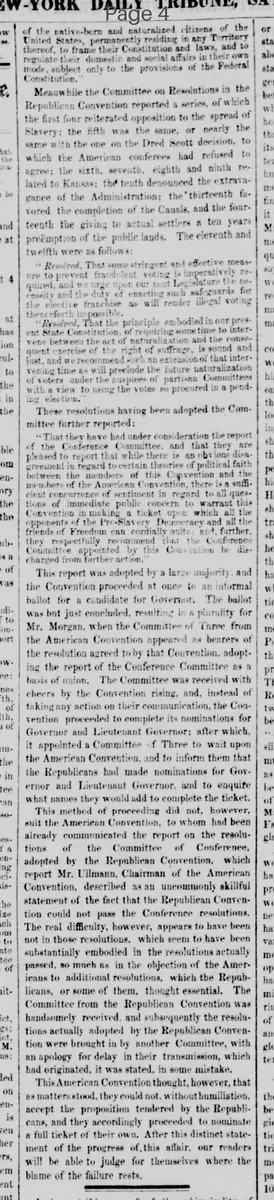
Meanwhile the Committee on Resolutions in the Republican Convention reported a series, of which the first four reiterated opposition to the spread of Slavery: the fifth was the same or nearly the same with the one on the Dred Scott decision to which the American conferees had refused to agree: the sixth, seventh, eighth and ninth related to Kansas: the tenth denounced the extravagance of the Administration: the thirteenth favored the completion of the Canals, and the fourteenth the giving to actual settlers a ten years preemption of the public lands. The eleventh and twelfth were as follows:
To prevent fraudulent voting is imperatively required, and we urge upon our next Legislature the necessity and the duty of enacting such safeguards for the elective franchise as will render illegal voting thenceforth impossible.
"Resolved, That the principle embodied in our present State Constitution, of requiring some time to intervene between the act of naturalization and the consequent exercise of the right of suffrage, is sound and just, and we recommend such an extension of that intervening time as will preclude the future naturalization of voters under the auspices of partisan Committees with a view to using the votes so procured in a pending election."
These resolutions having been adopted the Committee further reported:
That they have had under consideration the report of the Conference Committee, and that they are pleased to report that while there is an obvious disagreement in regard to certain theories of political faith between the members of this Convention and the members of the American Convention, there is a sufficient concurrence of sentiment in regard to all questions of immediate public concern to warrant this Convention in making a ticket upon which all the opponents of the Pro-Slavery Democracy and all the friends of Freedom can cordially unite: and, further, they respectfully recommend that the Conference Committee appointed by this Convention be discharged from further action.
This report was adopted by a large majority, and the Convention proceeded at once to an informal ballot for a candidate for Governor. The ballot was but just concluded, resulting in a plurality for Mr. Morgan, when the Committee of Three from the American Convention appeared as bearers of the resolution agreed to by that Convention, adopting the report of the Conference Committee as a basis of union. The Committee was received with cheers by the Convention rising, and, instead of taking any action on their communication, the Convention proceeded to complete its nominations for Governor and Lieutenant Governor: after which, it appointed a Committee of Three to wait upon the American Convention, and to inform them that the Republicans had made nominations for Governor and Lieutenant Governor, and to enquire what names they would add to complete the ticket.
This method of proceeding did not, however, suit the American Convention, to whom had been already communicated the report on the resolutions of the Committee of Conference, adopted by the Republican Convention, which report Mr. Ullmann, Chairman of the American Convention, described as an uncommonly skillful statement of the fact that the Republican Convention could not pass the Conference resolutions. The real difficulty, however, appears to have been not in those resolutions, which seem to have been substantially embodied in the resolutions actually passed, so much as in the objection of the Americans to additional resolutions, which the Republicans, or some of them, thought essential. The Committee from the Republican Convention was handsomely received, and subsequently the resolutions actually adopted by the Republican Convention were brought in by another Committee, with an apology for delay in their transmission, which had originated, it was stated, in some mistake. This American Convention thought, however, that as matters stood, they could not, without humiliation, accept the proposition tendered by the Republicans, and they accordingly proceeded to nominate a full ticket of their own. After this distinct statement of the progress of this affair, our readers will be able to judge for themselves where the blame of the failure rests.
What sub-type of article is it?
What keywords are associated?
What entities or persons were involved?
Domestic News Details
Key Persons
Outcome
failure to unite the conventions; republicans nominate morgan for governor and proceed with their ticket; americans nominate a full separate ticket.
Event Details
The Republican Convention adopts resolutions opposing slavery spread, Dred Scott decision, Kansas issues, administration extravagance, canal completion, land preemption, fraudulent voting prevention, and naturalization delays for suffrage. They discharge the conference committee and nominate candidates for Governor (Mr. Morgan) and Lieutenant Governor despite American Convention's union proposal, leading to separate nominations by the Americans after disagreements over additional resolutions.