Thank you for visiting SNEWPapers!
Sign up free
The Daily Madisonian
Washington, District Of Columbia
What is this article about?
U.S. Senate debate on a protective tariff bill, with speeches from various senators including Crittenden, Bagby, and Calhoun. The bill passed on third reading by a vote of 24-23, followed by adjournment.
Clipping
OCR Quality
Full Text
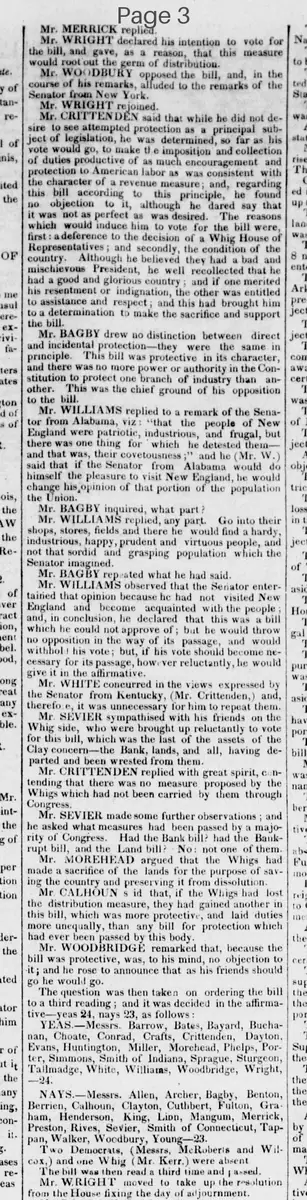
Mr. Wright declared his intention to vote for the bill, and gave, as a reason, that this measure would root out the germ of distribution.
Mr. Woodbury opposed the bill, and, in the course of his remarks, alluded to the remarks of the Senator from New York.
Mr. Wright rejoined.
Mr. Crittenden said that while he did not desire to see attempted protection as a principal subject of legislation, he was determined, so far as his vote would go, to make the imposition and collection of duties productive of as much encouragement and protection to American labor as was consistent with the character of a revenue measure; and, regarding this bill according to this principle, he found no objection to it, although he dared say that it was not as perfect as was desired. The reasons which would induce him to vote for the bill were, first: a deference to the decision of a Whig House of Representatives; and secondly, the condition of the country. Although he believed they had a bad and mischievous President, he well recollected that he had a good and glorious country; and if one merited his resentment or indignation, the other was entitled to assistance and respect; and this had brought him to a determination to make the sacrifice and support the bill.
Mr. Bagby drew no distinction between direct and incidental protection—they were the same in principle. This bill was protective in its character, and there was no more power or authority in the Constitution to protect one branch of industry than another. This was the chief ground of his opposition to the bill.
Mr. Williams replied to a remark of the Senator from Alabama, viz: "that the people of New England were patriotic, industrious, and frugal, but there was one thing for which he detested them—and that was, their covetousness;" and he (Mr. W.) said that if the Senator from Alabama would do himself the pleasure to visit New England, he would change his opinion of that portion of the population of the Union.
Mr. Bagby inquired, what part?
Mr. Williams replied, any part. Go into their shops, stores, fields and there he would find a hardy, industrious, happy, prudent and virtuous people, and not that sordid and grasping population which the Senator imagined.
Mr. Bagby repeated what he had said.
Mr. Williams observed that the Senator entertained that opinion because he had not visited New England and become acquainted with the people; and, in conclusion, he declared that this was a bill which he could not approve of; but he would throw no opposition in the way of its passage, and would withhold his vote; but, if his vote should become necessary for its passage, however reluctantly, he would give it in the affirmative.
Mr. White concurred in the views expressed by the Senator from Kentucky, (Mr. Crittenden,) and, therefore, it was unnecessary for him to repeat them.
Mr. Sevier sympathised with his friends on the Whig side, who were brought up reluctantly to vote for this bill, which was the last of the assets of the Clay concern—the Bank, lands, and all, having departed and been wrested from them.
Mr. Crittenden replied with great spirit, contending that there was no measure proposed by the Whigs which had not been carried by them through Congress.
Mr. Sevier made some further observations; and he asked what measures had been passed by a majority of Congress. Had the Bank bill? had the Bankrupt bill, and the Land bill? No: not one of them.
Mr. Morehead argued that the Whigs had made a sacrifice of the lands for the purpose of saving the country and preserving it from dissolution.
Mr. Calhoun said that, if the Whigs had lost the distribution measure, they had gained another in this bill, which was more protective, and laid duties more unequally, than any bill for protection which had ever been passed by this body.
Mr. Woodbridge remarked that, because the bill was protective, was, to his mind, no objection to it; and he rose to announce that as his friends should go he would go.
The question was then taken on ordering the bill to a third reading; and it was decided in the affirmative—yeas 24, nays 23, as follows:
YEAS.—Messrs. Barrow, Bates, Bayard, Buchanan, Choate, Conrad, Crafts, Crittenden, Dayton, Evans, Huntington, Miller, Morehead, Phelps, Porter, Simmons, Smith of Indiana, Sprague, Sturgeon, Tallmadge, White, Williams, Woodbridge, Wright, —24.
NAYS.—Messrs. Allen, Archer, Bagby, Benton, Berrien, Calhoun, Clayton, Cuthbert, Fulton, Graham, Henderson, King, Linn, Mangum, Merrick, Preston, Rives, Sevier, Smith of Connecticut, Tappan, Walker, Woodbury, Young—23.
Two Democrats, (Messrs. McRoberts and Wilcox,) and one Whig (Mr. Kerr,) were absent
The bill was then read a third time and passed.
Mr. Wright moved to take up the resolution from the House fixing the day of adjournment.
Mr. Barrow moved to adjourn.
On this motion the yeas and nays were ordered and being taken were—yeas 24, nays 20.
So the Senate adjourned at half-past seven o'clock
What sub-type of article is it?
What keywords are associated?
What entities or persons were involved?
Where did it happen?
Domestic News Details
Primary Location
Washington, D.C.
Key Persons
Outcome
the bill passed on third reading by a vote of 24 yeas to 23 nays. senate adjourned at half-past seven o'clock.
Event Details
Senators debated a revenue bill with protective duties, with supporters like Crittenden citing deference to the House and national condition, opponents like Bagby arguing constitutional issues and no distinction between direct and incidental protection. Debate included exchanges on New England character and Whig measures. Vote ordered bill to third reading and passed it.