Thank you for visiting SNEWPapers!
Sign up free
Literary
February 5, 1830
Rhode Island American, Statesman And Providence Gazette
Providence, Providence County, Rhode Island
What is this article about?
Eyewitness account of a lavish medieval-style tournament held in Vienna during the 1814 Congress of Sovereigns, attended by European monarchs, nobles, and ladies. Describes the opulent setting, participants' attire, chivalric performances, and absence of Empress Maria Louisa.
Clipping
OCR Quality
95%
Excellent
Full Text
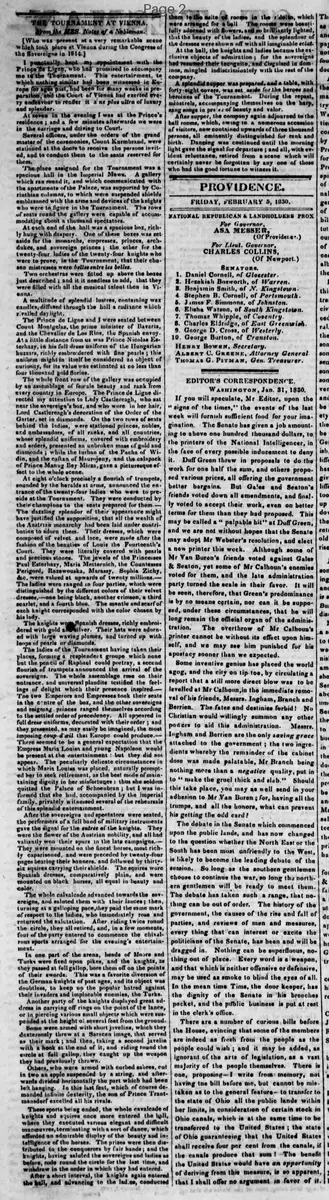
[Who was present at a very remarkable scene which took place at Vienna during the Congress of the Sovereigns in 1814.]
I punctually kept my appointment with the Prince de Ligne, who had promised to accompany me to the Tournament. This entertainment, to which nothing similar had been witnessed in Europe for ages past, had been for many weeks in preparation, and the Court of Vienna had exerted every endeavour to render it a ne plus ultra of luxury and splendor.
At seven in the evening I was at the Prince's residence; and a few minutes afterwards we were in the carriage and driving to Court.
Several officers, under the orders of the grand master of the ceremonies, Count Kurnbrand, were stationed at the doors to receive the persons invited, and to conduct them to the seats reserved for them.
The place assigned for the Tournament was a spacious hall in the Imperial Mews. A gallery which ran round it, and which communicated with the apartments of the Palace, was supported by Corinthian columns, to which were suspended shields emblazoned with the arms and devices of the knights who were to figure in the Tournament. The rows of seats round the gallery were capable of accommodating about a thousand spectators.
At each end of the hall was a spacious box, richly hung with drapery. One of these boxes was set aside for the monarchs, empresses, princes, archdukes, and sovereign princes; the other for the twenty-four ladies of the twenty-four knights who were to prove, in the Tournament, that their chosen mistresses were belles entre les belles.
Two orchestras were fitted up above the boxes just described; and it is needless to add, that they were filled with all the musical talent then in Vienna.
A multitude of splendid lustres, containing wax candles, diffused through the hall a radiance which rivalled daylight.
The Prince de Ligne and I were seated between Count Montgelas, the prime minister of Bavaria, and the Chevalier de Los Rios, the Spanish envoy.
At a little distance from us was Prince Nicholas Esterhazy, in his full dress uniform of the Hungarian hussars, richly embroidered with fine pearls; this uniform might in itself be considered an object of curiosity, for its value was estimated at no less than four thousand gold florins.
The whole front row of the gallery was occupied by an assemblage of female beauty and rank from every country in Europe. The Prince de Ligne directed my attention to Lady Castlereagh, who sat near the sovereign's box, and who wore in her hair, Lord Castlereagh's decoration of the Order of the Garter, set in diamonds. On the two rows of seats behind the ladies, were stationed princes, nobles, and ambassadors, of all ranks, and all countries, whose splendid uniforms, covered with embroidery and orders, presented an unbroken mass of gold and diamonds; while the turban of the Pacha of Widin, and the catan of Maurouzy, and the calapack of Prince Manug Bey Mirza, gave a picturesque effect to the whole scene.
At eight o'clock precisely a flourish of trumpets, sounded by the heralds at arms, announced the entrance of the twenty-four ladies who were to preside at the Tournament. They were conducted by their champions to the seats prepared for them. The dazzling splendor of their appearance might have justified the supposition, that all the wealth of the Austrian monarchy had been laid under contribution to adorn them. Their dresses, which were composed of velvet and lace, were made after the fashion of the beauties of Louis the Fourteenth's Court. They were literally covered with pearls and precious stones. The jewels of the Princesses Paul Esterhazy, Maria Metternich, the Countesses Perigord, Razewouska, Marassy, Sophia Zichy, &c, were valued at upwards of twenty millions.
The ladies were ranged in four parties, which were distinguished by the different colors of their velvet dresses,-one being black, another crimson, a third scarlet, and a fourth blue. The mantle and scarf of each knight corresponded with the color chosen by his lady.
The knights wore Spanish dresses, richly embroidered with gold and silver. Their hats were adorned with large waving plumes, and turned up with loops of pearls or diamonds.
The ladies of the Tournament having taken their places, forming a resplendent groupe which none but the pencil of Raphael could portray, a second flourish of trumpets announced the arrival of the sovereigns. The whole assemblage rose on their entrance, and universal plaudits testified the feelings of delight which their presence inspired.
The two Emperors and Empresses took their seats in the centre of the box, and the other sovereigns and reigning princes ranged themselves according to the settled order of precedency. All appeared in full dress uniforms, decorated with their orders; and they presented, as may easily be imagined, the most imposing coup-d'oeil that Europe could produce.
There seemed to be a general expectation that the Empress Maria Louisa and young Napoleon would be present at the entertainment: but they did not appear. The peculiarly delicate circumstances in which Maria Louisa was placed, naturally prompted her to seek retirement, as the best mode of maintaining dignity in her misfortunes: thus she seldom quitted the Palace of Schoenbrunn; but I was informed that she had, accompanied by the imperial family, privately witnessed several of the rehearsals of this splendid entertainment.
After the sovereigns and spectators were seated, the performers of a full band of military instruments gave the signal for the entree of the knights. They were the flower of the Austrian nobility, and all had valiantly won their spurs in the late campaigns. They were mounted on the finest horses, most richly caparisoned, and were preceded by twenty-four pages bearing their banners, and followed by thirty-six squires carrying their shields. The squires wore Spanish dresses, comparatively plain, and were mounted on black horses, all equal in beauty and color.
The whole cavalcade advanced towards the sovereigns, and saluted them with their lances; then, turning at a galloping pace, they paid the same mark of respect to the ladies, who immediately rose and returned the salutation. After riding twice round the circle, they all retired, and, in a few moments, four of the party entered to commence the chivalrous sports arranged for the evening's entertainment.
In one part of the arena, heads of Moors and Turks were fixed upon pikes, and the knights, as they passed at full gallop, bore them off on the points of their swords. This was a favorite diversion of the German knights of past ages, and its object was doubtless, to keep up the popular hatred against their invaders and implacable enemies, the Turks.
Another party of the knights displayed great address in carrying off rings on the point of the lance, or in piercing various small objects which were suspended at the height of several feet from the ground.
Some were armed with short javelins, which they dexterously threw at a Saracen image, that served as their mark; and then, taking a second javelin with a hook at the end of it, and riding round the circle at full gallop, they caught up the weapon they had previously thrown.
Others, who were armed with curved sabres, cut in two an apple suspended by a string, and afterwards divided horizontally the part which had been left hanging. In this last feat, which of course demanded infinite dexterity, the son of Prince Trauttmansdorf excelled all his rivals.
These sports being ended, the whole cavalcade of knights and squires once more entered the hall, where they executed various elegant and difficult manoeuvres, terminating with a sort of dance, which afforded an admirable display of the beauty and intelligence of the horses. The prizes were then distributed to the conquerors by fair hands; and the knights, having saluted the sovereigns and ladies as before, rode round the circle for the last time, and withdrew in the order in which they had entered.
After a short interval, the knights again entered the hall, and advancing to the ladies, conducted
I punctually kept my appointment with the Prince de Ligne, who had promised to accompany me to the Tournament. This entertainment, to which nothing similar had been witnessed in Europe for ages past, had been for many weeks in preparation, and the Court of Vienna had exerted every endeavour to render it a ne plus ultra of luxury and splendor.
At seven in the evening I was at the Prince's residence; and a few minutes afterwards we were in the carriage and driving to Court.
Several officers, under the orders of the grand master of the ceremonies, Count Kurnbrand, were stationed at the doors to receive the persons invited, and to conduct them to the seats reserved for them.
The place assigned for the Tournament was a spacious hall in the Imperial Mews. A gallery which ran round it, and which communicated with the apartments of the Palace, was supported by Corinthian columns, to which were suspended shields emblazoned with the arms and devices of the knights who were to figure in the Tournament. The rows of seats round the gallery were capable of accommodating about a thousand spectators.
At each end of the hall was a spacious box, richly hung with drapery. One of these boxes was set aside for the monarchs, empresses, princes, archdukes, and sovereign princes; the other for the twenty-four ladies of the twenty-four knights who were to prove, in the Tournament, that their chosen mistresses were belles entre les belles.
Two orchestras were fitted up above the boxes just described; and it is needless to add, that they were filled with all the musical talent then in Vienna.
A multitude of splendid lustres, containing wax candles, diffused through the hall a radiance which rivalled daylight.
The Prince de Ligne and I were seated between Count Montgelas, the prime minister of Bavaria, and the Chevalier de Los Rios, the Spanish envoy.
At a little distance from us was Prince Nicholas Esterhazy, in his full dress uniform of the Hungarian hussars, richly embroidered with fine pearls; this uniform might in itself be considered an object of curiosity, for its value was estimated at no less than four thousand gold florins.
The whole front row of the gallery was occupied by an assemblage of female beauty and rank from every country in Europe. The Prince de Ligne directed my attention to Lady Castlereagh, who sat near the sovereign's box, and who wore in her hair, Lord Castlereagh's decoration of the Order of the Garter, set in diamonds. On the two rows of seats behind the ladies, were stationed princes, nobles, and ambassadors, of all ranks, and all countries, whose splendid uniforms, covered with embroidery and orders, presented an unbroken mass of gold and diamonds; while the turban of the Pacha of Widin, and the catan of Maurouzy, and the calapack of Prince Manug Bey Mirza, gave a picturesque effect to the whole scene.
At eight o'clock precisely a flourish of trumpets, sounded by the heralds at arms, announced the entrance of the twenty-four ladies who were to preside at the Tournament. They were conducted by their champions to the seats prepared for them. The dazzling splendor of their appearance might have justified the supposition, that all the wealth of the Austrian monarchy had been laid under contribution to adorn them. Their dresses, which were composed of velvet and lace, were made after the fashion of the beauties of Louis the Fourteenth's Court. They were literally covered with pearls and precious stones. The jewels of the Princesses Paul Esterhazy, Maria Metternich, the Countesses Perigord, Razewouska, Marassy, Sophia Zichy, &c, were valued at upwards of twenty millions.
The ladies were ranged in four parties, which were distinguished by the different colors of their velvet dresses,-one being black, another crimson, a third scarlet, and a fourth blue. The mantle and scarf of each knight corresponded with the color chosen by his lady.
The knights wore Spanish dresses, richly embroidered with gold and silver. Their hats were adorned with large waving plumes, and turned up with loops of pearls or diamonds.
The ladies of the Tournament having taken their places, forming a resplendent groupe which none but the pencil of Raphael could portray, a second flourish of trumpets announced the arrival of the sovereigns. The whole assemblage rose on their entrance, and universal plaudits testified the feelings of delight which their presence inspired.
The two Emperors and Empresses took their seats in the centre of the box, and the other sovereigns and reigning princes ranged themselves according to the settled order of precedency. All appeared in full dress uniforms, decorated with their orders; and they presented, as may easily be imagined, the most imposing coup-d'oeil that Europe could produce.
There seemed to be a general expectation that the Empress Maria Louisa and young Napoleon would be present at the entertainment: but they did not appear. The peculiarly delicate circumstances in which Maria Louisa was placed, naturally prompted her to seek retirement, as the best mode of maintaining dignity in her misfortunes: thus she seldom quitted the Palace of Schoenbrunn; but I was informed that she had, accompanied by the imperial family, privately witnessed several of the rehearsals of this splendid entertainment.
After the sovereigns and spectators were seated, the performers of a full band of military instruments gave the signal for the entree of the knights. They were the flower of the Austrian nobility, and all had valiantly won their spurs in the late campaigns. They were mounted on the finest horses, most richly caparisoned, and were preceded by twenty-four pages bearing their banners, and followed by thirty-six squires carrying their shields. The squires wore Spanish dresses, comparatively plain, and were mounted on black horses, all equal in beauty and color.
The whole cavalcade advanced towards the sovereigns, and saluted them with their lances; then, turning at a galloping pace, they paid the same mark of respect to the ladies, who immediately rose and returned the salutation. After riding twice round the circle, they all retired, and, in a few moments, four of the party entered to commence the chivalrous sports arranged for the evening's entertainment.
In one part of the arena, heads of Moors and Turks were fixed upon pikes, and the knights, as they passed at full gallop, bore them off on the points of their swords. This was a favorite diversion of the German knights of past ages, and its object was doubtless, to keep up the popular hatred against their invaders and implacable enemies, the Turks.
Another party of the knights displayed great address in carrying off rings on the point of the lance, or in piercing various small objects which were suspended at the height of several feet from the ground.
Some were armed with short javelins, which they dexterously threw at a Saracen image, that served as their mark; and then, taking a second javelin with a hook at the end of it, and riding round the circle at full gallop, they caught up the weapon they had previously thrown.
Others, who were armed with curved sabres, cut in two an apple suspended by a string, and afterwards divided horizontally the part which had been left hanging. In this last feat, which of course demanded infinite dexterity, the son of Prince Trauttmansdorf excelled all his rivals.
These sports being ended, the whole cavalcade of knights and squires once more entered the hall, where they executed various elegant and difficult manoeuvres, terminating with a sort of dance, which afforded an admirable display of the beauty and intelligence of the horses. The prizes were then distributed to the conquerors by fair hands; and the knights, having saluted the sovereigns and ladies as before, rode round the circle for the last time, and withdrew in the order in which they had entered.
After a short interval, the knights again entered the hall, and advancing to the ladies, conducted
What sub-type of article is it?
Essay
What themes does it cover?
Social Manners
Political
What keywords are associated?
Vienna Congress
Tournament
1814
Prince De Ligne
Sovereigns
Knights
Ladies
Chivalric Sports
Austrian Nobility
Literary Details
Subject
Tournament At The Congress Of Sovereigns In Vienna, 1814
Form / Style
Descriptive Prose Account Of A Chivalric Tournament
Key Lines
This Entertainment, To Which Nothing Similar Had Been Witnessed In Europe For Ages Past, Had Been For Many Weeks In Preparation, And The Court Of Vienna Had Exerted Every Endeavour To Render It A Ne Plus Ultra Of Luxury And Splendor.
The Dazzling Splendor Of Their Appearance Might Have Justified The Supposition, That All The Wealth Of The Austrian Monarchy Had Been Laid Under Contribution To Adorn Them.
The Whole Assemblage Rose On Their Entrance, And Universal Plaudits Testified The Feelings Of Delight Which Their Presence Inspired.
In One Part Of The Arena, Heads Of Moors And Turks Were Fixed Upon Pikes, And The Knights, As They Passed At Full Gallop, Bore Them Off On The Points Of Their Swords.