Thank you for visiting SNEWPapers!
Sign up free
Editorial
September 27, 1837
Republican Herald
Providence, Providence County, Rhode Island
What is this article about?
Satirical critique of Federalist party for inflating the greatness of loyal but mediocre politicians while demoting defectors, with examples including Adams, Clay, Webster, Calhoun, and Wise.
Clipping
OCR Quality
95%
Excellent
Full Text
FEDERAL PUFFING.
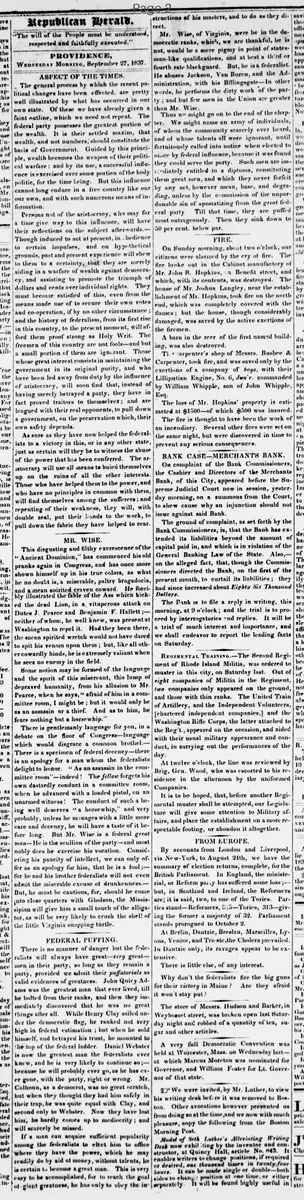
There is no manner of danger but the federalists will always have great—very great—men in their party, so long as they remain a party, provided we admit their puffatorials as valid evidences of greatness. John Quincy Adams was the greatest man that ever lived, till he bolted from their ranks, and then they immediately discovered that he was no great things after all. While Henry Clay sailed under the democratic flag, he ranked not very high in federal estimation; but when he sold himself, and betrayed his trust, he mounted to the top of the federal ladder. Daniel Webster is now the greatest man the federalists ever knew, and he is very likely to continue so;—because he will probably ever go, as he has ever gone, with the party, right or wrong. Mr. Calhoun, as a democrat, was no great scratch, but when they thought they had him safely in their trap, he was quite equal with Clay, and second only to Webster. Now they have lost him, he hardly comes up to mediocrity; and will scarcely be missed.
If a man can acquire sufficient popularity among the federalists to elect him to office where they have the power, which he may readily do by aid of money, without talents, he is certain to become a great man. This is very easy to be accomplished, for to reach the goal of giant greatness, he has only to obey the instructions of his masters, and to do as they direct.
Mr. Wise, of Virginia, were he in the democratic ranks, which, we are thankful, he is not, would be a mere pigmy in point of statesman-like qualifications, and at best a third or fourth rate blackguard. But, he is a federalist. He abuses Jackson, Van Buren, and the Administration, with his Billingsgate—In other words, he performs the dirty work of the party; and but few men in the Union are greater than Mr. Wise.
Thus we might go on to the end of the chapter. We might name an army of individuals, of whom the community scarcely ever heard, and of whose talents all were ignorant, until fortuitously called into notice when elected to office by federal influence, because it was found they could serve the party. Such men are immediately entitled to a diploma, constituting them great men, and which they never forfeit by any act, however mean, base, and degrading, unless by the commission of the unpardonable sin of apostatizing from the great federal party. Till that time, they are puffed most outrageously. Then they sink down to 50 per cent. below par.
There is no manner of danger but the federalists will always have great—very great—men in their party, so long as they remain a party, provided we admit their puffatorials as valid evidences of greatness. John Quincy Adams was the greatest man that ever lived, till he bolted from their ranks, and then they immediately discovered that he was no great things after all. While Henry Clay sailed under the democratic flag, he ranked not very high in federal estimation; but when he sold himself, and betrayed his trust, he mounted to the top of the federal ladder. Daniel Webster is now the greatest man the federalists ever knew, and he is very likely to continue so;—because he will probably ever go, as he has ever gone, with the party, right or wrong. Mr. Calhoun, as a democrat, was no great scratch, but when they thought they had him safely in their trap, he was quite equal with Clay, and second only to Webster. Now they have lost him, he hardly comes up to mediocrity; and will scarcely be missed.
If a man can acquire sufficient popularity among the federalists to elect him to office where they have the power, which he may readily do by aid of money, without talents, he is certain to become a great man. This is very easy to be accomplished, for to reach the goal of giant greatness, he has only to obey the instructions of his masters, and to do as they direct.
Mr. Wise, of Virginia, were he in the democratic ranks, which, we are thankful, he is not, would be a mere pigmy in point of statesman-like qualifications, and at best a third or fourth rate blackguard. But, he is a federalist. He abuses Jackson, Van Buren, and the Administration, with his Billingsgate—In other words, he performs the dirty work of the party; and but few men in the Union are greater than Mr. Wise.
Thus we might go on to the end of the chapter. We might name an army of individuals, of whom the community scarcely ever heard, and of whose talents all were ignorant, until fortuitously called into notice when elected to office by federal influence, because it was found they could serve the party. Such men are immediately entitled to a diploma, constituting them great men, and which they never forfeit by any act, however mean, base, and degrading, unless by the commission of the unpardonable sin of apostatizing from the great federal party. Till that time, they are puffed most outrageously. Then they sink down to 50 per cent. below par.
What sub-type of article is it?
Partisan Politics
Satire
What keywords are associated?
Federalists
Puffing
Greatness
Party Loyalty
Mediocre Politicians
Satire
Apostasy
What entities or persons were involved?
John Quincy Adams
Henry Clay
Daniel Webster
Mr. Calhoun
Mr. Wise Of Virginia
Jackson
Van Buren
The Administration
Editorial Details
Primary Topic
Federalist Puffing Of Mediocre Loyalists
Stance / Tone
Satirical Mockery Of Federalists
Key Figures
John Quincy Adams
Henry Clay
Daniel Webster
Mr. Calhoun
Mr. Wise Of Virginia
Jackson
Van Buren
The Administration
Key Arguments
Federalists Inflate Greatness Of Party Loyalists Regardless Of Talent
Defectors Like Adams And Calhoun Are Demoted To Mediocrity
Loyalty And Obedience, Aided By Money, Elevate Politicians To Greatness
Abusive Figures Like Wise Are Praised For Serving Party Dirty Work
Puffery Continues Until Apostasy, Then Value Drops Sharply