Thank you for visiting SNEWPapers!
Sign up free
The Glacier Reporter
Browning, Glacier County, Montana
What is this article about?
The Blackfeet Tribe in Montana enacted urban renewal legislation in 1959 to combat slum conditions on their reservation, particularly Moccasin Flats in Browning, ahead of state efforts. The law, signed by Governor Aronson in March, applies only to city limits, disappointing the tribe, but other communities like Butte are following.
Merged-components note: Continuation of the Blackfeet Tribe slum improvement story across adjacent blocks.
Clipping
OCR Quality
Full Text
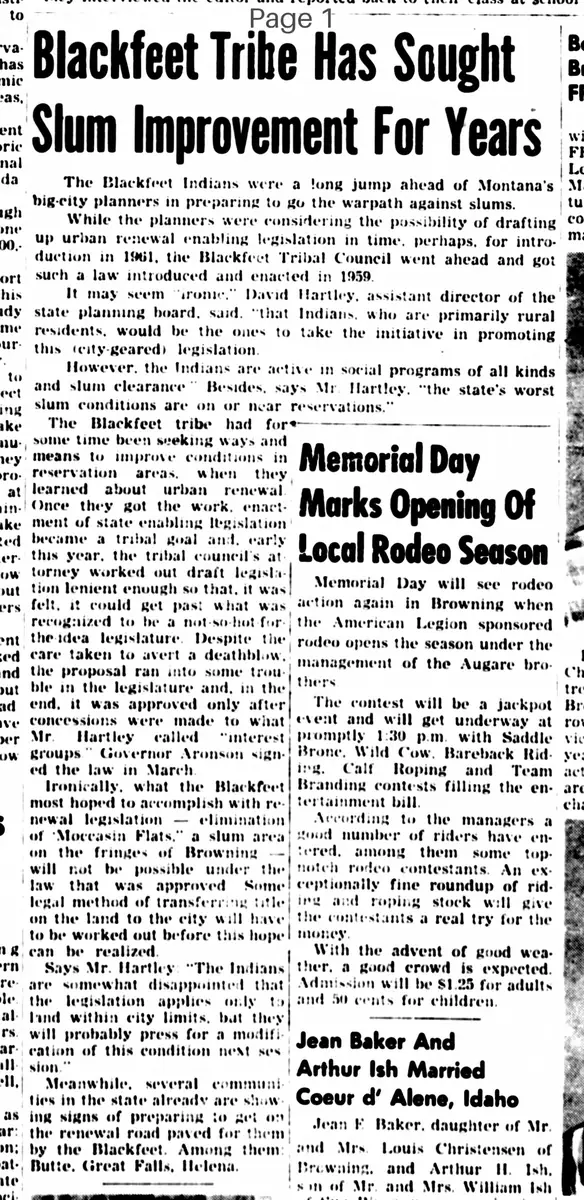
The Blackfeet Indians were a long jump ahead of Montana's big-city planners in preparing to go the warpath against slums.
While the planners were considering the possibility of drafting up urban renewal enabling legislation in time, perhaps, for introduction in 1961, the Blackfeet Tribal Council went ahead and got such a law introduced and enacted in 1959.
It may seem ironic, David Hartley, assistant director of the state planning board, said, "that Indians, who are primarily rural residents, would be the ones to take the initiative in promoting this (city-geared) legislation."
However, the Indians are active in social programs of all kinds and slum clearance. Besides, says Mr. Hartley, "the state's worst slum conditions are on or near reservations."
The Blackfeet tribe had for some time been seeking ways and means to improve conditions in reservation areas, when they learned about urban renewal.
Once they got the word, enactment of state enabling legislation became a tribal goal and, this year, the tribal council's attorney worked out draft legislation lenient enough so that, it was felt, it could get past what was recognized to be a not-so-hot-for-the-idea legislature. Despite the care taken to avert a deathblow, the proposal ran into some trouble in the Legislature and, in the end, it was approved only after concessions were made to what Mr. Hartley called "interest groups." Governor Aronson signed the law in March.
Ironically, what the Blackfeet most hoped to accomplish with renewal legislation - elimination of "Moccasin Flats," a slum area on the fringes of Browning -- will not be possible under the law that was approved. Some legal method of transferring title on the land to the city will have to be worked out before this hope can be realized.
Says Mr. Hartley, "The Indians are somewhat disappointed that the legislation applies only to land within city limits, but they will probably press for a modification of this condition next session."
Meanwhile, several communities in the state already are showing signs of preparing to get on the renewal road paved for them by the Blackfeet. Among them: Butte, Great Falls, Helena.
What sub-type of article is it?
What keywords are associated?
What entities or persons were involved?
Where did it happen?
Domestic News Details
Primary Location
Blackfeet Reservation, Montana
Event Date
1959
Key Persons
Outcome
legislation enacted but limited to city limits; cannot yet eliminate moccasin flats without title transfer; tribe disappointed but plans to seek modification.
Event Details
The Blackfeet Tribal Council introduced and enacted urban renewal enabling legislation in 1959 to improve slum conditions on the reservation, particularly Moccasin Flats near Browning. Drafted to pass a reluctant legislature, it faced concessions to interest groups before Governor Aronson signed it in March. The tribe, active in social programs, initiated this ahead of state planners, though the law's city-limit restriction hinders their goals.