Thank you for visiting SNEWPapers!
Sign up free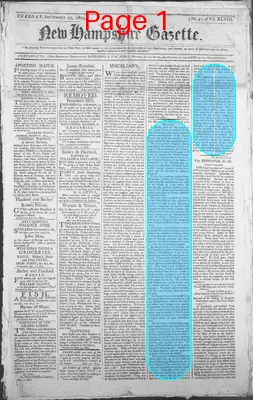
Editorial
September 27, 1803
The New Hampshire Gazette
Portsmouth, Rockingham County, New Hampshire
What is this article about?
This editorial praises the Republican administration under Thomas Jefferson for religious liberty, progress against slavery, peace policies, economic prosperity via Louisiana Purchase and exports, immigration, and banking growth, contrasting with Federalist approaches.
Clipping
OCR Quality
95%
Excellent
Full Text
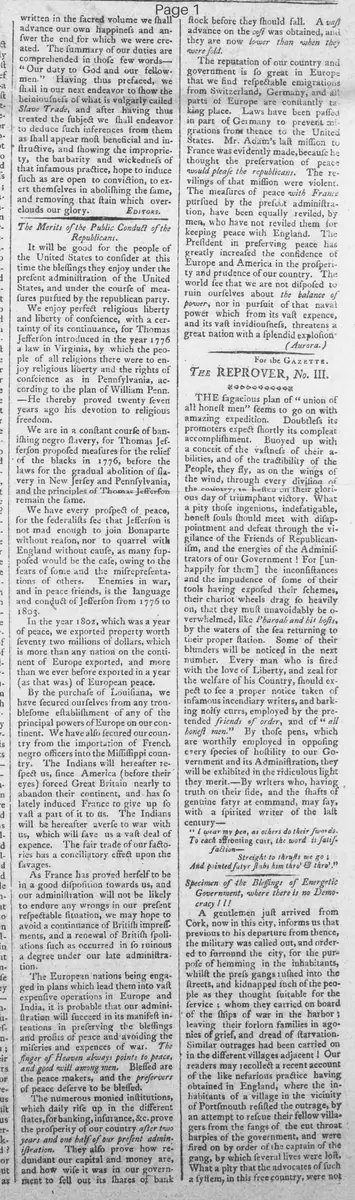
The Merits of the Public Conduct of the Republicans.
It will be good for the people of the United States to consider at this time the blessings they enjoy under the present administration of the United States, and under the course of measures pursued by the republican party.
We enjoy perfect religious liberty and liberty of conscience, with a certainty of its continuance, for Thomas Jefferson introduced in the year 1776 a law in Virginia, by which the people of all religions there were to enjoy religious liberty and the rights of conscience as in Pennsylvania, according to the plan of William Penn.—He thereby proved twenty seven years ago his devotion to religious freedom.
We are in a constant course of banishing negro slavery, for Thomas Jefferson proposed measures for the relief of the blacks in 1776, before the laws for the gradual abolition of slavery in New Jersey and Pennsylvania, and the principles of Thomas Jefferson remain the same.
We have every prospect of peace, for the federalists see that Jefferson is not mad enough to join Bonaparte without reason, nor to quarrel with England without cause, as many supposed would be the case, owing to the fears of some and the misrepresentations of others. Enemies in war, and in peace friends, is the language and conduct of Jefferson from 1776 to 1803.
In the year 1802, which was a year of peace, we exported property worth seventy two millions of dollars, which is more than any nation on the continent of Europe exported, and more than we ever before exported in a year (as that was) of European peace.
By the purchase of Louisiana, we have secured ourselves from any troublesome establishment of any of the principal powers of Europe on our continent. We have also secured our country from the importation of French negro officers into the Mississippi country. The Indians will hereafter respect us, since America (before their eyes) forced Great Britain nearly to abandon their continent, and has so lately induced France to give up so vast a part of it to us. The Indians will be hereafter averse to war with us, which will save us a vast deal of expense. The fair trade of our factories has a conciliatory effect upon the savages.
As France has proved herself to be in a good disposition towards us, and our administration will not be likely to endure any wrongs in our present respectable situation, we may hope to avoid a continuance of British impressments, and a renewal of British depredations such as occurred in so ruinous a degree under our late administration.
The European nations being engaged in plans which lead them into vast expensive operations in Europe and India, it is probable that our administration will succeed in its manifest intentions in preserving the blessings and profits of peace and avoiding the miseries and expenses of war. The finger of Heaven always points to peace, and good will among men. Blessed are the peace makers, and the preservers of peace deserve to be blessed.
The numerous monied institutions, which daily rise up in the different states, for banking, insurance, &c. prove the prosperity of our country after two years and one half of our present administration. They also prove how redundant our capital and money are, and how wise it was in our government to sell out its shares of bank stock before they should fall. A vast advance on the cost was obtained, and they are now lower than when they were sold.
The reputation of our country and government is so great in Europe that we find respectable emigrations from Switzerland, Germany, and all parts of Europe are constantly taking place. Laws have been passed in part of Germany to prevent emigrations from thence to the United States. Mr. Adams's last mission to France was evidently made, because he thought the preservation of peace would please the republicans. The revilings of that mission were violent. The measures of peace with France pursued by the present administration, have been equally reviled, by men, who have not reviled them for keeping peace with England. The President in preserving peace has greatly increased the confidence of Europe and America in the prosperity and prudence of our country. The world see that we are not disposed to ruin ourselves about the balance of power, nor in pursuit of that naval power which from its vast expense, and its vast invidiousness, threatens a great nation with a splendid explosion (Aurora.)
It will be good for the people of the United States to consider at this time the blessings they enjoy under the present administration of the United States, and under the course of measures pursued by the republican party.
We enjoy perfect religious liberty and liberty of conscience, with a certainty of its continuance, for Thomas Jefferson introduced in the year 1776 a law in Virginia, by which the people of all religions there were to enjoy religious liberty and the rights of conscience as in Pennsylvania, according to the plan of William Penn.—He thereby proved twenty seven years ago his devotion to religious freedom.
We are in a constant course of banishing negro slavery, for Thomas Jefferson proposed measures for the relief of the blacks in 1776, before the laws for the gradual abolition of slavery in New Jersey and Pennsylvania, and the principles of Thomas Jefferson remain the same.
We have every prospect of peace, for the federalists see that Jefferson is not mad enough to join Bonaparte without reason, nor to quarrel with England without cause, as many supposed would be the case, owing to the fears of some and the misrepresentations of others. Enemies in war, and in peace friends, is the language and conduct of Jefferson from 1776 to 1803.
In the year 1802, which was a year of peace, we exported property worth seventy two millions of dollars, which is more than any nation on the continent of Europe exported, and more than we ever before exported in a year (as that was) of European peace.
By the purchase of Louisiana, we have secured ourselves from any troublesome establishment of any of the principal powers of Europe on our continent. We have also secured our country from the importation of French negro officers into the Mississippi country. The Indians will hereafter respect us, since America (before their eyes) forced Great Britain nearly to abandon their continent, and has so lately induced France to give up so vast a part of it to us. The Indians will be hereafter averse to war with us, which will save us a vast deal of expense. The fair trade of our factories has a conciliatory effect upon the savages.
As France has proved herself to be in a good disposition towards us, and our administration will not be likely to endure any wrongs in our present respectable situation, we may hope to avoid a continuance of British impressments, and a renewal of British depredations such as occurred in so ruinous a degree under our late administration.
The European nations being engaged in plans which lead them into vast expensive operations in Europe and India, it is probable that our administration will succeed in its manifest intentions in preserving the blessings and profits of peace and avoiding the miseries and expenses of war. The finger of Heaven always points to peace, and good will among men. Blessed are the peace makers, and the preservers of peace deserve to be blessed.
The numerous monied institutions, which daily rise up in the different states, for banking, insurance, &c. prove the prosperity of our country after two years and one half of our present administration. They also prove how redundant our capital and money are, and how wise it was in our government to sell out its shares of bank stock before they should fall. A vast advance on the cost was obtained, and they are now lower than when they were sold.
The reputation of our country and government is so great in Europe that we find respectable emigrations from Switzerland, Germany, and all parts of Europe are constantly taking place. Laws have been passed in part of Germany to prevent emigrations from thence to the United States. Mr. Adams's last mission to France was evidently made, because he thought the preservation of peace would please the republicans. The revilings of that mission were violent. The measures of peace with France pursued by the present administration, have been equally reviled, by men, who have not reviled them for keeping peace with England. The President in preserving peace has greatly increased the confidence of Europe and America in the prosperity and prudence of our country. The world see that we are not disposed to ruin ourselves about the balance of power, nor in pursuit of that naval power which from its vast expense, and its vast invidiousness, threatens a great nation with a splendid explosion (Aurora.)
What sub-type of article is it?
Partisan Politics
Foreign Affairs
Economic Policy
What keywords are associated?
Republican Administration
Thomas Jefferson
Religious Liberty
Negro Slavery
Louisiana Purchase
Peace Policy
Economic Prosperity
European Emigration
What entities or persons were involved?
Thomas Jefferson
Republican Party
Federalists
Bonaparte
England
France
William Penn
Mr. Adams
Editorial Details
Primary Topic
Merits Of The Republican Administration Under Jefferson
Stance / Tone
Strongly Pro Republican And Pro Jefferson
Key Figures
Thomas Jefferson
Republican Party
Federalists
Bonaparte
England
France
William Penn
Mr. Adams
Key Arguments
Perfect Religious Liberty Ensured By Jefferson's 1776 Virginia Law
Progress Toward Banishing Negro Slavery Via Jefferson's 1776 Proposals
Prospect Of Peace As Jefferson Avoids Unnecessary Wars With France Or England
Record Exports Of $72 Million In 1802 Under Peace
Louisiana Purchase Secures Continent From European Powers And Aids Indian Relations
Avoidance Of British Impressments And Depredations
Prosperity Shown By Rising Monied Institutions And Wise Bank Stock Sale
Increased European Emigration Due To U.S. Reputation
Peace Policies Enhance Global Confidence In U.S. Prudence