Thank you for visiting SNEWPapers!
Sign up free
Story
August 30, 1879
West Virginia Argus
Kingwood, Preston County, West Virginia
What is this article about?
In a tale of young love, lawyer Frank Howard sends Maud Evans a bouquet of violets and a love letter via a boy, but the note is lost in a mishap. Misunderstanding ensues at a party, leading to heartbreak, until a friend returns the letter, reuniting the lovers happily.
Clipping
OCR Quality
98%
Excellent
Full Text
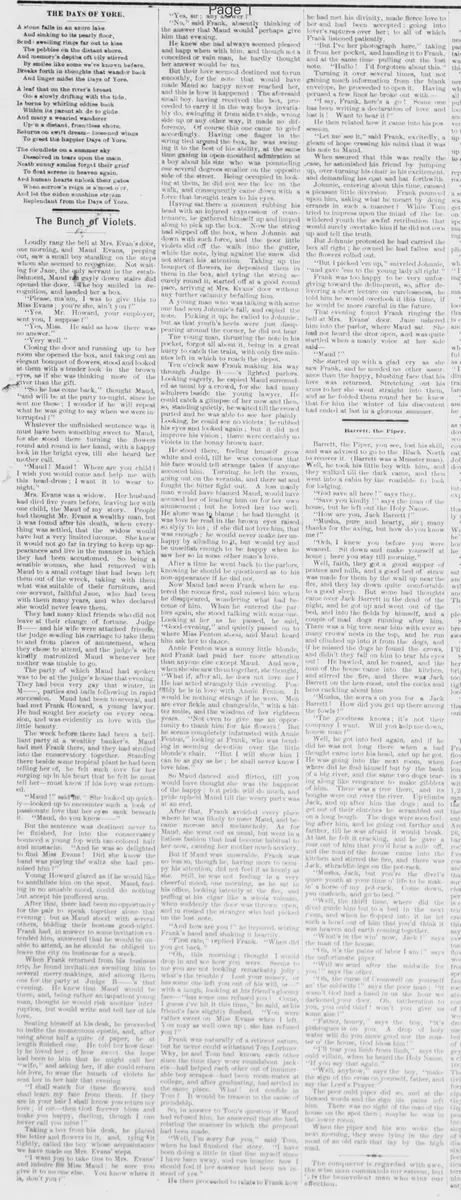
The Bunch of Violets.
Loudly rang the bell at Mrs. Evans' door one morning, and Maud Evans, peeping out, saw a small boy standing on the steps whom she seemed to recognize. Not waiting for Jane, the only servant in the establishment, Maud ran gayly down stairs and opened the door. The boy smiled in recognition, and handed her a box.
"Please, ma'am, I was to give this to Miss Evans: you're she, ain't you?"
"Yes. Mr. Howard, your employer, sent you, I suppose?"
"Yes, Miss. He said as how there was no answer."
"Very well."
Closing the door and running up to her room she opened the box, and taking out an elegant bouquet of flowers, stood and looked at them with a tender look in the brown eyes, as if she was thinking more of the giver than the gift.
"So he has come back," thought Maud, "and will be at the party to-night, since he sent me these. I wonder if he will repeat what he was going to say when we were interrupted?"
Whatever the unfinished sentence was, it must have been something sweet to Maud, for she stood there turning the flowers round and round in her hand, with a happy look in the bright eyes, till she heard her mother call.
"Maud! Maud! Where are you child? I wish you would come and help me with this head-dress; I want it to wear to night."
Mrs. Evans was a widow. Her husband had died five years before, leaving her with one child, the Maud of my story. People had thought Mr. Evans a wealthy man, but it was found after his death, when everything was settled, that the widow would have but a very limited income. She knew it would not go far in trying to keep up appearances and live in the manner in which they had been accustomed. So being a sensible woman, she had removed with Maud to a small cottage that had been left them out of the wreck, taking with them what was suitable of their furniture, and one servant, faithful Jane, who had been with them many years, and who declared she would never leave them.
They had many kind friends who did not leave at their change of fortune. Judge Band his wife were attached friends, the judge sending his carriage to take them to and from places of amusement, when they chose to attend, and the judge's wife kindly matronized Maud whenever her mother was unable to go.
The party of which Maud had spoken was to be at the judge's house that evening. They had been very gay that winter, in M-, parties and balls following in rapid succession. Maud had been to several, and had met Frank Howard, a young lawyer. He had sought her society on every occasion, and was evidently in love with the little beauty.
The week before there had been a brilliant party at a wealthy banker's. Maud had met Frank there, and they had strolled into the conservatory together. Standing there beside some tropical plant he had been telling her of, he felt such love for her surging up in his heart that he felt he must tell her—must know if his love was returned.
"Maud!" said he. She looked up quickly—looked up to encounter such a look of passionate love that her eyes sank beneath it. "Maud, do you know"
But the sentence was destined never to be finished, for into the conservatory bounced a young fop with tan-colored hair and mustache. "And he was so delighted to find Miss Evans! Did she know the band was playing the waltz she had promised him?"
Young Howard glared as if he would like to annihilate him on the spot. Maud, feeling in no amiable mood, could do nothing but accept his proffered arm.
After that, there had been no opportunity for the pair to speak together alone that evening; but as Maud stood with several others, bidding their hostess good-night, Frank had, in answer to some invitation extended him, answered that he would be unable to attend, as he should be obliged to leave the city on business for a week.
When Frank returned from his business trip, he found invitations awaiting him to several merry-makings, and among them one for the party at Judge B-'s that evening. He knew that Maud would be there, and, being rather an impatient young man, thought he would risk another interruption, but would write and tell her of his love.
Seating himself at his desk, he proceeded to indite the momentous epistle, and, after using about half a quire of paper, he at length finished one. He told her how dearly he loved her, of how sweet the hope had been to him that he might call her "wife," and asking her, if she could return his love, to wear the bunch of violets he sent her in her hair that evening.
"I shall watch for these flowers, and shall learn my fate from them. If they are in your hair I shall know you return my love; if not—then God forever bless and make you happy, darling, though I can never call you mine!"
Taking a box from his desk, he placed the letter and flowers in it, and, tying it tightly, called the boy whose acquaintance we have made on Mrs. Evans' steps.
"I want you to take this to Mrs. Evans and inquire for Miss Maud; be sure you give it to no one else. You know where it is, don't you?"
"No," said Frank, absently thinking of the answer that Maud would perhaps give him that evening.
He knew she had always seemed pleased and happy when with him, and though not a conceited or vain man, he hardly thought her answer would be no.
But their love seemed destined not to run smoothly, for the note that would have made Maud so happy never reached her, and this is how it happened: The aforesaid small boy, having received the box, proceeded to carry it in the way boys invariably do, swinging it from side to side, wrong side up or any other way, it made no difference. Of course this one came to grief accordingly. Having one finger in the string tied around the box, he was swinging it to the best of his ability, at the same time gazing in open-mouthed admiration at a boy about his size who was pommeling one several degrees smaller on the opposite side of the street. Being occupied in looking at them, he did not see the ice on the walk, and consequently came down with a force that brought tears to his eyes.
Having sat there a moment rubbing his head with an injured expression of countenance, he gathered himself up and limped along to pick up the box. Now the string had slipped off the box, when Johnnie sat down with such force, and the poor little violets slid off the walk into the gutter, while the note, lying against the snow did not attract his attention. Taking up the bouquet of flowers, he deposited them in the box, and tying the string securely round it, started off at a good round pace, arriving at Mrs. Evans' door without any further calamity befalling him.
A young man who was talking with some one had seen Johnnie's fall, and espied the note. Picking it up, he called to Johnnie, but as that youth's heels were just disappearing around the corner, he did not hear.
The young man, thrusting the note in his pocket, forgot all about it, being in a great hurry to catch the train, with only five minutes left in which to reach the depot.
Ten o'clock saw Frank making his way through Judge B-'s lighted parlors. Looking eagerly, he espied Maud surrounded as usual by a crowd, for she had many admirers beside the young lawyer. He could catch a glimpse of her now and then, so, standing quietly, he waited till the crowd parted and he was able to see her plainly.
Looking, he could see no violets; he rubbed his eyes and looked again; but it did not improve his vision, there were certainly no violets in the bonny brown hair.
He stood there, feeling himself grow white and cold, till he was conscious that his face would tell strange tales if anyone accosted him. Turning, he left the room, going out on the veranda, and there sat and fought the bitter fight out. A less manly man would have blamed Maud, would have accused her of leading him on for her own amusement; but he loved her too well.
He alone was to blame: he had thought it was love he read in the brown eyes raised so slyly to his, if she did not love him, that was enough: he would never make her unhappy by alluding to it, but would try and be unselfish enough to be happy when he saw her so in some other man's love.
After a time he went back to the parlors, knowing he should be questioned as to his non-appearance if he did not.
Now Maud had seen Frank when he entered the rooms first, and missed him when he disappeared, wondering what had become of him. When he entered the parlors again, she stood talking with some one. Looking at her as he passed, he said, "Good-evening," and quietly passed on to where Miss Fenton stood, and Maud heard him ask her to dance.
Annie Fenton was a sunny little blonde, and Frank had paid her more attention than anyone else except Maud. And now, when she saw them together, she thought, "What if, after all, he does not love me? He has acted strangely this evening. Possibly he is in love with Annie Fenton. It would be nothing strange if he were. Men are ever fickle and changeable," with a bitter smile, and the wisdom of her eighteen years. "Not even to give me an opportunity to thank him for his flowers! But he seems completely infatuated with Annie Fenton," looking at Frank, who was bending in seeming devotion over the little blonde's chair. "But I will show him I can be as gay as he: he shall never know I love him."
So Maud danced and flirted, till you would have thought she was the happiest of the happy; but pride will do much, and pride upheld Maud till the weary party was at an end.
After that, Frank avoided every place where he was likely to meet Maud, and became morose and melancholy. As for Maud, she went out as usual, but went in a listless fashion that had become habitual to her now, causing her mother much anxiety.
But if Maud was miserable, Frank was no less so, though he, having more to occupy his attention, did not feel it as keenly as she. Still, he was not feeling in a very cheerful mood, one morning, as he sat in his office, looking intently at the fire, and puffing at his cigar like a whole volcano, when suddenly the door was thrown open, and in rushed the stranger who had picked up the lost note.
"And how are you?" he inquired, seizing Frank's hand and shaking it heartily.
"First rate," replied Frank. "When did you get back?"
"Oh, this morning; thought I would drop in and see how you were. Seems to me you are not looking remarkably jolly—what's the trouble? Lost your money, or has some one left you out of his will, or"—with a laugh, looking at his friend's gloomy face—"has some one refused you? Come, I guess I've hit it this time," he said, as his friend's face slightly flushed. "You were rather sweet on Miss Evans when I left. You may as well own up: she has refused you!"
Frank was naturally of a reticent nature, but he never could withstand Tom Lorimer. Why, he and Tom had known each other since the time they wore roundabout jackets—had helped each other out of innumerable boy scrapes—had been room-mates at college, and after graduating, had settled in the same place. What! not confide in Tom! It would be treason to the cause of friendship.
So, in answer to Tom's question if Maud had refused him, he answered that she had, relating the manner in which the proposal had been made.
"Well, I'm sorry for you," said Tom, when he had finished the story. "I have been doing a little in that line myself since I have been away, and can imagine how I should feel if her answer had been no instead of yea."
He then proceeded to relate to Frank how he had met his divinity, made fierce love to her and had been accepted: going into lover's raptures over her; to all of which Frank listened patiently.
"But I've her photograph here." taking it from his pocket, and handing it to Frank, and at the same time pulling out the lost note. "Hullo! I'd forgotten about this."
Turning it over several times, but not gaining much information from the blank envelope, he proceeded to open it. Having perused a few lines he broke out with,—
"I say, Frank, here's a go! Some one has been writing a declaration of love and lost it! Want to hear it?"
He then related how it came into his possession.
"Let me see it," said Frank, excitedly, a gleam of hope crossing his mind that it was his note to Maud.
When assured that this was really the case, he astonished his friend by jumping up, over-turning his chair in his excitement, and demanding his coat and hat forthwith.
Johnnie, entering about this time, caused a pleasant little diversion. Frank pounced upon him, asking what he meant by doing errands in such a manner! While Tom tried to impress upon the mind of the bewildered youth the awful retribution that would surely overtake him if he did not own up and tell the truth.
But Johnnie protested he had carried the box all right; he owned he had fallen and the flowers rolled out.
"But I picked 'em up," sniveled Johnnie, "and gave 'em to the young lady all right."
Frank was too happy to be very unforgiving toward the delinquent, so, after delivering a short lecture on carelessness, he told him he would overlook it this time, if he would be more careful in the future.
That evening found Frank ringing the bell at Mrs. Evans' door. Jane ushered him into the parlor, where Maud sat. She had not heard the door open, and was quite startled when a manly voice at her side said
"Maud!"
She started up with a glad cry as she saw Frank, and he needed no other assurance than the happy, blushing face that his love was returned. Stretching out his arms to her she went straight into them, and as he folded them round her he knew that for him the winter of his discontent had ended at last in a glorious summer.
Loudly rang the bell at Mrs. Evans' door one morning, and Maud Evans, peeping out, saw a small boy standing on the steps whom she seemed to recognize. Not waiting for Jane, the only servant in the establishment, Maud ran gayly down stairs and opened the door. The boy smiled in recognition, and handed her a box.
"Please, ma'am, I was to give this to Miss Evans: you're she, ain't you?"
"Yes. Mr. Howard, your employer, sent you, I suppose?"
"Yes, Miss. He said as how there was no answer."
"Very well."
Closing the door and running up to her room she opened the box, and taking out an elegant bouquet of flowers, stood and looked at them with a tender look in the brown eyes, as if she was thinking more of the giver than the gift.
"So he has come back," thought Maud, "and will be at the party to-night, since he sent me these. I wonder if he will repeat what he was going to say when we were interrupted?"
Whatever the unfinished sentence was, it must have been something sweet to Maud, for she stood there turning the flowers round and round in her hand, with a happy look in the bright eyes, till she heard her mother call.
"Maud! Maud! Where are you child? I wish you would come and help me with this head-dress; I want it to wear to night."
Mrs. Evans was a widow. Her husband had died five years before, leaving her with one child, the Maud of my story. People had thought Mr. Evans a wealthy man, but it was found after his death, when everything was settled, that the widow would have but a very limited income. She knew it would not go far in trying to keep up appearances and live in the manner in which they had been accustomed. So being a sensible woman, she had removed with Maud to a small cottage that had been left them out of the wreck, taking with them what was suitable of their furniture, and one servant, faithful Jane, who had been with them many years, and who declared she would never leave them.
They had many kind friends who did not leave at their change of fortune. Judge Band his wife were attached friends, the judge sending his carriage to take them to and from places of amusement, when they chose to attend, and the judge's wife kindly matronized Maud whenever her mother was unable to go.
The party of which Maud had spoken was to be at the judge's house that evening. They had been very gay that winter, in M-, parties and balls following in rapid succession. Maud had been to several, and had met Frank Howard, a young lawyer. He had sought her society on every occasion, and was evidently in love with the little beauty.
The week before there had been a brilliant party at a wealthy banker's. Maud had met Frank there, and they had strolled into the conservatory together. Standing there beside some tropical plant he had been telling her of, he felt such love for her surging up in his heart that he felt he must tell her—must know if his love was returned.
"Maud!" said he. She looked up quickly—looked up to encounter such a look of passionate love that her eyes sank beneath it. "Maud, do you know"
But the sentence was destined never to be finished, for into the conservatory bounced a young fop with tan-colored hair and mustache. "And he was so delighted to find Miss Evans! Did she know the band was playing the waltz she had promised him?"
Young Howard glared as if he would like to annihilate him on the spot. Maud, feeling in no amiable mood, could do nothing but accept his proffered arm.
After that, there had been no opportunity for the pair to speak together alone that evening; but as Maud stood with several others, bidding their hostess good-night, Frank had, in answer to some invitation extended him, answered that he would be unable to attend, as he should be obliged to leave the city on business for a week.
When Frank returned from his business trip, he found invitations awaiting him to several merry-makings, and among them one for the party at Judge B-'s that evening. He knew that Maud would be there, and, being rather an impatient young man, thought he would risk another interruption, but would write and tell her of his love.
Seating himself at his desk, he proceeded to indite the momentous epistle, and, after using about half a quire of paper, he at length finished one. He told her how dearly he loved her, of how sweet the hope had been to him that he might call her "wife," and asking her, if she could return his love, to wear the bunch of violets he sent her in her hair that evening.
"I shall watch for these flowers, and shall learn my fate from them. If they are in your hair I shall know you return my love; if not—then God forever bless and make you happy, darling, though I can never call you mine!"
Taking a box from his desk, he placed the letter and flowers in it, and, tying it tightly, called the boy whose acquaintance we have made on Mrs. Evans' steps.
"I want you to take this to Mrs. Evans and inquire for Miss Maud; be sure you give it to no one else. You know where it is, don't you?"
"No," said Frank, absently thinking of the answer that Maud would perhaps give him that evening.
He knew she had always seemed pleased and happy when with him, and though not a conceited or vain man, he hardly thought her answer would be no.
But their love seemed destined not to run smoothly, for the note that would have made Maud so happy never reached her, and this is how it happened: The aforesaid small boy, having received the box, proceeded to carry it in the way boys invariably do, swinging it from side to side, wrong side up or any other way, it made no difference. Of course this one came to grief accordingly. Having one finger in the string tied around the box, he was swinging it to the best of his ability, at the same time gazing in open-mouthed admiration at a boy about his size who was pommeling one several degrees smaller on the opposite side of the street. Being occupied in looking at them, he did not see the ice on the walk, and consequently came down with a force that brought tears to his eyes.
Having sat there a moment rubbing his head with an injured expression of countenance, he gathered himself up and limped along to pick up the box. Now the string had slipped off the box, when Johnnie sat down with such force, and the poor little violets slid off the walk into the gutter, while the note, lying against the snow did not attract his attention. Taking up the bouquet of flowers, he deposited them in the box, and tying the string securely round it, started off at a good round pace, arriving at Mrs. Evans' door without any further calamity befalling him.
A young man who was talking with some one had seen Johnnie's fall, and espied the note. Picking it up, he called to Johnnie, but as that youth's heels were just disappearing around the corner, he did not hear.
The young man, thrusting the note in his pocket, forgot all about it, being in a great hurry to catch the train, with only five minutes left in which to reach the depot.
Ten o'clock saw Frank making his way through Judge B-'s lighted parlors. Looking eagerly, he espied Maud surrounded as usual by a crowd, for she had many admirers beside the young lawyer. He could catch a glimpse of her now and then, so, standing quietly, he waited till the crowd parted and he was able to see her plainly.
Looking, he could see no violets; he rubbed his eyes and looked again; but it did not improve his vision, there were certainly no violets in the bonny brown hair.
He stood there, feeling himself grow white and cold, till he was conscious that his face would tell strange tales if anyone accosted him. Turning, he left the room, going out on the veranda, and there sat and fought the bitter fight out. A less manly man would have blamed Maud, would have accused her of leading him on for her own amusement; but he loved her too well.
He alone was to blame: he had thought it was love he read in the brown eyes raised so slyly to his, if she did not love him, that was enough: he would never make her unhappy by alluding to it, but would try and be unselfish enough to be happy when he saw her so in some other man's love.
After a time he went back to the parlors, knowing he should be questioned as to his non-appearance if he did not.
Now Maud had seen Frank when he entered the rooms first, and missed him when he disappeared, wondering what had become of him. When he entered the parlors again, she stood talking with some one. Looking at her as he passed, he said, "Good-evening," and quietly passed on to where Miss Fenton stood, and Maud heard him ask her to dance.
Annie Fenton was a sunny little blonde, and Frank had paid her more attention than anyone else except Maud. And now, when she saw them together, she thought, "What if, after all, he does not love me? He has acted strangely this evening. Possibly he is in love with Annie Fenton. It would be nothing strange if he were. Men are ever fickle and changeable," with a bitter smile, and the wisdom of her eighteen years. "Not even to give me an opportunity to thank him for his flowers! But he seems completely infatuated with Annie Fenton," looking at Frank, who was bending in seeming devotion over the little blonde's chair. "But I will show him I can be as gay as he: he shall never know I love him."
So Maud danced and flirted, till you would have thought she was the happiest of the happy; but pride will do much, and pride upheld Maud till the weary party was at an end.
After that, Frank avoided every place where he was likely to meet Maud, and became morose and melancholy. As for Maud, she went out as usual, but went in a listless fashion that had become habitual to her now, causing her mother much anxiety.
But if Maud was miserable, Frank was no less so, though he, having more to occupy his attention, did not feel it as keenly as she. Still, he was not feeling in a very cheerful mood, one morning, as he sat in his office, looking intently at the fire, and puffing at his cigar like a whole volcano, when suddenly the door was thrown open, and in rushed the stranger who had picked up the lost note.
"And how are you?" he inquired, seizing Frank's hand and shaking it heartily.
"First rate," replied Frank. "When did you get back?"
"Oh, this morning; thought I would drop in and see how you were. Seems to me you are not looking remarkably jolly—what's the trouble? Lost your money, or has some one left you out of his will, or"—with a laugh, looking at his friend's gloomy face—"has some one refused you? Come, I guess I've hit it this time," he said, as his friend's face slightly flushed. "You were rather sweet on Miss Evans when I left. You may as well own up: she has refused you!"
Frank was naturally of a reticent nature, but he never could withstand Tom Lorimer. Why, he and Tom had known each other since the time they wore roundabout jackets—had helped each other out of innumerable boy scrapes—had been room-mates at college, and after graduating, had settled in the same place. What! not confide in Tom! It would be treason to the cause of friendship.
So, in answer to Tom's question if Maud had refused him, he answered that she had, relating the manner in which the proposal had been made.
"Well, I'm sorry for you," said Tom, when he had finished the story. "I have been doing a little in that line myself since I have been away, and can imagine how I should feel if her answer had been no instead of yea."
He then proceeded to relate to Frank how he had met his divinity, made fierce love to her and had been accepted: going into lover's raptures over her; to all of which Frank listened patiently.
"But I've her photograph here." taking it from his pocket, and handing it to Frank, and at the same time pulling out the lost note. "Hullo! I'd forgotten about this."
Turning it over several times, but not gaining much information from the blank envelope, he proceeded to open it. Having perused a few lines he broke out with,—
"I say, Frank, here's a go! Some one has been writing a declaration of love and lost it! Want to hear it?"
He then related how it came into his possession.
"Let me see it," said Frank, excitedly, a gleam of hope crossing his mind that it was his note to Maud.
When assured that this was really the case, he astonished his friend by jumping up, over-turning his chair in his excitement, and demanding his coat and hat forthwith.
Johnnie, entering about this time, caused a pleasant little diversion. Frank pounced upon him, asking what he meant by doing errands in such a manner! While Tom tried to impress upon the mind of the bewildered youth the awful retribution that would surely overtake him if he did not own up and tell the truth.
But Johnnie protested he had carried the box all right; he owned he had fallen and the flowers rolled out.
"But I picked 'em up," sniveled Johnnie, "and gave 'em to the young lady all right."
Frank was too happy to be very unforgiving toward the delinquent, so, after delivering a short lecture on carelessness, he told him he would overlook it this time, if he would be more careful in the future.
That evening found Frank ringing the bell at Mrs. Evans' door. Jane ushered him into the parlor, where Maud sat. She had not heard the door open, and was quite startled when a manly voice at her side said
"Maud!"
She started up with a glad cry as she saw Frank, and he needed no other assurance than the happy, blushing face that his love was returned. Stretching out his arms to her she went straight into them, and as he folded them round her he knew that for him the winter of his discontent had ended at last in a glorious summer.
What sub-type of article is it?
Romance
What themes does it cover?
Love
Misfortune
Triumph
What keywords are associated?
Romance
Misunderstanding
Lost Letter
Violets
Proposal
Reunion
What entities or persons were involved?
Maud Evans
Frank Howard
Mrs. Evans
Judge B
Tom Lorimer
Johnnie
Where did it happen?
M
Story Details
Key Persons
Maud Evans
Frank Howard
Mrs. Evans
Judge B
Tom Lorimer
Johnnie
Location
M
Story Details
Young lawyer Frank Howard sends a love letter and violets to Maud Evans via a boy, but the note is lost when the boy falls. At a party, Frank misinterprets Maud's lack of violets as rejection, leading to mutual heartbreak. Friend Tom Lorimer returns the note, resolving the misunderstanding and uniting the lovers.