Thank you for visiting SNEWPapers!
Sign up free
Editorial
January 27, 1897
The Salt Lake Herald
Salt Lake City, Salt Lake County, Utah
What is this article about?
An editorial defending the novel against moral prejudices, referencing Professor James K. Hosmer's lecture in St. Louis. It argues novels can teach truths but are not ideal for moral lessons or young readers, criticizing those who seek to restrict reading choices.
Clipping
OCR Quality
98%
Excellent
Full Text
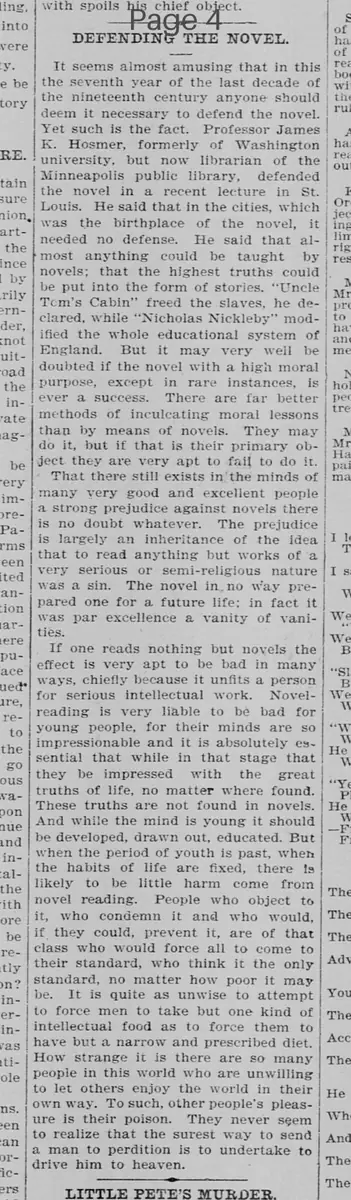
DEFENDING THE NOVEL.
It seems almost amusing that in this the seventh year of the last decade of the nineteenth century anyone should deem it necessary to defend the novel. Yet such is the fact. Professor James K. Hosmer, formerly of Washington university, but now librarian of the Minneapolis public library, defended the novel in a recent lecture in St. Louis. He said that in the cities, which was the birthplace of the novel, it needed no defense. He said that almost anything could be taught by novels: that the highest truths could be put into the form of stories. "Uncle Tom's Cabin" freed the slaves, he declared, while "Nicholas Nickleby" modified the whole educational system of England. But it may very well be doubted if the novel with a high moral purpose, except in rare instances, is ever a success. There are far better methods of inculcating moral lessons than by means of novels. They may do it, but if that is their primary object they are very apt to fail to do it.
That there still exists in the minds of many very good and excellent people a strong prejudice against novels there is no doubt whatever. The prejudice is largely an inheritance of the idea that to read anything but works of a very serious or semi-religious nature was a sin. The novel in no way prepared one for a future life: in fact it was par excellence a vanity of vanities. If one reads nothing but novels the effect is very apt to be bad in many ways, chiefly because it unfits a person for serious intellectual work. Novel-reading is very liable to be bad for young people, for their minds are so impressionable and it is absolutely essential that while in that stage that they be impressed with the great truths of life, no matter where found. These truths are not found in novels. And while the mind is young it should be developed, drawn out, educated. But when the period of youth is past, when the habits of life are fixed, there is likely to be little harm come from novel reading.
People who object to it, who condemn it and who would, if they could, prevent it, are of that class who would force all to come to their standard, who think it the only standard, no matter how poor it may be. It is quite as unwise to attempt to force men to take but one kind of intellectual food as to force them to have but a narrow and prescribed diet. How strange it is there are so many people in this world who are unwilling to let others enjoy the world in their own way. To such, other people's pleasure is their poison. They never seem to realize that the surest way to send a man to perdition is to undertake to drive him to heaven.
It seems almost amusing that in this the seventh year of the last decade of the nineteenth century anyone should deem it necessary to defend the novel. Yet such is the fact. Professor James K. Hosmer, formerly of Washington university, but now librarian of the Minneapolis public library, defended the novel in a recent lecture in St. Louis. He said that in the cities, which was the birthplace of the novel, it needed no defense. He said that almost anything could be taught by novels: that the highest truths could be put into the form of stories. "Uncle Tom's Cabin" freed the slaves, he declared, while "Nicholas Nickleby" modified the whole educational system of England. But it may very well be doubted if the novel with a high moral purpose, except in rare instances, is ever a success. There are far better methods of inculcating moral lessons than by means of novels. They may do it, but if that is their primary object they are very apt to fail to do it.
That there still exists in the minds of many very good and excellent people a strong prejudice against novels there is no doubt whatever. The prejudice is largely an inheritance of the idea that to read anything but works of a very serious or semi-religious nature was a sin. The novel in no way prepared one for a future life: in fact it was par excellence a vanity of vanities. If one reads nothing but novels the effect is very apt to be bad in many ways, chiefly because it unfits a person for serious intellectual work. Novel-reading is very liable to be bad for young people, for their minds are so impressionable and it is absolutely essential that while in that stage that they be impressed with the great truths of life, no matter where found. These truths are not found in novels. And while the mind is young it should be developed, drawn out, educated. But when the period of youth is past, when the habits of life are fixed, there is likely to be little harm come from novel reading.
People who object to it, who condemn it and who would, if they could, prevent it, are of that class who would force all to come to their standard, who think it the only standard, no matter how poor it may be. It is quite as unwise to attempt to force men to take but one kind of intellectual food as to force them to have but a narrow and prescribed diet. How strange it is there are so many people in this world who are unwilling to let others enjoy the world in their own way. To such, other people's pleasure is their poison. They never seem to realize that the surest way to send a man to perdition is to undertake to drive him to heaven.
What sub-type of article is it?
Moral Or Religious
Education
What keywords are associated?
Novel Defense
Reading Prejudice
Moral Lessons
Fiction Influence
Youth Education
Intellectual Freedom
What entities or persons were involved?
Professor James K. Hosmer
Uncle Tom's Cabin
Nicholas Nickleby
Editorial Details
Primary Topic
Defense Of The Novel Against Prejudice
Stance / Tone
Supportive Of Novels With Caveats, Critical Of Restrictive Moralists
Key Figures
Professor James K. Hosmer
Uncle Tom's Cabin
Nicholas Nickleby
Key Arguments
Novels Can Teach High Truths And Influence Society, As In Uncle Tom's Cabin And Nicholas Nickleby.
Novels With Explicit Moral Purposes Often Fail.
Prejudice Against Novels Stems From Religious Ideas Viewing Fiction As Sinful.
Excessive Novel Reading Harms Intellectual Development, Especially In Youth.
Adults Can Read Novels Harmlessly Once Habits Are Fixed.
Condemning Novels Reflects Intolerance And Unwise Restriction Of Intellectual Freedom.