Thank you for visiting SNEWPapers!
Sign up free
Literary
September 8, 1818
The Portland Gazette
Portland, Cumberland County, Maine
What is this article about?
Biographical account of Napoleon Bonaparte's life, highlighting his military genius in battles like Marengo and Austerlitz, rise from humble origins, uninterrupted successes until Waterloo in 1815, exile to Elba and St. Helena, and the peace Europe enjoys after his fall due to his fatal ambition.
Clipping
OCR Quality
95%
Excellent
Full Text
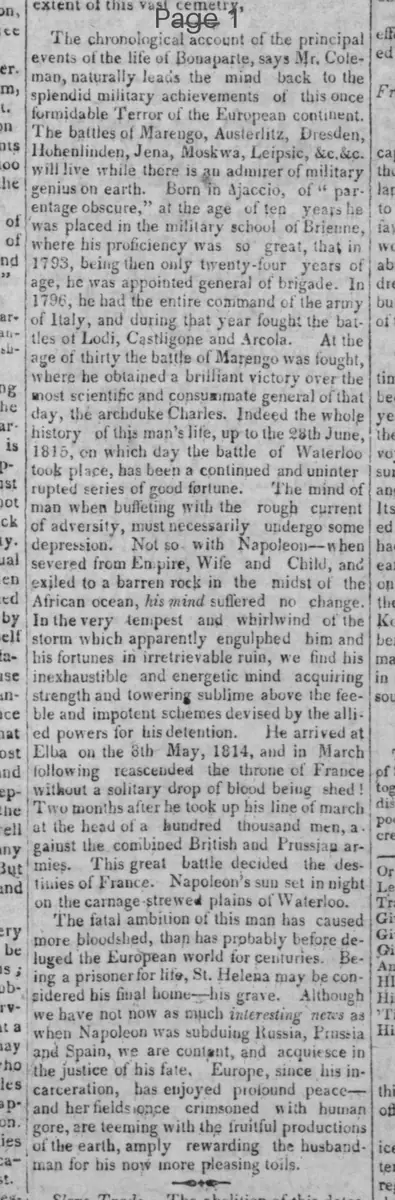
The chronological account of the principal events of the life of Bonaparte, says Mr. Coleman, naturally leads the mind back to the splendid military achievements of this once formidable Terror of the European continent. The battles of Marengo, Austerlitz, Dresden, Hohenlinden, Jena, Moskwa, Leipsic, &c. &c. will live while there is an admirer of military genius on earth. Born in Ajaccio, of "parentage obscure," at the age of ten years he was placed in the military school of Brienne, where his proficiency was so great, that in 1793, being then only twenty-four years of age, he was appointed general of brigade. In 1796, he had the entire command of the army of Italy, and during that year fought the battles of Lodi, Castiglione and Arcola. At the age of thirty the battle of Marengo was fought, where he obtained a brilliant victory over the most scientific and consummate general of that day, the archduke Charles. Indeed the whole history of this man's life, up to the 18th June, 1815, on which day the battle of Waterloo took place, has been a continued and uninterrupted series of good fortune. The mind of man when buffeting with the rough current of adversity, must necessarily undergo some depression. Not so. with Napoleon - when severed from Empire, Wife and Child, and exiled to a barren rock in the midst of the African ocean, his mind suffered no change. In the very tempest and whirlwind of the storm which apparently engulfed him and his fortunes in irretrievable ruin, we find his inexhaustible and energetic mind acquiring strength and towering sublime above the feeble and impotent schemes devised by the allied powers for his detention. He arrived at Elba on the 3d May, 1814, and in March following reascended the throne of France without a solitary drop of blood being shed! Two months after he took up his line of march at the head of a hundred thousand men, against the combined British and Prussian armies. This great battle decided the destinies of France. Napoleon's sun set in night on the carnage-strewed plains of Waterloo. The fatal ambition of this man has caused more bloodshed, than has probably before deluged the European world for centuries. Being a prisoner for life, St. Helena may be considered his final home - his grave. Although we have not now as much interesting news as when Napoleon was subduing Russia, Prussia and Spain, we are content, and acquiesce in the justice of his fate, Europe, since his incarceration, has enjoyed profound peace - and her fields once crimsoned with human gore, are teeming with the fruitful productions of the earth, amply rewarding the husbandman for his now more pleasing toils.
What sub-type of article is it?
Essay
What themes does it cover?
War Peace
Political
What keywords are associated?
Napoleon Bonaparte
Military Achievements
Waterloo Battle
Exile St Helena
European Peace
Literary Details
Subject
Life And Fate Of Napoleon Bonaparte
Form / Style
Biographical Prose Reflection
Key Lines
The Battles Of Marengo, Austerlitz, Dresden, Hohenlinden, Jena, Moskwa, Leipsic, &C. &C. Will Live While There Is An Admirer Of Military Genius On Earth.
Napoleon's Sun Set In Night On The Carnage Strewed Plains Of Waterloo.
The Fatal Ambition Of This Man Has Caused More Bloodshed, Than Has Probably Before Deluged The European World For Centuries.
Europe, Since His Incarceration, Has Enjoyed Profound Peace And Her Fields Once Crimsoned With Human Gore, Are Teeming With The Fruitful Productions Of The Earth