Thank you for visiting SNEWPapers!
Sign up free
American Watchman And Delaware Advertiser
Wilmington, New Castle County, Delaware
What is this article about?
Analysis of Spain's political crisis in 1820s: divisions between Clergy and Liberals, French influence under Ferdinand VII, potential insurrection, and British push for Portuguese representative government amid tensions.
Clipping
OCR Quality
Full Text
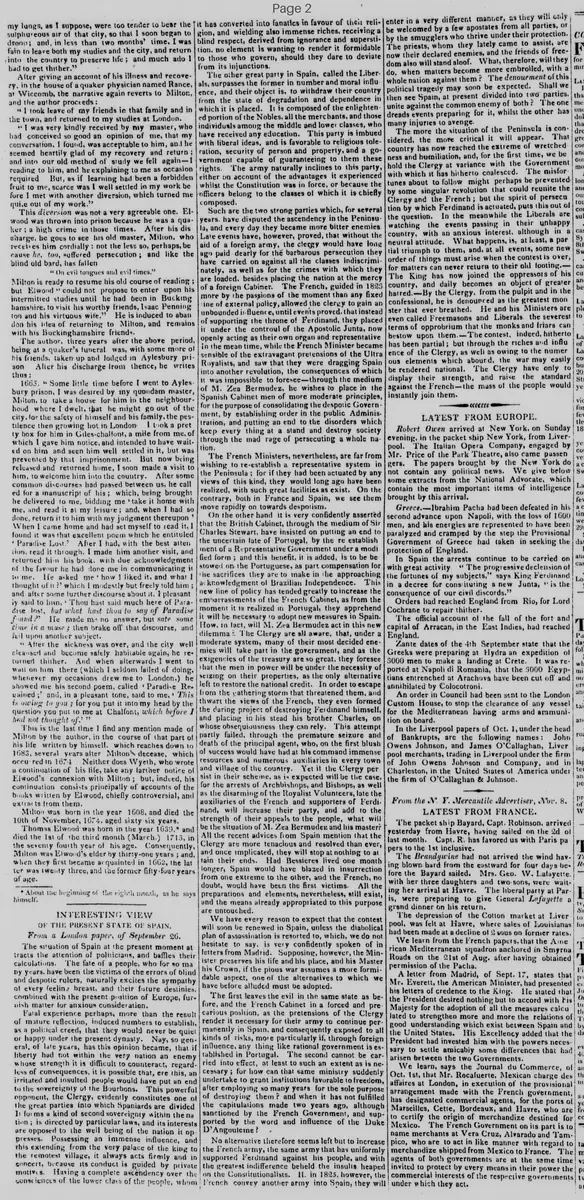
From a London paper, of September 26.
The situation of Spain at the present moment attracts the attention of politicians, and baffles their calculations. The fate of a people, who for so many years, have been the victims of the errors of blind and despotic rulers, naturally excites the sympathy of every feeling breast, and their future destinies, combined with the present position of Europe, furnish matter for anxious consideration.
Fatal experience perhaps, more than the result of mature reflection, induced numbers to establish, as a political creed, that they would never be quiet or happy under the present dynasty. Nay, so general, of late years, has this opinion become, that if liberty had not within the very nation an enemy whose strength it is difficult to counteract, regardless of consequences, it is possible that, ere this, an irritated and insulted people would have put an end to the sovereignty of the Bourbons. This powerful opponent, the Clergy, evidently constitutes one of the great parties into which Spaniards are divided. It forms a kind of second sovereignty within the nation; is directed by particular laws, and its interests are opposed to the well being of the nation it oppresses. Possessing an immense influence, and this extending from the very palace of the king to the remotest village, it always acts firmly and in concert, because its conduct is guided by private motives. Having a complete ascendency over the consciences of the lower classes of the people, whom it has converted into fanatics in favour of their religion, and wielding also immense riches, receiving a blind respect, derived from ignorance and superstition, no element is wanting to render it formidable to those who govern, should they dare to deviate from its injunctions.
The other great party in Spain, called the Liberals, surpasses the former in number and moral influence, and their object is, to withdraw their country from the state of degradation and dependence in which it is placed. It is composed of the enlightened portion of the Nobles, all the merchants, and those individuals among the middle and lower classes, who have received any education. This party is imbued with liberal ideas, and is favorable to religious toleration, security of person and property, and a government capable of guaranteeing to them these rights. The army naturally inclines to this party, either on account of the advantages it experienced whilst the Constitution was in force, or because the officers belong to the classes of which it is chiefly composed.
Such are the two strong parties which, for several years, have disputed the ascendency in the Peninsula, and every day they become more bitter enemies. Late events have, however, proved, that without the aid of a foreign army, the clergy would have long ago paid dearly for the barbarous persecution they have carried on against all the classes indiscriminately, as well as for the crimes with which they are loaded, besides placing the nation at the mercy of a foreign Cabinet. The French, guided in 1823 more by the passions of the moment than any fixed line of external policy, allowed the clergy to gain an unbounded influence, until events proved, that instead of supporting the throne of Ferdinand, they placed it under the controul of the Apostolic Junta, now openly acting as their own organ and representative. In the mean time, while the French Minister became sensible of the extravagant pretensions of the Ultra Royalists, and saw that they were dragging Spain into another revolution, the consequences of which it was impossible to foresee—through the medium of M. Zea Bermudez, he wishes to place in the Spanish Cabinet men of more moderate principles, for the purpose of consolidating the despotic Government, by establishing order in the public Administration, and putting an end to the disorders which keep every thing at a stand and destroy society through the mad rage of persecuting a whole nation.
The French Ministers, nevertheless, are far from wishing to re-establish a representative system in the Peninsula; for if they had been actuated by any views of this kind, they would long ago have been realized, with such great facilities as exist. On the contrary, both in France and Spain, we see them move rapidly on towards despotism.
On the other hand it is very confidently asserted that the British Cabinet, through the medium of Sir Charles Stewart, have insisted on putting an end to the uncertain state of Portugal, by the re-establishment of a Representative Government under a modified form: and this benefit, it is added, is to be bestowed on the Portuguese, as part compensation for the sacrifices they are to make in the approaching acknowledgment of Brazilian Independence. This new line of policy has tended greatly to increase the embarrassments of the French Cabinet, as from the moment it is realized in Portugal, they apprehend it will be necessary to adopt new measures in Spain. How, in fact, will M. Zea Bermudez act in this new dilemma? The Clergy are all aware, that, under a moderate system, many of their most decided enemies will take part in the government, and as the exigencies of the treasury are so great, they foresee that the men in power will be under the necessity of seizing on their properties, as the only alternative left to restore the national credit. In order to escape from the gathering storm that threatened them, and thwart the views of the French, they even formed the daring project of destroying Ferdinand himself, and placing in his stead his brother Charles, on whose obsequiousness they can rely. This attempt partly failed, through the premature seizure and death of the principal agent, who, on the first blush of success would have had at his command immense resources and numerous auxiliaries in every town and village of the country. Yet if the Clergy persist in their scheme, as is expected will be the case, for the arrests of Archbishops, and Bishops, as well as the disarming of the Royalist Volunteers, late the auxiliaries of the French and supporters of Ferdinand, will increase their party, and add to the strength of their appeals to the people, what will be the situation of M. Zea Bermudez and his masters? All the recent advices from Spain mention that the Clergy are more tenacious and resolved than ever, and once implicated, they will stop at nothing to attain their ends. Had Bessieres lived one month longer, Spain would have blazed in insurrection from one extreme to the other, and the French, no doubt, would have been the first victims. All the preparations and elements, nevertheless, still exist, and the means already appropriated to this purpose are untouched.
We have every reason to expect that the contest will soon be renewed in Spain, unless the diabolical plan of assassination is resorted to, which, we do not hesitate to say, is very confidently spoken of in letters from Madrid. Supposing, however, the Minister preserves his life and his place, and his Master his Crown, if the pious war assumes a more formidable aspect, one of the alternatives to which we have before alluded must be adopted.
The first leaves the evil in the same state as before, and the French Cabinet in a forced and precarious position, as the pretensions of the Clergy render it necessary for their army to continue permanently in Spain, and consequently exposed to all kinds of risks, more particularly if, through foreign influence, any thing like rational government is established in Portugal. The second cannot be carried into effect, at least to such an extent as is necessary; for how can that same ministry suddenly undertake to grant institutions favorable to freedom, after employing so many years for the sole purpose of destroying them? and when it has not fulfilled the capitulations made two years ago, although sanctioned by the French Government, and supported by the word and influence of the Duke D'Angouleme?
No alternative therefore seems left but to increase the French army, the same army that has uniformly supported Ferdinand against his people, and with the greatest indifference beheld the insults heaped on the Constitutionalists. It, in 1825, however, the French convey another army into Spain, they will enter in a very different manner, as they will only be welcomed by a few apostates from all parties, or by the smugglers who thrive under their protection. The priests, whom they lately came to assist, are now their declared enemies, and the friends of freedom also will stand aloof. What, therefore, will they do, when matters become more embroiled, with a whole nation against them? The denouement of this political tragedy may soon be expected. Shall we then see Spain, at present divided into two parties, unite against the common enemy of both? The one dreads events preparing for it, whilst the other has many injuries to avenge.
The more the situation of the Peninsula is considered, the more critical it will appear. That country has now reached the extreme of wretchedness and humiliation, and, for the first time, we behold the Clergy at variance with the Government with which it has hitherto coalesced. The misfortunes about to follow might perhaps be prevented by some singular revolution that could reunite the Clergy and the French; but the spirit of persecution by which Ferdinand is actuated, puts this out of the question. In the meanwhile the Liberals are watching the events passing in their unhappy country, with an anxious interest, although in a neutral attitude. What happens, is, at least, a partial triumph to them, and, at all events, some new order of things must arise when the contest is over, for matters can never return to their old footing. The King has now joined the oppressors of his country, and daily becomes an object of greater hatred. By the Clergy, from the pulpit and in the confessional, he is denounced as the greatest monster that ever breathed. He and his Ministers are even called Freemasons and Liberals, the severest terms of opprobrium that the monks and friars can bestow upon them. The contest, indeed, hitherto has been partial; but through the riches and influence of the Clergy, as well as owing to the numerous elements which abound, the war may easily be rendered national. The Clergy have only to display their strength, and raise the standard against the French—the mass of the people would instantly join them.
What sub-type of article is it?
What keywords are associated?
What entities or persons were involved?
Where did it happen?
Foreign News Details
Primary Location
Spain
Event Date
As Of September 26
Key Persons
Outcome
potential insurrection brewing; failed plot to assassinate ferdinand and install charles; arrests of clergy and disarming of royalist volunteers; ongoing tensions may lead to national war against french.
Event Details
Spain divided between Clergy (opposing liberal reforms, influential over masses) and Liberals (seeking toleration, security, and moderate government; supported by army and educated classes). French intervention in 1823 bolstered Clergy initially but now faces backlash; French seek moderate Spanish cabinet via Zea Bermudez to stabilize despotism. British push for representative government in Portugal embarrasses French. Clergy plots against Ferdinand failed partially; expect renewed contest or assassination. No viable alternatives but increased French military presence, risking broader revolt.