Thank you for visiting SNEWPapers!
Sign up free
The Enquirer
Richmond, Henrico County, Virginia
What is this article about?
In 'The Old Bachelor No. XIII,' the narrator reflects on his contented life in mediocrity, spared from avarice and ambition. He shares his mother's cautionary tale of cousin Henry Morton, a noble youth who, influenced by his father's fears of poverty, pursued wealth obsessively, becoming a miser and losing his virtue and happiness.
Merged-components note: Continuation of serialized literary piece 'The Old Bachelor' across pages.
Clippings
1 of 2
OCR Quality
Full Text
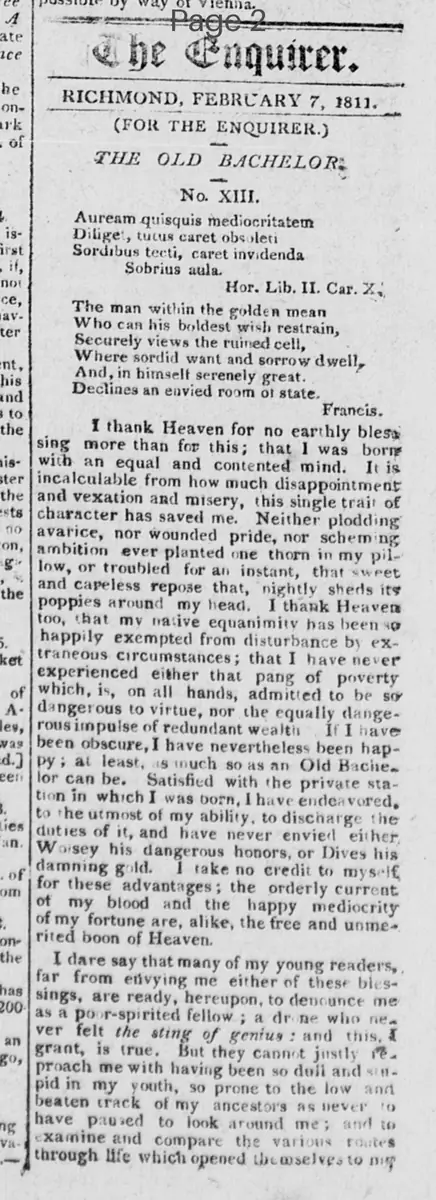
RICHMOND, FEBRUARY 7, 1811.
(FOR THE ENQUIRER.)
THE OLD BACHELOR
No. XIII.
Auream quisquis mediocritatem
Dilige, tutus caret obsolet
Sordibus tecti, caret invidenda
Sobrius aula.
Hor. Lib. II. Car. X.
The man within the golden mean
Who can his boldest wish restrain,
Securely views the ruined cell,
Where sordid want and sorrow dwell,
And, in himself serenely great,
Declines an envied room of state.
Francis.
I thank Heaven for no earthly blessing more than for this; that I was born with an equal and contented mind. It is incalculable from how much disappointment and vexation and misery, this single trait of character has saved me. Neither plodding avarice, nor wounded pride, nor scheming ambition ever planted one thorn in my pillow, or troubled for an instant, that sweet and careless repose that, nightly sheds its poppies around my head. I thank Heaven too, that my native equanimity has been so happily exempted from disturbance by extraneous circumstances: that I have never experienced either that pang of poverty which, is, on all hands, admitted to be so dangerous to virtue, nor the equally dangerous impulse of redundant wealth. If I have been obscure, I have nevertheless been happy; at least, as much so as an Old Bachelor can be. Satisfied with the private station in which I was born, I have endeavored, to the utmost of my ability, to discharge the duties of it, and have never envied either Wolsey his dangerous honors, or Dives his damning gold. I take no credit to myself for these advantages; the orderly current of my blood and the happy mediocrity of my fortune are, alike, the free and unmerited boon of Heaven.
I dare say that many of my young readers, far from envying me either of these blessings, are ready, hereupon, to denounce me as a poor-spirited fellow; a drone who never felt the sting of genius: and this, grant, is true. But they cannot justly reproach me with having been so dull and stupid in my youth, so prone to the low and beaten track of my ancestors as never to have paused to look around me; and to examine and compare the various routes through life which opened themselves to my
Viewed and counted my choice. Nor can they say that I was so purblind, as not to see the temples of wealth and glory seated on alpine heights, which seemed to bound and overlook those bright careers, and beckon the young adventurer on. I saw them all: and at a time of life, too, when neither intervening glaciers nor overhanging steeps, however arduous or perilous, would have deterred me from the enterprize. I saw them in my youth, when I was borne along by an enthusiasm of character before which the Alps and Pyreneans would have sunk into a plain, in any cause congenial with my soul. But that enthusiasm was never touched by the prospect either of wealth or of political honors; and had it not been to please one among the best and most beloved of mothers, I am very certain that, unless from literary curiosity, I should never have perused a page either of Bracton or Hippocrates.
As to wealth; very early in my childhood I was forcibly struck with a plate in one of the volumes of Pope's works which represented a miser. He was lying among his bags of money, pale, emaciated; with his countenance marked and furrowed with painful apprehension and pining want; while a horrid serpent encircled his body in several folds, and with fangs fastened in his breast seemed to be sucking from his system the last drop of the milk of human kindness, and supplying its place with his own poison. The plate was large, for the volume was a quarto; and the device so well executed, so true to the life, that I shuddered involuntarily and drew back as I opened it. I was too young to understand the design by reading the text, and, of course, had to ask its meaning, of my mother. It was then for the first time, and with feelings all awake that I heard the danger of riches described; and saw painted to the mind's eye and to the heart a picture of avarice so strong, so indelibly impressive, that all I have since heard and read upon the subject (Bourdaloue's sublime sermon not excepted) has seemed comparatively dull and flat. My mother knew well that the whole secret of producing great and lasting effects consisted in hitting the critical minute, when all the powers and feelings of the mind are violently excited and drawn to the enquiry; and no one knew better than she did how to seize and improve those occasions. She spoke with great spirit as well as sensibility, and she had an eye that spoke more impressively even than her lips. I shall never forget the lecture while my mind retains its faculties; for striking as it was in every other respect, she interwove with it several little stories which gave it all the dramatic interest that suited my years, and was most happily calculated to engrave the moral on my memory. There was one of those stories, I well remember, whose incidents as she recalled and repeated them, frequently filled her eyes with tears, and obstructed her utterance. I've often thought of that story, and recollecting the strong emotions with which she related it I can not help suspecting that the hero of her narrative had in her early life had a deep interest in her heart.
He was a cousin of hers, she said, had lived in the same village, gone to the same school, and mingled with her, for many a happy year, in the same Christmas gambols and holy-day dances. She dwelt upon his person. His figure even at the early age of fifteen was turned in the highest style of elegance; his countenance erect, open and noble--his step lofty, firm and graceful. He was as wild and active, she said, as a roe upon the mountain--as strong and as brave as a young lion--as gentle and pious as the tender dove. Her eyes sparkled and a momentary blush flashed across her cheek as the following incident arose in her memory. A much larger boy than he was, had took a liberty with her in school unperceived by the master, so rude and insulting as to make her burst into tears: which her cousin no sooner discovered and understood their cause, than forgetting where he was he gave the ruffian a blow in the face which felled him to the ground and deluged him with his own blood. The schoolmaster, it seems, was above the ordinary grade; for touched with the generosity and gallantry of the motive, he passed over the offence with a slight reproof. Her knight, however, she said had to follow up his blows; on their way home, that evening he was challenged to the ring by their adversary; and he met him with all the intrepid and resistless chivalry, which his cause was so well calculated to invite. Her emotions increased and her speech quickened as she added-- He was the genius as well as the hero of the school. The village rang with his praises. Every one had some generous act of his to relate or some beautiful sentiment to echo. No wonder then that the village girls were all in love with him. He, too, was a lover--
Here her look became entirely abstracted, and it was plain that she had forgotten to whom she was speaking and where she was. After a pause, full of busy memory and of the most intense feeling, she added slowly, and with a sigh, "Yes! he was indeed a Lover!--And such a one, too! Ah! poor Henry!--how well do I remember--those swimming eyes--that trembling voice--that look of pure--tender--melting supplication--"
Here my mother hid her face with her handkerchief and in vain attempted to conceal the violent emotions which her heaving bosom and her sobs betrayed. This weakness, however, if such it must be called, was very short lived. The energy of her character returned; and pointing to the figure of the miser on Pope's plate, she said, with a voice of composed and pathetic dignity-- "who knows but this haggard and ghastly wretch was once as warm and as noble as Henry Morton!"--then pausing, for a moment, as if to weigh this thought, she resumed her narrative.
At the age of eighteen his father sent him to a distant town and bound him apprentice to an attorney at law. He was forbidden to return to the village until he should be directed so to do or to hold correspondence with any other than his father; and forbidden, too, under pain of a father's displeasure and his curse. The motive of these measures was well understood; it was to dissolve the attachment which he had formed in the village, and which thwarted the ambitious views of his father. Old Morton had, in his youth, been wild and dissipated, and had contracted habits of irregularity and heedless extravagance which had kept him all his life poor, embarrassed and miserable. He was a man of strong and impetuous feelings; but too vehement for anything like accuracy of thinking. Hence led by his sufferings and not by his mind he had come to the conclusion, that poverty was not only the greatest but almost the only evil in life; and that to ensure the happiness of his son, he had but to guard him effectually against that most direful of human curses.
It required, however, no little address to call down such a towering soul as Henry's and make it stoop to the ignoble prey which his father had in view for him. The first obstacle to be removed was his passion in the village: and this the father had, in effect, removed by the orders under which he had exiled him from its object. The faults of Henry were all on the side of virtue. If piety towards parents can be carried to excess, it was so carried by Henry Morton. He honored his father and mother in the fullest sense of the divine command. He was all affection to them, all devotion,-- O! that such an advantage, so impious, so sacrilegious should have been taken of such a temper!--It was taken, however; and old Morton felt well assured there was no danger that such a son would violate a father's mandate, especially when coupled with denunciations so terrible.
This point gained, the next was to infuse into his generous bosom "the infamous thirst of gold." Here was an undertaking that called for all the self command, and all the cunning and management of the father. It required less than his sagacity to perceive that this vicious passion was in no way to be introduced but under the mask of some noble virtue. Accordingly Henry was soon led to understand by a letter from his father that the old gentleman's increasing age and infirmities forbade the hope of a much longer life. For himself, he said, Death had no terrors, but rather "came like a friend to relieve him from pain;" but that it wrung his heart to reflect on the wretched state of poverty and want in which he was about to leave his family: his only consolation, his only hope was in his Henry; to his exertions, to his piety, he committed the pleasing, the sacred duty of providing for his aged mother and helpless sisters: he had no doubt that he would sustain the character of their protector much more successfully than his father had done, and escape those pangs which had lacerated his heart and hastened his dissolution. He then drew a very unreserved picture of his own sufferings and the causes from which they had proceeded; and threw into the draught so many strokes of sound precept and practical good sense as might have duped a more experienced and suspicious mind than Henry's. The radical error of his life, he said, had been the childish and silly passion of being thought generous and good-hearted: the idle, the foolish, the ruinous emulation of being hailed, by every circle of bon vivants, as the king of good fellows. To support this character, it was necessary for him to display on every occasion, and that, too, with the most stupid ostentation, not merely a neglect, but a sovereign contempt for money: for money, without which the most brilliant man that was ever yet born, might hope, in vain, to secure a permanent and respectable footing in life: And what had he gained by all his generosity and good-heartedness?--Why, he had been praised--pitied--laughed at and despised. Was this all?--No: he had gained the pleasure of living or rather breathing for forty years at the mercy of his creditors: he had worn all his life the chains of the most abject, the most mortifying, the most humiliating dependence on those whom, instead of leaning on them, nature had formed him to sustain and to control: he had gained, too, the cheering prospect not only of dying in this condition, himself, but of entailing the same hopeless want and misery on the wife of his bosom and the children of his love.
Here my mother paused to admonish me that much of this was sound and wholesome doctrine; that she had, herself known more than one victim to the same vanity for which old Morton reproached himself; that generosity and goodness of heart, however amiable and winning when fed and regulated and graced by prudence, lost, nevertheless, all their attractive character and forfeited all title to the very name of goodness, when indulged at the expense of the severer virtues; especially at the expense of that justice which every man owed both at home and abroad. Old Morton's fault, she said, consisted in this, that he sought to extinguish his son's generosity, altogether, instead of seeking to guide it by the rein of prudence.
Then returning to her narrative, she said that old Morton having appealed to his son's independence of spirit by the excruciating picture of his own poverty and woe, reversed the piece and drew him as the founder, anew, of his family. He shewed him that it was in his power to raise the name of Morton from its hereditary obscurity, to encircle it with a blaze of glory, and, in the language of Cicero, to make it more famous to posterity than those of the Scauri and the Catuli. To effect this, however, he apprised him that it was indispensable to lay a vast and solid basis of wealth in order to support and transmit his family honors. Such an estate, he said, was necessary to give his talents their proper rank in society, and to shew, even, his virtues in their true lustre: it was necessary as a political engine to give force and power to his enterprises and to ensure them success: it was necessary as a monument to sustain and eternize his name and achievements: and without it, let his virtues be what they might, they would soon vanish from the memory and affections of his countrymen.
He then sketched with a bold and striking pencil, a picture of Henry Morton in the midst of wealth and glory, the object of universal admiration and respect, and the first ornament and honor of his Country. Through these splendid portals and in this illusive robe of heavenly radiance, did the demon of avarice first gain admission into the bosom of Henry Morton. Nor was there anything in her first movements to unmask her character. The father, when satisfied that he had sufficiently attuned Henry's mind to his purpose, raised a thousand dollars of which he made him a present, and advised him to invest it under the advice of his master, the sage and experienced Launcelot Surrebutter: a man, who although not very profound or eminent in his profession in other respects, was singularly skilled in that branch of legal learning which treats of the doctrines of fraud and usury. No man knew better than Mr. Surrebutter how near one might sail to the wind's eye, on those subjects, without being taken aback--no one knew better when and how it was best to beat to windward or to bear away. In short, he was one of those men who not having talents to ascend to the higher regions of the profession, are satisfied to employ their industry in its dirt; and who can ruin a fellow creature with as little ceremony or emotion, as they can calculate a sum in the rule of three. It was long, however, before he could prevail on Henry to draw blood, although he himself like a vampire, was continually sucking it from the human heart.
Young Morton's first essays were not only within the pale of the law, but of morality and feeling. In his first accumulations he saw only a pledge of independence to his mother and sisters; and perhaps the germ of future glory to himself. By degrees he began to be satisfied with acting within the pale of cold and rigid morality, leaving the question of feeling to shift for itself--then he began to be astute in finding out arguments to prove that he was within the pale of morality and to draw by force cases within it which, at the first view, he was conscious seemed far without--by imperceptible gradations, he slided from the moral ground into the mere question of law; and as the pile increased, "his solicitude, his affections shifted from the consequences to the cause: it was no longer the effects, but the money itself that he loved; and all the opening blossoms of his youthful heart and mind withered and fell." Before he was five and twenty he had married a very silly and disgusting girl with five and twenty thousand pounds, and being well prepared for both his professions, returned to establish himself in his native village. In the mean time, said my mother, I had married your father and removed to Virginia: and it was not until several years afterwards, on a visit to my relations, that I saw the once gay, and elegant and noble Henry Morton. Alas! how little did he now resemble that beloved youth to whom, about twenty years before the whole village had spontaneously flocked out, to bid adieu: whom even the children followed with clasped hands and eager eyes, to the bend of the road, and when they could see him no longer "turned and wept."--I could scarcely believe my brother, when from his window he pointed to a tall, pale, thoughtful, anxious spectre that slowly stalked along the street with eyes bent on the ground, and told me that was my old acquaintance Henry Morton: "he is coming," said he "to claim the payment of a sum of money borrowed at usury, for which our father was surety." I gazed upon him with amazement and with the most painful regret. Gone was the animated step that once seemed to tread on air--gone, the blooming cheek, the sparkling eye, the enkindling smile, the beaming benevolence that once scattered pleasure wherever he went, and drew upon him the blessings of the old and the young. The aged no longer followed him "with their prayers, nor did the children run out to seize his hand and receive his cheering salutation.-- On the contrary, he moved like a pest--lence and desolation was around his path.-- Virtue retired from the blasting spectacle, and poverty shrunk back with intuitive terror. If an eye was turned upon him, it was to curse and not to bless. The widow and the orphan, when they saw the merciless wolf upon his walk, remembered the sepulchre in which the ashes of a broken-hearted husband and father mouldered.
O! my son, avoid this fatal error. Believe me that excessive wealth is neither glory nor happiness. The cold and sordid wretch who thinks only of himself; who draws his head within his shell and never puts it out, but for the purposes of lucre or of ostentation--who looks upon his fellow creatures not only without sympathy, but with arrogance and insolence, as if they were made to be his vassals and he was made to be their lord--as if they were formed for no other purpose than to pamper his avarice or to contribute to his aggrandizement--such a man may be rich, but trust me, that he can never be happy nor virtuous nor great. There is in fortune a golden mean which is the appropriate region of virtue and intelligence.
"Be content with that; and if the horn of plenty overflow, let its droppings fall upon your fellow men; let them fall, like the droppings of the honey in the wilderness, to cheer the faint and way-worn pilgrim. I wish you indeed to be distinguished; but not for your wealth; nor is wealth at all essential to distinction. Look at the illustrious patriots, philosophers and philanthropists who in various ages have blessed the world; was it their wealth that made them great? Where was the wealth of Aristides, of Socrates, of Plato, of Epaminondas, of Fabricius, of Cincinnatus, and a countless host upon the rolls of fame, with whom you will by and by become better acquainted? Their wealth was in the mind and in the heart. Those are the treasures by which they have been immortalized, and such alone are the treasures that are worth a serious struggle."
But the lecture of this beloved parent has made me forget the reader. To what an unexpected and tedious length have I drawn out this paper? Let no man say I will set down and write a little book, says Sterne. Let no man promise himself that he will set down and write a short essay, says Robert Cecil; unless, indeed, he has some control over his mind and pen, which I confess that I have not. I sat down, for instance, to treat of the folly of solicitude for wealth & political honors; and instead of animadverting, as I had intended, on both subjects, I have barely touched on one of them. Yet be not formal nor hasty with me, gentle reader: I am an old-fashioned old fellow, whose earnest desire is to amuse and serve you; but, as we say in the country, you must frequently take the will for the deed. If you choose to be my reader you must be content, as I am, to follow the wanderings of my mind in its own way; and to drop resume and continue a broken subject, just as occasion and fancy prompt.
What sub-type of article is it?
What themes does it cover?
What keywords are associated?
What entities or persons were involved?
Literary Details
Title
The Old Bachelor No. Xiii.
Author
(For The Enquirer.)
Subject
Reflections On Contentment And The Dangers Of Wealth
Form / Style
Personal Essay With Embedded Moral Narrative
Key Lines