Thank you for visiting SNEWPapers!
Sign up free
Letter to Editor
June 2, 1802
The Recorder, Or, Lady's And Gentleman's Miscellany
Richmond, Virginia
What is this article about?
James T. Callender's Letter IV to the public defends his publications against the Examiner newspaper, demands a trial for Skelton Jones in the duel death of Armstead Selden, critiques dueling customs and Virginia laws, and clarifies financial matters with editor Meriwether Jones in Richmond, 1802.
Clipping
OCR Quality
95%
Excellent
Full Text
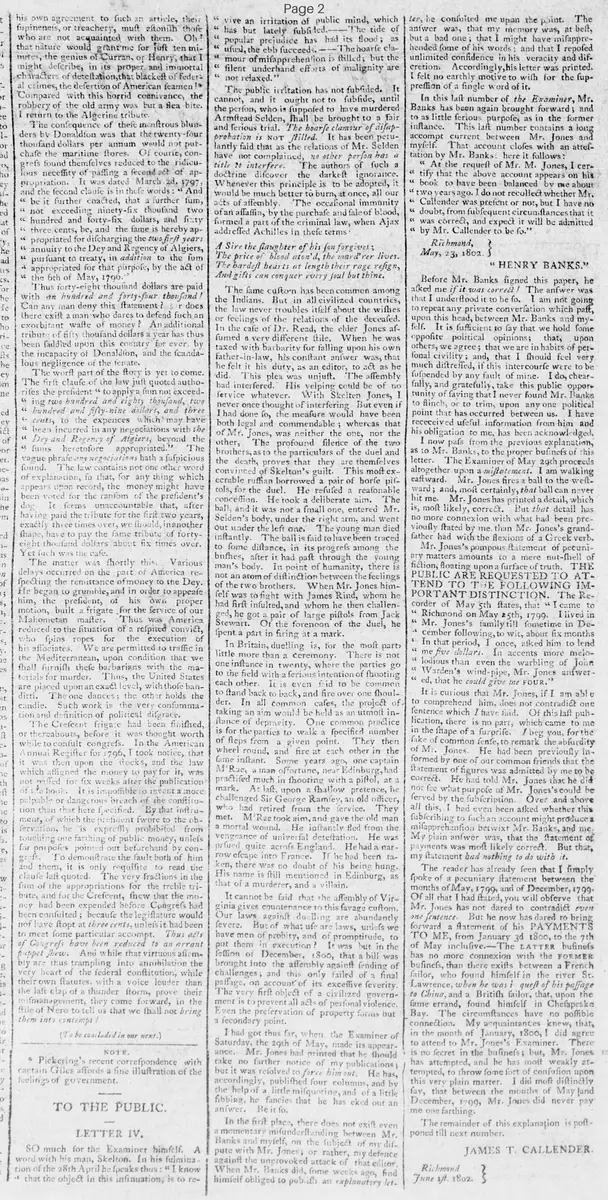
TO THE PUBLIC.
LETTER IV.
SO much for the Examiner himself. A word with his man, Skelton. In his fulmination of the 28th April he speaks thus : "I know that the object in this insinuation, is to revive an irritation of public mind, which has but lately subsided.----The tide of popular prejudice has had its flood; as usual, the ebb succeeds: --The hoarse clamour of misapprehension is stilled; but the silent underhand efforts of malignity are not relaxed."
The public irritation has not subsided. It cannot, and it ought not to subside, until the person, who is supposed to have murdered Armstead Selden, shall be brought to a fair and serious trial. The hoarse clamour of disapprobation is not stilled. It has been petulantly said that as the relations of Mr. Selden have not complained, no other person has a title to interfere. The authors of such a doctrine discover the darkest ignorance. Whenever this principle is to be adopted, it would be much better to burn, at once, all our acts of assembly. The occasional immunity of an assassin, by the purchase and sale of blood, formed a part of the criminal law, when Ajax addressed Achilles in these terms
A Sire the slaughter of his son forgives;
The price of blood atoned, the marderer lives.
The hardest hearts at length their rage resign,
And gifts can conquer every soul but thine.
The same custom has been common among the Indians. But in all civilized countries, the law never troubles itself about the wishes or feelings of the relations of the deceased. In the case of Dr. Read, the elder Jones assumed a very different stile. When he was taxed with barbarity for falling upon his own father-in-law, his constant answer was, that he felt it his duty, as an editor, to act as he did. This plea was unjust. The assembly had interfered.' His yelping could be of no service whatever. With Skelton Jones, I never once thought of interfering But even if I had done so, the measure would have been both legal and commendable ; whereas that of Mr. Jones, was neither the one, nor the other, The profound silence of the two brothers, as to the particulars of the duel and the death, proves that they are themselves convinced of Skelton's guilt. This most execrable ruffian borrowed a pair of horse pistols, for the duel. He refused a reasonable concession. He took a deliberate aim. The ball, and it was not a small one, entered Mr. Selden's body, under the right arm. and went out under the left one.' The young man died instantly. The ball is said to have been traced to some distance, in its progress among the bushes, after it had past through the young man's body. In point of humanity, there is not an atom of distinction between the feelings of the two brothers. When Mr. Jones himself was to fight with James Rind, whom he had first insulted,and whom he then challenged, he got a pair of large pistols from Jack Stewart. Of the forenoon of the duel, he spent a part in firing at a mark.
In Britain, duelling is, for the most part little more than a ceremony. There is not one instance in twenty, where the parties go to the field with a serious intention of shooting each other. It is even said to be common to stand back to back, and fire over one shoulder. In all common cases. the project of taking an aim would be held as an utmost instance of depravity. One common practice is for the parties to walk a specified number of steps from a given point. They then wheel round, and fire at each other in the same instant. Some years ago, one captain M'Rae, a man of fortune, near Edinburgh, had practised much in shooting with a pistol, at a mark. At last, upon a shallow pretence, he challenged Sir George Ramsay, an old officer, who had retired from the service. They met. M Rae took aim,and gave the old man a mortal wound. He instantly fled from the vengeance of universal detestation. He was pursued quite across England. He had a narrow escape into France. If he had been taken, there was no doubt of his being hung. His name is still mentioned in Edinburgh, as that of a murderer, and a villain.
It cannot be said that the assembly of Virginia gives countenance to this savage custom. Our laws against duelling are abundantly severe. But of what use are laws, unless we have men of probity, and of promptitude, to put them in execution? It was but in the session of December, 1800, that a bill was brought into the assembly against sending of challenges; and this only failed of a final passage, on account of its excessive severity. The very first object of a civilized government is to prevent all acts of personal violence. Even the preservation of property follows but a secondary point.
I had got thus far, when the Examiner of Saturday, the 29th of May, made its appearance. Mr. Jones had printed that he should take no farther notice of my publications; but it was resolved to force him out. He has, accordingly, published four columns, and by the help of a little misquoting, and of a little fibbing, he fancies that he has raked out an answer. Be it so.
In the first place, there does not exist even a momentary misunderstanding between Mr. Banks and myself, on the subject of my dispute with Mr. Jones; or rather, my defence against the unprovoked attack of that editor. When Mr. Banks did, some weeks ago, find himself obliged to publish an explanatory letter, he consulted me upon the point. The answer was, that my memory was, at best. but a bad one ; that I might have misapprehended some of his words; and that I reposed unlimited confidence in his veracity and discretion: Accordingly, his letter was printed. I felt no earthly motive to wish for the suppression of a single word of it.
In this last number of the Examiner, Mr. Banks has been again brought forward; and to as little serious purpose, as in the former instance. This last number contains a long account current between Mr. Jones and myself. That account closes with an attestation by Mr. Banks: here it follows:
" At the request of Mr. M. Jones, I certify that the above account appears on his book to have been balanced by me about two years ago. I do not recollect whether Mr. Callender was present or not, but I have no doubt. from subsequent circumstances that it was correct, and expect it will be admitted by Mr. Callender to be so."
Richmond,
May, 23, 1802.
" HENRY BANKS."
Before Mr. Banks signed this paper, he asked me if it was correct / The answer was that I understood it to be so. I am not going to repeat any private conversation which past, upon this head, between Mr. Banks and myself. It is sufficient to say that we hold some opposite political opinions; that, upon others, we agree; that we are in habits of personal civility; and, that I should feel very much distressed, if this intercourse were to be suspended by any fault of mine. I do, cheerfully, and gratefully, take this public opportunity of saying that I never found Mr. Banks to flinch, or to trim, upon any one political point that has occurred between us. I have received useful information from him and his obligation to me, has been acknowledged.
I now pass from the previous explanation, as to Mr. Banks, to the proper business of this letter. The Examiner of May 29th proceeds altogether upon a misstatement. I am walking eastward. Mr. Jones fires a ball to the westward; and, most certainly, that ball can never hit me. Mr. Jones has printed a detail, which is, most likely, correct. But that detail has no more connexion with what had been previously stated by me. than Mr. Jones's grandfather had with the flexions of a Greek verb.
Mr. Jones's pompous statement of pecuniary matters amounts to a mere nut-shell of fiction, floating upon a surface of truth. THE PUBLIC ARE REQUESTED TO ATTEND TO THE FOLLOWING IMPORTANT DISTINCTION. The Recorder of May 5th states, that " I came to Richmond on May 25th, 1799. I lived in Mr. Jones's family till sometime in December following, to wit, about six months . In that period, I once, asked him to lend me five dollars. In accents more melodious than even the warbling of John Warden's wind-pipe, Mr. Jones answered, that he could give me four."
It is curious that Mr. Jones, if I am able to comprehend him. does not contradict one sentence which I have said. Of this last publication, there is no part, which came to me in the shape of a surprize. I beg you, for the sake of common sense, to remark the absurdity of Mr. Jones. He had been previously informed by one of our common friends that the statement of figures was admitted by me to be correct. He had told Mr. Jones that he did not see what purpose of Mr. Jones's could be served by the subscription. Over and above all this, I had even been asked whether this subscribing to such an account might produce misapprehension betwixt Mr. Banks, and me. My plain answer was, that tho statement of payments was most likely correct. But that, my statement had nothing to do with it.
The reader has already seen that I simply spoke of a pecuniary statement between the months of May, 1799, and of December, 1799. Of all that I had stated, you will observe that Mr. Jones has not dared to contradict even one sentence. But he now has dared to bring forward a statement of his PAYMENTS TO ME, from January 3d 1800, to the 7th of May inclusive.--The LATTER business has no more connexion with the FORMER business, than there exists between a French sailor, who found himself in the river St. Lawrence, when he was in quest of his passage to China, and a British sailor, that, upon the same errand, found himself in Chesapeake Bay. The circumstances have no possible connection. My acquaintances knew, that, in the month of January, 1800, I did agree to attend to Mr. Jones's Examiner. There is no secret in the business; but, Mr. Jones has attempted, and he has most weakly attempted, to throw some sort of confusion upon this very plain matter. I did most distinctly say, that between the months of May and December, 1799, Mr. Jones did never pay me one farthing.
The remainder of this explanation is postponed till next number.
JAMES T. CALLENDER.
Richmond
June 1st. 1802.
LETTER IV.
SO much for the Examiner himself. A word with his man, Skelton. In his fulmination of the 28th April he speaks thus : "I know that the object in this insinuation, is to revive an irritation of public mind, which has but lately subsided.----The tide of popular prejudice has had its flood; as usual, the ebb succeeds: --The hoarse clamour of misapprehension is stilled; but the silent underhand efforts of malignity are not relaxed."
The public irritation has not subsided. It cannot, and it ought not to subside, until the person, who is supposed to have murdered Armstead Selden, shall be brought to a fair and serious trial. The hoarse clamour of disapprobation is not stilled. It has been petulantly said that as the relations of Mr. Selden have not complained, no other person has a title to interfere. The authors of such a doctrine discover the darkest ignorance. Whenever this principle is to be adopted, it would be much better to burn, at once, all our acts of assembly. The occasional immunity of an assassin, by the purchase and sale of blood, formed a part of the criminal law, when Ajax addressed Achilles in these terms
A Sire the slaughter of his son forgives;
The price of blood atoned, the marderer lives.
The hardest hearts at length their rage resign,
And gifts can conquer every soul but thine.
The same custom has been common among the Indians. But in all civilized countries, the law never troubles itself about the wishes or feelings of the relations of the deceased. In the case of Dr. Read, the elder Jones assumed a very different stile. When he was taxed with barbarity for falling upon his own father-in-law, his constant answer was, that he felt it his duty, as an editor, to act as he did. This plea was unjust. The assembly had interfered.' His yelping could be of no service whatever. With Skelton Jones, I never once thought of interfering But even if I had done so, the measure would have been both legal and commendable ; whereas that of Mr. Jones, was neither the one, nor the other, The profound silence of the two brothers, as to the particulars of the duel and the death, proves that they are themselves convinced of Skelton's guilt. This most execrable ruffian borrowed a pair of horse pistols, for the duel. He refused a reasonable concession. He took a deliberate aim. The ball, and it was not a small one, entered Mr. Selden's body, under the right arm. and went out under the left one.' The young man died instantly. The ball is said to have been traced to some distance, in its progress among the bushes, after it had past through the young man's body. In point of humanity, there is not an atom of distinction between the feelings of the two brothers. When Mr. Jones himself was to fight with James Rind, whom he had first insulted,and whom he then challenged, he got a pair of large pistols from Jack Stewart. Of the forenoon of the duel, he spent a part in firing at a mark.
In Britain, duelling is, for the most part little more than a ceremony. There is not one instance in twenty, where the parties go to the field with a serious intention of shooting each other. It is even said to be common to stand back to back, and fire over one shoulder. In all common cases. the project of taking an aim would be held as an utmost instance of depravity. One common practice is for the parties to walk a specified number of steps from a given point. They then wheel round, and fire at each other in the same instant. Some years ago, one captain M'Rae, a man of fortune, near Edinburgh, had practised much in shooting with a pistol, at a mark. At last, upon a shallow pretence, he challenged Sir George Ramsay, an old officer, who had retired from the service. They met. M Rae took aim,and gave the old man a mortal wound. He instantly fled from the vengeance of universal detestation. He was pursued quite across England. He had a narrow escape into France. If he had been taken, there was no doubt of his being hung. His name is still mentioned in Edinburgh, as that of a murderer, and a villain.
It cannot be said that the assembly of Virginia gives countenance to this savage custom. Our laws against duelling are abundantly severe. But of what use are laws, unless we have men of probity, and of promptitude, to put them in execution? It was but in the session of December, 1800, that a bill was brought into the assembly against sending of challenges; and this only failed of a final passage, on account of its excessive severity. The very first object of a civilized government is to prevent all acts of personal violence. Even the preservation of property follows but a secondary point.
I had got thus far, when the Examiner of Saturday, the 29th of May, made its appearance. Mr. Jones had printed that he should take no farther notice of my publications; but it was resolved to force him out. He has, accordingly, published four columns, and by the help of a little misquoting, and of a little fibbing, he fancies that he has raked out an answer. Be it so.
In the first place, there does not exist even a momentary misunderstanding between Mr. Banks and myself, on the subject of my dispute with Mr. Jones; or rather, my defence against the unprovoked attack of that editor. When Mr. Banks did, some weeks ago, find himself obliged to publish an explanatory letter, he consulted me upon the point. The answer was, that my memory was, at best. but a bad one ; that I might have misapprehended some of his words; and that I reposed unlimited confidence in his veracity and discretion: Accordingly, his letter was printed. I felt no earthly motive to wish for the suppression of a single word of it.
In this last number of the Examiner, Mr. Banks has been again brought forward; and to as little serious purpose, as in the former instance. This last number contains a long account current between Mr. Jones and myself. That account closes with an attestation by Mr. Banks: here it follows:
" At the request of Mr. M. Jones, I certify that the above account appears on his book to have been balanced by me about two years ago. I do not recollect whether Mr. Callender was present or not, but I have no doubt. from subsequent circumstances that it was correct, and expect it will be admitted by Mr. Callender to be so."
Richmond,
May, 23, 1802.
" HENRY BANKS."
Before Mr. Banks signed this paper, he asked me if it was correct / The answer was that I understood it to be so. I am not going to repeat any private conversation which past, upon this head, between Mr. Banks and myself. It is sufficient to say that we hold some opposite political opinions; that, upon others, we agree; that we are in habits of personal civility; and, that I should feel very much distressed, if this intercourse were to be suspended by any fault of mine. I do, cheerfully, and gratefully, take this public opportunity of saying that I never found Mr. Banks to flinch, or to trim, upon any one political point that has occurred between us. I have received useful information from him and his obligation to me, has been acknowledged.
I now pass from the previous explanation, as to Mr. Banks, to the proper business of this letter. The Examiner of May 29th proceeds altogether upon a misstatement. I am walking eastward. Mr. Jones fires a ball to the westward; and, most certainly, that ball can never hit me. Mr. Jones has printed a detail, which is, most likely, correct. But that detail has no more connexion with what had been previously stated by me. than Mr. Jones's grandfather had with the flexions of a Greek verb.
Mr. Jones's pompous statement of pecuniary matters amounts to a mere nut-shell of fiction, floating upon a surface of truth. THE PUBLIC ARE REQUESTED TO ATTEND TO THE FOLLOWING IMPORTANT DISTINCTION. The Recorder of May 5th states, that " I came to Richmond on May 25th, 1799. I lived in Mr. Jones's family till sometime in December following, to wit, about six months . In that period, I once, asked him to lend me five dollars. In accents more melodious than even the warbling of John Warden's wind-pipe, Mr. Jones answered, that he could give me four."
It is curious that Mr. Jones, if I am able to comprehend him. does not contradict one sentence which I have said. Of this last publication, there is no part, which came to me in the shape of a surprize. I beg you, for the sake of common sense, to remark the absurdity of Mr. Jones. He had been previously informed by one of our common friends that the statement of figures was admitted by me to be correct. He had told Mr. Jones that he did not see what purpose of Mr. Jones's could be served by the subscription. Over and above all this, I had even been asked whether this subscribing to such an account might produce misapprehension betwixt Mr. Banks, and me. My plain answer was, that tho statement of payments was most likely correct. But that, my statement had nothing to do with it.
The reader has already seen that I simply spoke of a pecuniary statement between the months of May, 1799, and of December, 1799. Of all that I had stated, you will observe that Mr. Jones has not dared to contradict even one sentence. But he now has dared to bring forward a statement of his PAYMENTS TO ME, from January 3d 1800, to the 7th of May inclusive.--The LATTER business has no more connexion with the FORMER business, than there exists between a French sailor, who found himself in the river St. Lawrence, when he was in quest of his passage to China, and a British sailor, that, upon the same errand, found himself in Chesapeake Bay. The circumstances have no possible connection. My acquaintances knew, that, in the month of January, 1800, I did agree to attend to Mr. Jones's Examiner. There is no secret in the business; but, Mr. Jones has attempted, and he has most weakly attempted, to throw some sort of confusion upon this very plain matter. I did most distinctly say, that between the months of May and December, 1799, Mr. Jones did never pay me one farthing.
The remainder of this explanation is postponed till next number.
JAMES T. CALLENDER.
Richmond
June 1st. 1802.
What sub-type of article is it?
Persuasive
Political
Investigative
What themes does it cover?
Crime Punishment
Politics
Morality
What keywords are associated?
Duel
Murder
Armstead Selden
Skelton Jones
Meriwether Jones
Callender Defense
Dueling Laws
Virginia Assembly
Financial Dispute
Richmond 1802
What entities or persons were involved?
James T. Callender.
To The Public.
Letter to Editor Details
Author
James T. Callender.
Recipient
To The Public.
Main Argument
callender argues that public outrage over armstead selden's death in a duel with skelton jones should persist until a fair trial occurs, criticizes dueling practices and the jones brothers' involvement, and clarifies unrelated financial disputes with meriwether jones to defend his reputation.
Notable Details
Quotes Skelton Jones's Statement From April 28
References Homer's Iliad Via Ajax And Achilles On Blood Atonement
Details Duel: Deliberate Aim, Ball Entry/Exit, Instant Death
Compares To British Dueling Customs And M'rae Case
Mentions Virginia Assembly Bill Against Challenges In December 1800
Discusses Henry Banks's Attestation On Financial Account