Thank you for visiting SNEWPapers!
Sign up free
The Virginia Gazette
Richmond, Williamsburg, Richmond County, Virginia
What is this article about?
A correspondent reflects on Plautus's satire of scandalmongers, quoting a translation, and shares an original poem denouncing calumny as a venomous evil, advocating introspection and compassion over detraction. Addressed to printers Purdie and Dixon; signed X.
Merged-components note: The poem is the poetical essay on calumny produced and referenced in the letter to the editor.
Clipping
OCR Quality
Full Text
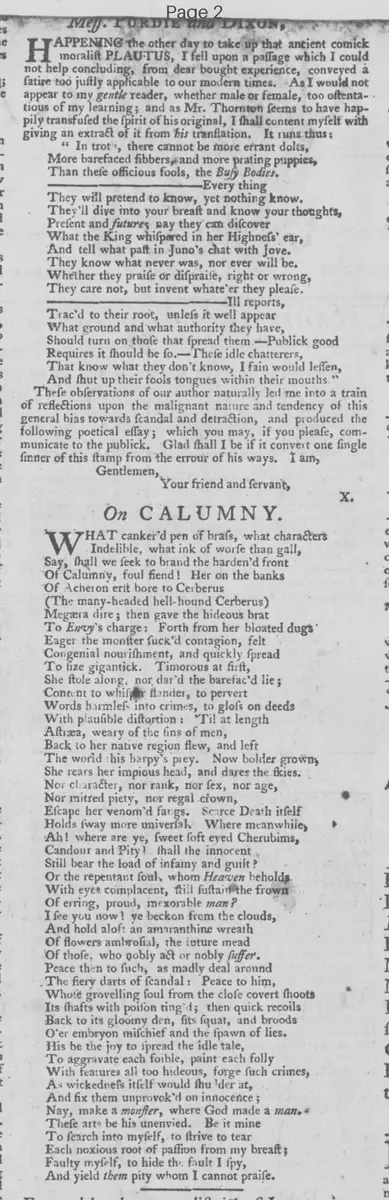
HAPPENING the other day to take up that ancient comic moralist PLAUTUS, I fell upon a passage which I could not help concluding, from dear bought experience, conveyed a satire too justly applicable to our modern times. As I would not appear to my gentle reader, whether male or female, too ostentatious of my learning; and as Mr. Thornton seems to have happily transfused the spirit of his original, I shall content myself with giving an extract of it from his translation. It runs thus:
"In troth, there cannot be more errant dolts,
More barefaced fibbers, and more prating puppies,
Than these officious fools, the Busy Bodies.
Every thing
They will pretend to know, yet nothing know.
They'll dive into your breast and know your thoughts
Present and future nay they can discover
What the King whispered in her Highness' ear,
And tell what past in Juno's chat with Jove.
They know what never was, nor ever will be.
Whether they praise or dispraise, right or wrong,
They care not, but invent whate'er they please.
Ill reports,
Trac'd to their root, unless it well appear
What ground and what authority they have,
Should turn on those that spread them - Publick good
Requires it should be so.—These idle chatterers,
That know what they don't know, I fain would see,
And shut up their fool's tongues within their mouths"
These observations of our author naturally led me into a train of reflections upon the malignant nature and tendency of this general bias towards scandal and detraction, and produced the following poetical essay; which you may, if you please, communicate to the publick. Glad shall I be if it convert one single sinner of this stamp from the error of his ways. I am,
Gentlemen,
Your friend and servant,
X.
On CALUMNY
What canker'd fiends, what characters
Say, shall we seek to brand the harden'd front
Of Calumny, foul fiend! Her on the banks
Of cheron e'er bore to Cerberus
(The many-headed hell-hound Cerberus)
Megara dire; then gave the hideous brat
To Envy's charge: Forth from her bloated dugs
Eager the monster suck'd contagion, felt
Congenial nourishment, and quickly spread
To size gigantick. Timorous at first,
She stole along, nor dar'd the barefac'd lie;
Content to whisper slander, to pervert
Words harmless into crimes, to gloss on deeds
With plausible distortion: Til at length
Astraea, weary of the sins of men,
Back to her native region flew, and left
The world her harpy's prey. Now bolder grown
She rears her impious head, and dares the skies.
Nor character, nor rank, nor sex, nor age,
Nor mitred piety, nor regal crown,
Escape her venom'd stings. Scarce Death itself
Holds sway more universal. Where meanwhile
Ah! where are ye, sweet soft eyed Cherubims,
Candour and Pity! shall the innocent
Still bear the load of infamy and guilt?
Or there repentant soul, whom Heaven beholds
With eyes complacent, ill sustain the frown
Of erring, proud, inexorable man?
I see you now! ye beckon from the clouds,
And hold aloft an amaranthine wreath
Of flowers ambrosial, the future meed
Of those, who nobly act or nobly suffer.
Peace then to such, as madly deal around
The fiery darts of scandal: Peace to him,
Whose grovelling soul from the close covert shoots
Its shafts with poison ting'd; then quick recoils
Back to its gloomy den, sits squat, and broods
O'er embryon mischief and the spawn of lies.
His be the joy to spread the idle tale,
To aggravate each foible, paint each folly
With features all too hideous, forge such crimes,
As wickedness itself would shudder at,
And fix them unprovok'd on innocence;
Nay, make a monster, where God made a man
These arts be his unenvied. Be it mine
To search into myself, to strive to tear
Each noxious root of passion from my breast;
Faulty myself, to hide the fault I spy,
And yield them pity whom I cannot praise.
What sub-type of article is it?
What themes does it cover?
What keywords are associated?
What entities or persons were involved?
Letter to Editor Details
Author
X.
Recipient
Messrs. Purdie And Dixon
Main Argument
the letter condemns the spread of scandal and calumny as destructive vices, drawing from plautus to illustrate busybodies' folly, and presents an original poem urging self-reflection, pity, and avoidance of slander.
Notable Details