Thank you for visiting SNEWPapers!
Sign up free
Literary
October 27, 1818
Elizabeth Town Gazette
Elizabeth, Union County, New Jersey
What is this article about?
An essay titled 'THE BRIEF REMARKER' from the Connecticut Courant discusses the proverb 'Cut your coat according to your cloth,' advising financial prudence, the value of arithmetic in managing expenses, and building reputation modestly. It critiques extravagance and quotes Cervantes, Chesterfield, Locke, and a poem by Sir Thomas Moore.
Clipping
OCR Quality
95%
Excellent
Full Text
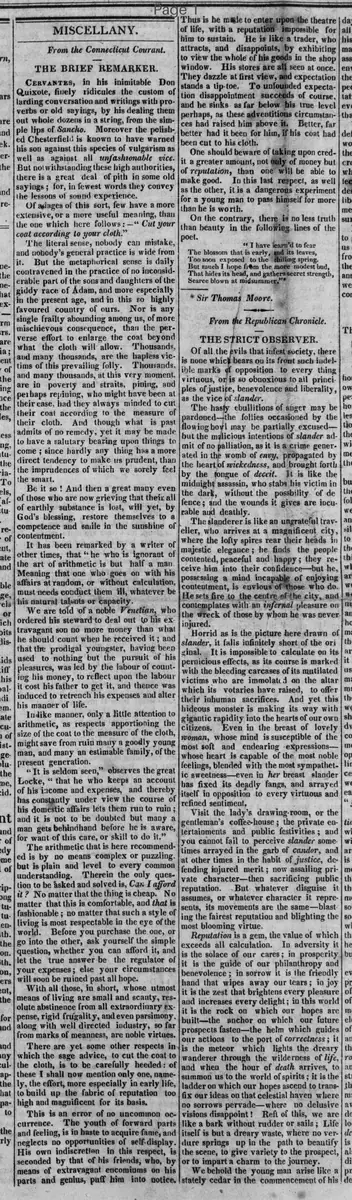
MISCELLANY.
From the Connecticut Courant.
THE BRIEF REMARKER.
Cervantes, in his inimitable Don Quixote, lively ridicules the custom of larding conversation and writings with proverbs or old sayings, by his dealing them out whole dozens in a string, from the simple lips of Sancho. Moreover the polished Chesterfield is known to have warned his son against this species of vulgarism as well as against all unfashionable vice.
But notwithstanding these high authorities, there is a great deal of pith in some old sayings; for, in fewest words they convey the lessons of sound experience.
Of adages of this sort, few have a more extensive, or a more useful meaning, than the one which here follows: "Cut your coat according to your cloth."
The literal sense, nobody can mistake, and nobody's general practice is wide from it. But the metaphorical sense is daily contravened in the practice of no inconsiderable part of the sons and daughters of the giddy race of Adam, and more especially in the present age, and in this so highly favoured country of ours. Nor is any single frailty abounding among us, of more mischievous consequence, than the perverse effort to enlarge the coat beyond what the cloth will allow. Thousands, and many thousands, are the hapless victims of this prevailing folly. Thousands, and many thousands, at this very moment, are in poverty and straits, pining, and perhaps repining, who might have been at their ease, had they always minded to cut their coat according to the measure of their cloth. And though what is past admits of no remedy, yet it may be made to have a salutary bearing upon things to come; since hardly any thing has a more direct tendency to make us prudent, than the imprudences of which we sorely feel the smart.
Be it so! And then a great many even of those who are now grieving that their all of earthly substance is lost, will yet, by God's blessing, restore themselves to a competence and smile in the sunshine of contentment.
It has been remarked by a writer of other times, that "he who is ignorant of the art of arithmetic is but half a man"—Meaning that one who goes on with his affairs at random, or without calculation, must needs conduct them ill, whatever be his natural talents or capacity.
We are told of a noble Venetian, who ordered his steward to deal out to his extravagant son no more money than what he should count when he received it; and that the prodigal youngster, having been used to nothing but the pursuit of his pleasures, was led by the labour of counting his money, to reflect upon the labour it cost his father to get it, and thence was induced to retrench his expenses and alter his manner of life.
In like manner, only a little attention to arithmetic, as respects apportioning the size of the coat to the measure of the cloth, might save from ruin many a goodly young man, and many an estimable family, of the present generation.
"It is seldom seen," observes the great Locke, "that he who keeps an account of his income and expenses, and thereby has constantly under view the course of his domestic affairs lets them run to ruin; and it is not to be doubted but many a man gets behindhand before he is aware, for want of this care, or skill to do it."
The arithmetic that is here recommended is by no means complex or puzzling but is plain and level to every common understanding. Therein the only question to be asked and solved is, Can I afford it? No matter that the thing is cheap. No matter that this is comfortable, and that is fashionable; no matter that such a style of living is most respectable in the eye of the world. Before you purchase the one, or go into the other, ask yourself the simple question, whether you can afford it, and let the true answer be the regulator of your expenses; else your circumstances will soon be ruined past all hope.
With all those, in short, whose utmost means of living are small and scanty, resolute abstinence from all extraordinary expense, rigid frugality, and even parsimony, along with well directed industry, so far from marks of meanness, are noble virtues.
There are yet some other respects in which the sage advice, to cut the coat to the cloth, is to be carefully heeded: of these I shall now mention only one, namely, the effort, more especially in early life, to build up the fabric of reputation too high and magnificent for its basis.
This is an error of no uncommon occurrence. The youth of forward parts and feeling, is in haste to acquire fame, and neglects no opportunities of self-display. His own indiscretion in this respect, is seconded by that of his friends, who, by means of extravagant encomiums on his parts and genius, puff him into notice.
Thus is he made to enter upon the theatre of life, with a reputation impossible for him to sustain. He is like a trader, who attracts, and disappoints, by exhibiting to view the whole of his goods in the shop window. His stores are all seen at once. They dazzle at first view, and expectation stands a tip-toe. To unfounded expectation disappointment succeeds of course, and he sinks as far below his true level perhaps, as these adventitious circumstances had raised him above it. Better, far better had it been for him, if his coat had been cut to his cloth.
One should beware of taking upon credit a greater amount, not only of money but of reputation, than one will be able to make good. In this last respect, as well as the other, it is a dangerous experiment for a young man to pass himself for more than he is worth.
On the contrary, there is no less truth than beauty in the following lines of the poet.
"I have learn'd to fear
The blossom that is early, and its leaves,
Too soon exposed to the chilling spring.
But much I hope from the more modest bud,
That hides its head, and gathers secret strength,
Scarce blown at midsummer."
* Sir Thomas Moore.
From the Connecticut Courant.
THE BRIEF REMARKER.
Cervantes, in his inimitable Don Quixote, lively ridicules the custom of larding conversation and writings with proverbs or old sayings, by his dealing them out whole dozens in a string, from the simple lips of Sancho. Moreover the polished Chesterfield is known to have warned his son against this species of vulgarism as well as against all unfashionable vice.
But notwithstanding these high authorities, there is a great deal of pith in some old sayings; for, in fewest words they convey the lessons of sound experience.
Of adages of this sort, few have a more extensive, or a more useful meaning, than the one which here follows: "Cut your coat according to your cloth."
The literal sense, nobody can mistake, and nobody's general practice is wide from it. But the metaphorical sense is daily contravened in the practice of no inconsiderable part of the sons and daughters of the giddy race of Adam, and more especially in the present age, and in this so highly favoured country of ours. Nor is any single frailty abounding among us, of more mischievous consequence, than the perverse effort to enlarge the coat beyond what the cloth will allow. Thousands, and many thousands, are the hapless victims of this prevailing folly. Thousands, and many thousands, at this very moment, are in poverty and straits, pining, and perhaps repining, who might have been at their ease, had they always minded to cut their coat according to the measure of their cloth. And though what is past admits of no remedy, yet it may be made to have a salutary bearing upon things to come; since hardly any thing has a more direct tendency to make us prudent, than the imprudences of which we sorely feel the smart.
Be it so! And then a great many even of those who are now grieving that their all of earthly substance is lost, will yet, by God's blessing, restore themselves to a competence and smile in the sunshine of contentment.
It has been remarked by a writer of other times, that "he who is ignorant of the art of arithmetic is but half a man"—Meaning that one who goes on with his affairs at random, or without calculation, must needs conduct them ill, whatever be his natural talents or capacity.
We are told of a noble Venetian, who ordered his steward to deal out to his extravagant son no more money than what he should count when he received it; and that the prodigal youngster, having been used to nothing but the pursuit of his pleasures, was led by the labour of counting his money, to reflect upon the labour it cost his father to get it, and thence was induced to retrench his expenses and alter his manner of life.
In like manner, only a little attention to arithmetic, as respects apportioning the size of the coat to the measure of the cloth, might save from ruin many a goodly young man, and many an estimable family, of the present generation.
"It is seldom seen," observes the great Locke, "that he who keeps an account of his income and expenses, and thereby has constantly under view the course of his domestic affairs lets them run to ruin; and it is not to be doubted but many a man gets behindhand before he is aware, for want of this care, or skill to do it."
The arithmetic that is here recommended is by no means complex or puzzling but is plain and level to every common understanding. Therein the only question to be asked and solved is, Can I afford it? No matter that the thing is cheap. No matter that this is comfortable, and that is fashionable; no matter that such a style of living is most respectable in the eye of the world. Before you purchase the one, or go into the other, ask yourself the simple question, whether you can afford it, and let the true answer be the regulator of your expenses; else your circumstances will soon be ruined past all hope.
With all those, in short, whose utmost means of living are small and scanty, resolute abstinence from all extraordinary expense, rigid frugality, and even parsimony, along with well directed industry, so far from marks of meanness, are noble virtues.
There are yet some other respects in which the sage advice, to cut the coat to the cloth, is to be carefully heeded: of these I shall now mention only one, namely, the effort, more especially in early life, to build up the fabric of reputation too high and magnificent for its basis.
This is an error of no uncommon occurrence. The youth of forward parts and feeling, is in haste to acquire fame, and neglects no opportunities of self-display. His own indiscretion in this respect, is seconded by that of his friends, who, by means of extravagant encomiums on his parts and genius, puff him into notice.
Thus is he made to enter upon the theatre of life, with a reputation impossible for him to sustain. He is like a trader, who attracts, and disappoints, by exhibiting to view the whole of his goods in the shop window. His stores are all seen at once. They dazzle at first view, and expectation stands a tip-toe. To unfounded expectation disappointment succeeds of course, and he sinks as far below his true level perhaps, as these adventitious circumstances had raised him above it. Better, far better had it been for him, if his coat had been cut to his cloth.
One should beware of taking upon credit a greater amount, not only of money but of reputation, than one will be able to make good. In this last respect, as well as the other, it is a dangerous experiment for a young man to pass himself for more than he is worth.
On the contrary, there is no less truth than beauty in the following lines of the poet.
"I have learn'd to fear
The blossom that is early, and its leaves,
Too soon exposed to the chilling spring.
But much I hope from the more modest bud,
That hides its head, and gathers secret strength,
Scarce blown at midsummer."
* Sir Thomas Moore.
What sub-type of article is it?
Essay
What themes does it cover?
Moral Virtue
Temperance
What keywords are associated?
Proverb
Frugality
Prudence
Reputation
Arithmetic
Extravagance
Temperance
Literary Details
Title
The Brief Remarker.
Subject
On The Proverb 'Cut Your Coat According To Your Cloth'
Key Lines
"Cut Your Coat According To Your Cloth."
"He Who Is Ignorant Of The Art Of Arithmetic Is But Half A Man"
"It Is Seldom Seen," Observes The Great Locke, "That He Who Keeps An Account Of His Income And Expenses, And Thereby Has Constantly Under View The Course Of His Domestic Affairs Lets Them Run To Ruin; And It Is Not To Be Doubted But Many A Man Gets Behindhand Before He Is Aware, For Want Of This Care, Or Skill To Do It."
"I Have Learn'd To Fear
The Blossom That Is Early, And Its Leaves,
Too Soon Exposed To The Chilling Spring.
But Much I Hope From The More Modest Bud,
That Hides Its Head, And Gathers Secret Strength,
Scarce Blown At Midsummer."