Thank you for visiting SNEWPapers!
Sign up free
Richmond Enquirer
Richmond, Richmond County, Virginia
What is this article about?
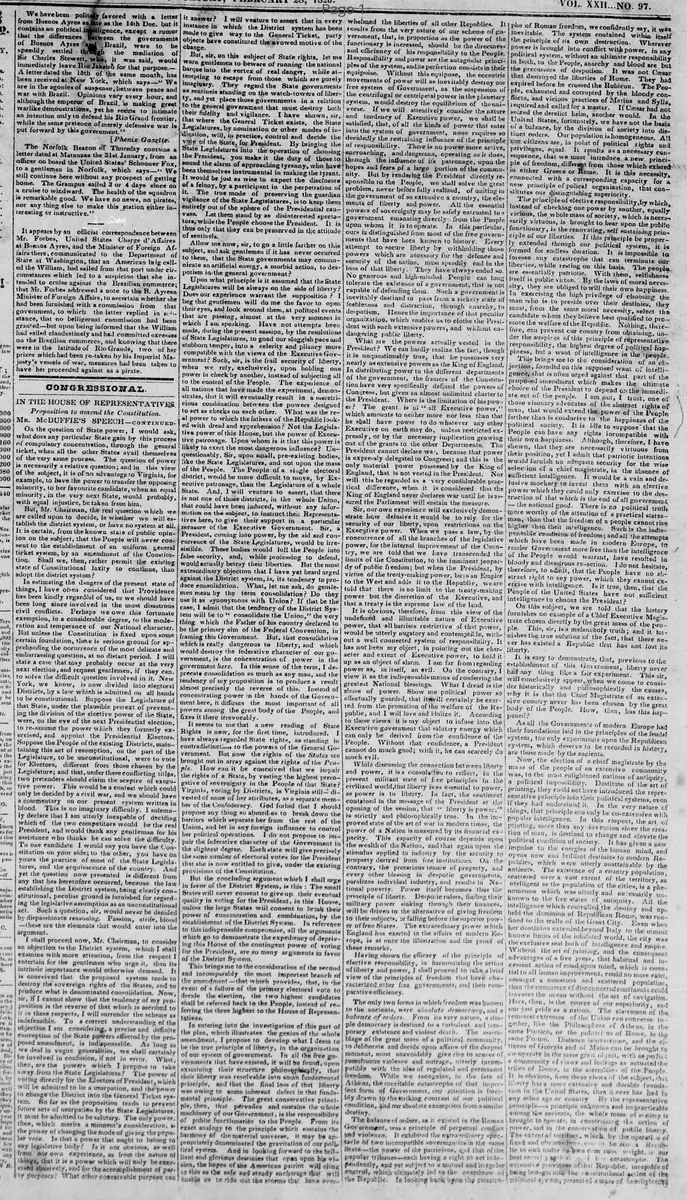
In the House, Mr. McDuffie continues his speech proposing constitutional amendments for a district-based electoral system and direct popular vote in contingent presidential elections, defending against objections and emphasizing people's responsibility and intelligence.
Merged-components note: These components form a continuous report of Mr. McDuffie's speech on constitutional amendments in Congress, spanning columns and pages; relabeled from 'story' and 'editorial' to 'domestic_news' as it covers congressional proceedings.
Clippings
1 of 2
OCR Quality
Full Text
IN THE HOUSE OF REPRESENTATIVES
Proposition to amend the Constitution.
MR. McDUFFIE'S SPEECH—CONTINUED.
On the question of State power, I would ask, what does any particular State gain by this process of compulsory concentration, through the general ticket, when all the other States avail themselves of the very same process. The question of power is necessarily a relative question; and in this view of the subject, it is of no advantage to Virginia, for example, to have the power to transfer the opposing minority, to her favourite candidate, when an equal minority, in the very next State, would probably, with equal injustice, be taken from him.
But, Mr. Chairman, the real question which we are called upon to decide, is whether we will establish the district system, or have no system at all. It is certain, from the known state of public opinion on the subject, that the People will never consent to the establishment of an uniform general ticket system, by an amendment of the Constitution. Shall we, then, rather permit the existing state of Constitutional laxity to continue, than adopt the district system?
In estimating the dangers of the present state of things, I have often considered that Providence has been kindly regardful of us, or we should have been long since involved in the most disastrous civil conflicts. Perhaps we owe this fortunate exemption, in a considerable degree, to the moderation and temperance of our National character.
But unless the Constitution is fixed upon some certain foundation, there is serious ground for apprehending the occurrence of the most delicate and embarrassing question, at no distant period. I will state a case that may probably occur at the very next election, and request gentlemen, if they can, to solve the difficult question involved in it. New York, we know, is now divided into electoral Districts, by a law which is admitted on all hands to be constitutional. Suppose the Legislature of that State, under the plausible pretext of preventing the division of the elective power of the State, were, on the eve of the next Presidential election, to re-assume the power which they formerly exercised, and appoint the Presidential Electors. Suppose the People of the existing Districts, maintaining this act of resumption, on the part of the Legislature, to be unconstitutional, were to vote for Electors, different from those chosen by the Legislature; and that, under these conflicting titles, two pretenders should claim the sceptre of executive power. This would be a contest which could only be decided by a civil war, and we should have a commentary on our present system written in blood. This is no imaginary difficulty. I solemnly declare that I am utterly incapable of deciding which of the two competitors would be the real President, and would thank any gentleman for his assistance who thinks he can solve the difficulty. To one candidate I would say you have the Constitution on your side; to the other, you have on yours the practice of most of the State Legislatures, and the acquiescence of the country. And yet the question now presented is different from any that has heretofore occurred, because the law establishing the District system, being clearly constitutional, peculiar ground is furnished for regarding the legislative assumption as an unconstitutional act. Such a question, sir, would never be decided by dispassionate reasoning. Passion, strife, blood—these are the elements that would enter into the argument.
I shall proceed now, Mr. Chairman, to consider an objection to the District system, which I shall examine with more attention, from the respect I entertain for the gentlemen who urge it, than its intrinsic importance would otherwise demand. It is conceived that the proposed system tends to destroy the sovereign rights of the States, and to produce what is denominated consolidation. Now, sir, if I cannot show that the tendency of my proposition is the reverse of that which is ascribed to it in these respects, I will surrender the scheme as indefensible. To a correct understanding of the objection I am considering, a precise and definite conception of the State powers affected by the proposed amendment, is indispensable. As long as we deal in vague generalities, we shall certainly be involved in confusion, if not in error. What, then, are the powers which I propose to take away from the State Legislatures? The power of voting directly for the Electors of President, which will be admitted to be a usurpation, and the power to change the District into the General Ticket system. So far as the proposition tends to prevent future acts of usurpation by the State Legislatures, it must be admitted to be salutary. The only power, then, which merits a moment's consideration, is the power of changing the mode of giving the popular vote. Is that a power that ought to belong to any legislative body? Is it not obvious, as well from our own experience, as from the nature of things, that it is a power which will only be exercised abusively, and for the accomplishment of party purposes? What other conceivable purpose can it answer? I will venture to assert that in every instance in which the District system has been made to give way to the General Ticket, party objects have constituted the avowed motive of the change.
But, sir, on this subject of State rights, let me warn gentlemen to beware of running the national barque into the vortex of real danger, while attempting to escape from those which are purely imaginary. They regard the State governments as sentinels standing on the watch-towers of liberty, and yet place those governments in a relation to the general government that must destroy both their fidelity and vigilance. I have shown, sir, that where the General Ticket exists, the State Legislatures, by nomination or other modes of indication, will, in practice, control and decide the vote of the State, for President. By bringing the State Legislatures into the operation of choosing the President, you make it the duty of those to sound the alarm of approaching tyranny, who have been themselves instrumental in making the tyrant. It would be just as wise to expect the disclosure of a felony, by a participant in the perpetration of it. The true mode of preserving the guardian vigilance of the State Legislatures, is to keep them entirely out of the sphere of the Presidential canvass. Let them stand by as disinterested spectators, while the People choose the President. It is thus only that they can be preserved in the attitude of sentinels.
Allow me now, sir, to go a little farther on this subject, and ask gentlemen if it has never occurred to them, that the State governments may communicate an artificial energy, a morbid action, to despotism in the general government?
Upon what principle is it assumed that the State Legislatures will be always on the side of liberty? Does our experience warrant the supposition ? I beg that gentlemen will do me the favor to open their eyes, and look around them, at political events that are passing, almost at the very moment in which I am speaking. Have not attempts been made, during the present session, by the resolutions of State Legislatures, to goad our sluggish pace and stubborn temper, into a celerity and pliancy more compatible with the views of the Executive Government? Such, sir, is the frail security of liberty, when we rely, exclusively, upon holding one power in check by another, instead of subjecting all to the control of the People. The experience of all nations that have made the experiment, demonstrates, that it will eventually result in a meretricious combination between the powers designed to act as checks on each other. What was the real power to which the fathers of the Republic looked with dread and apprehension? Not the Legislative power of this House, but the power of Executive patronage. Upon whom is it that this power is likely to exert the most dangerous influence? Unquestionably, Sir, upon small, pre-existing bodies, like the State Legislatures, and not upon the mass of the People. The People of a single electoral district, would be more difficult to move, by Executive patronage, than the Legislature of a whole State. And, I will venture to assert, that there is not one of those districts, in the whole Union, that could have been induced, without any information on the subject, to instruct their Representatives here, to give their support in a particular measure of the Executive Government. Sir, a President, coming into power, by the aid and concurrence of the State Legislatures, would be irresistible. These bodies would lull the People into false security, and, while professing to defend, would actually betray their liberties. But the most extraordinary objection that I have yet heard urged against the District system, is, its tendency to produce consolidation. What, let me ask, do gentlemen mean by the term consolidation? Do they use it as synonymous with Union? If that be the case, I admit that the tendency of the District System will be to "consolidate the Union," the very thing which the Father of his country declared to be the primary aim of the Federal Convention, in framing this Government. But, that consolidation which is really dangerous to liberty, and which would destroy the federative character of our government, is the concentration of power in the government here. In this sense of the term, I deprecate consolidation as much as any man, and the tendency of my proposition is to produce a result almost precisely the reverse of this. Instead of concentrating power in the hands of the Government here, it diffuses the most important of all powers among the great body of the People, and fixes it there irrevocably.
It seems to me that a new reading of State Rights is now, for the first time, introduced. I have always regarded State rights, as standing in contradistinction to the powers of the General Government. But now the rights of the States are brought out in array against the rights of the People. How can it be conceived that we impair the rights of a State, by vesting the highest prerogative of sovereignty in the People of that State? Virginia, voting by Districts, is Virginia still—divested of none of her attributes, as a separate member of the Confederacy. God forbid that I should propose any thing so absurd as to break down the barriers which separate her from the rest of the Union, and let in any foreign influence to control her political operations. I do not propose to impair the federative character of the Government in the slightest degree. Each state will give precisely the same number of electoral votes for the President that she is now entitled to give, under the existing provisions of the Constitution.
But the concluding argument which I shall urge in favor of the District System, is this : The small States will never consent to give up their eventual equality in voting for the President, in this House, unless the large States will consent to break their power of concentration and combination, by the establishment of the District System. In reference to this indispensable compromise, all the arguments which go to demonstrate the expediency of depriving this House of the contingent power of voting for the President, are so many arguments in favor of the District System.
This brings me to the consideration of the second and incomparably the most important branch of the amendment —that which provides, that, in the event of a failure of the primary electoral vote to decide the election, the two highest candidates shall be referred back to the People, instead of referring the three highest to the House of Representatives,
In entering into the investigation of this part of the plan, which illustrates the genius of the whole amendment, I propose to develop what I deem to be the true principle of liberty, in the organization of our system of government. In all the free governments that have existed, it will be found, upon examining their structure philosophically, that their liberty was resolvable into some fundamental principle, and that the final loss of that liberty was owing to some inherent defect in that fundamental principle. The great conservative principle, then, that pervades and sustains the whole machinery of our Government, is the responsibility of public functionaries to the People. From its exact analogy to the principle which sustains the harmony of the material universe, it may be appropriately denominated the gravitation of our political system. And in looking forward to the brilliant and glorious destinies that open upon his vision, the hopes of the American patriot will cling to this as the safe and steady anchorage that will enable us to ride out the storms that have overwhelmed the liberties of all other Republics. It results from the very nature of our scheme of government, that, in proportion as the power of the functionary is increased, should be the directness and efficiency of his responsibility to the People. Responsibility and power are the antagonist principles of the system, and its perfection consists in their equipoise. Without this equipoise, the eccentric movements of power will as inevitably destroy our free system of Government, as the suspension of the centrifugal or centripetal power in the planetary system, would destroy the equilibrium of the universe. If we will attentively consider the nature and tendency of Executive power, we shall be satisfied, that, of all the kinds of power that enter into the system of government, none requires so decidedly the restraining influence of the principle of responsibility. There is no power more active, encroaching, and dangerous, operating as it does, through the influence of its patronage, upon the hopes and fears of a large portion of the community. But by rendering the President directly responsible to the People, we shall solve the great problem, never before fully realized, of uniting in the government of so extensive a country, the elements of liberty and power. All the essential powers of sovereignty may be safely entrusted to a government emanating directly from the People upon whom it is to operate. In this particular, ours is distinguished from most of the free governments that have been known to history. Every attempt to secure liberty by withholding those powers which are necessary for the defence and security of the nation, must speedily end in the loss of that liberty. They have always ended so. No generous and high-minded People can long tolerate the existence of a government, that is not capable of defending them. Such a government is inevitably destined to pass from a rickety state of feebleness and distraction, through anarchy, to despotism. Hence the importance of that peculiar organization, which enables us to clothe the President with such extensive powers, and without endangering public liberty.
What are the powers actually vested in the President? We can hardly realize the fact, though it is unquestionably true, that he possesses very nearly as extensive powers as the King of England. In distributing power to the different departments of the government, the framers of the Constitution have very specifically defined the powers of Congress, but given an almost unlimited charter to the President. Where is the limitation of his power? The grant is of " all Executive power," which amounts to neither more nor less than that he shall have power to do whatever any other Executive on earth may do, unless restricted expressly, or by the necessary implication growing out of the grants to the other Departments. The President cannot declare war, because that power is expressly delegated to Congress; and this is the only material power possessed by the King of England, that is not vested in the President. Nor will this be regarded as a very considerable practical difference, when it is considered that the King of England never declares war until he is assured the Parliament will sustain the measure.
Sir, our own experience will exclusively demonstrate how delusive it would be to rely for the security of our liberty, upon restrictions on the Executive power. When we pass a law, by the concurrence of all the branches of the legislative power, for the internal improvement of the Country, we are told that we have transcended the limits of the Constitution, to the imminent jeopardy of public freedom; but when the President, by virtue of the treaty-making power, buys an Empire to the West and adds it to the Republic, we are told that there is no limit to the treaty-making power but the discretion of the Executive, and that a treaty is the supreme law of the land.
It is obvious, therefore, from this view of the undefined and illimitable nature of Executive power, that all barriers restrictive of that power, would be utterly nugatory and contemptible, without a well connected system of responsibility. It has not been my object, in pointing out the character and extent of Executive power, to hold it up as an object of alarm. I am far from regarding power as, in itself, an evil. On the contrary, I view it as the indispensable means of conferring the greatest National blessings. What I dread is the abuse of power. Show me political power so effectually guarded, that it will certainly be exercised for the promotion of the welfare of the Republic, and I will love and idolize it. According to these views it is my object to infuse into the Executive government that salutary energy which can only be derived from the confidence of the People. Without that confidence, a President cannot do much good; with it, he can scarcely do much evil.
While discussing the connection between liberty and power, it is a consolation to reflect, in the present militant state of free principles in the civilized world, that liberty is as essential to power, as power is to liberty. In fact, the sentiment contained in the message of the President at the opening of the session, that " liberty is power," is strictly and philosophically true. In the improved state of the art of war in modern times, the power of a Nation is measured by its financial capacity. This capacity of course depends upon the wealth of the Nation, and that again upon the stimulus applied to industry by the security to property derived from free institutions. On the contrary, the precarious tenure of property, and every other blessing in despotic governments, paralizes individual industry, and results in National poverty. Power itself becomes thus the principle of liberty. Despotic rulers, finding their military power sinking through their finances, will be driven to the alternative of giving freedom to their subjects, or falling before the superior power of free States. The extraordinary power which England has exerted in the affairs of modern Europe, is at once the illustration and the proof of these remarks.
Having shown the efficacy of the principle of elective responsibility, in harmonizing the action of liberty and power, I shall proceed to take a brief view of the principles of freedom that have characterized other free governments, and their comparative efficiency.
The only two forms in which freedom was known to the ancients, were absolute democracy, and a balance of orders. From its very nature, a simple democracy is destined to a turbulent and temporary existence and violent death. The assemblage of the great mass of a political community, to deliberate and decide upon affairs of the deepest moment, must unavoidably give rise to scenes of tumultuous violence and outrage, utterly incompatible with the idea of regulated and permanent freedom. While we recognize, in the fate of Athens, the inevitable catastrophe of that imperfect form of Government, our attention is forcibly drawn to the striking contrast of our political condition, and our absolute exemption from a similar destiny.
The balance of orders, as it existed in the Roman Government, was a principle of perpetual conflict and violence. It exhibited the extraordinary spectacle of two incompatible sovereignties in the same State—the power of the patricians, and that of the popular tribunes—each having a right to act independently, and yet subject to a mutual and irregular control, which ultimately led to the overthrow of the Republic. In looking back upon the catastrophe of Roman freedom, we confidently say, it was inevitable The system contained within itself the principle of its own destruction. Wherever power is brought into conflict with power, in any political system, without an ultimate responsibility in both, to the People, anarchy and blood are but the precursors of despotism. It was not Caesar that destroyed the liberties of Rome. They had expired before he crossed the Rubicon. The People, exhausted and corrupted by the bloody conflicts, and vicious practices of Marius and Sylla, required and called for a master, If Caesar had not seized the derelict helm, another would. In the United States, fortunately, we have not the basis of a balance, by the division of society into distinct orders. Our population is homogeneous. All our citizens are, in point of political rights and privileges, equal. It results as a necessary consequence, that we must introduce a new principle of freedom, different from those which existed in either Greece or Rome. It is this necessity, connected with a corresponding capacity for a new principle of political organization, that constitutes our distinguishing superiority.
The principle of elective responsibility, by which, instead of checking one power by another, equally vicious, the whole mass of society, which is necessarily virtuous, is brought to bear upon the public functionary, is the renovating, self sustaining principle of our liberties. If this principle be properly extended through our political system, it is formed for endless duration. It is impossible to foresee any catastrophe that can terminate our liberties, while resting on this basis. The people are essentially patriotic. With them, selfishness itself is public virtue. By the laws of moral necessity, they are obliged to will their own happiness. In exercising the high privilege of choosing the man who is to preside over their destinies, they must, from the same moral necessity, select the candidate whom they believe best qualified to promote the welfare of the Republic. Nothing, therefore, can prevent our country from obtaining, under the auspices of this principle of representative responsibility, the highest degree of political happiness, but a want of intelligence in the people.
This brings me to the consideration of an objection, founded on this supposed want of intelligence, that is often urged against that part of the proposed amendment which makes the ultimate choice of the President to depend on the immediate act of the people. I am not, I trust, one of those visionary advocates of the abstract rights of man, that would extend the power of the People farther than is conducive to the happiness of the political society. It is idle to suppose that the People can have any rights incompatible with their own happiness. Although, therefore, I have shewn, that they are necessarily virtuous from their position, yet I admit that patriotic intentions would furnish no adequate security for the wise selection of a chief magistrate, in the absence of sufficient intelligence. It would be a vain and delusive mockery to invest them with an elective power which they could only exercise to the destruction of that which is the end of all government — the national good. There is no political truth more worthy of the attention of a practical statesman, than that the freedom of a people cannot rise higher than their intelligence. Such is the indispensable condition of freedom; and all the attempts which have been made in modern Europe, to render Government more free than the intelligence of the People would warrant, have resulted in bloody and disastrous re-action. I do not hesitate, therefore, to admit, that the People have no abstract right to any power, which they cannot exercise with intelligence. Is it true, then, that the People of the United States have not sufficient intelligence to choose the President?
On this subject, we are told that the history furnishes no example of a Chief Executive Magistrate chosen directly by the great mass of the people. This, sir, is a melancholy truth; and it furnishes the true solution of the fact, that there never has existed a Republic that has not lost its liberty.
It is easy to demonstrate, that, previous to the establishment of this Government, liberty never had any thing like a fair experiment. This sir, will conclusively appear, when we come to consider historically and philosophically the causes, why it is that the Chief Magistrate of an extensive country never has been chosen by the great body of the People. How, then, has this happened?
As all the Governments of modern Europe had their foundations laid in the principles of the feudal system, the only experiments upon the Republican system, which deserve to be recorded in history, are those made by the ancients.
Now, the election of a chief magistrate by the mass of the people of an extensive community was, to the most enlightened nations of antiquity, a political impossibility. Destitute of the art of printing, they could not have introduced the representative principle into their political systems, even if they had understood it. In the very nature of things, that principle can only be co-extensive with popular intelligence. In this respect, the art of printing, more than any invention since the creation of man, is destined to change and elevate the political condition of society. It has given a new impulse to the energies of the human mind, and opens new and brilliant destinies to modern Republics, which were utterly unattainable by the ancients. The existence of a country population, scattered over a vast extent of the territory, as intelligent as the population of the cities, is a phenomenon which was utterly and necessarily unknown to the free states of antiquity. All the intelligence which controlled the destiny and upheld the dominion of Republican Rome, was confined to the walls of the Great City. Even when her dominion extended beyond Italy to the utmost known limits of the inhabited world, the city was the exclusive seat both of intelligence and empire. Without the art of printing, and the consequent advantages of a free press, that habitual and incessant action of mind upon mind, which is essential to all human improvement, could no more exist, amongst a numerous and scattered population, than the commerce of disconnected continents could traverse the ocean without the art of navigation.
Here, then, is the source of our superiority, and our just pride as a nation. The statesmen of the remotest extremes of the Union can converse together, like the Philosophers of Athens, in the same Portico, or the politicians of Rome, in the same Forum. Distance is overcome, and the citizens of Georgia and of Maine can be brought to co-operate in the same great object, with as perfect a community of views and feelings as actuated the tribes of Rome, in the assemblies of the People.
It is obvious, from these views of the subject, that Liberty has a more extensive and durable foundation in the United States, than it ever has had in any other age or country By the representative principle—a principle unknown and impracticable among the ancients, the whole mass of society is brought to operate, in constraining the action of power, and in the conservation of public liberty. The extent of territory, which, by the operation of fixed and obvious laws could be no Republic to sink under its own enormous weight, is our best security against such a catastrophe. The extensive provinces of that Republic, incapable of being brought into the constitutional action of the political system, presented a mass of unenlightened
phe of Roman freedom, we confidently say, it was inevitable The system contained within itself the principle of its own destruction. Wherever power is brought into conflict with power, in any political system, without an ultimate responsibility in both, to the People, anarchy and blood are but the precursors of despotism. It was not Cresar that destroyed the liberties of Rome. They had expired before he crossed the Rubicon. The People, exhausted and corrupted by the bloody conflicts, and vicious practices of Marius and Sylla, required and called for a master, If Cresar had not seized the derelict helm, another would. In the United States, fortunately, we have not the basis of a balance, by the division of society into distinct orders. Our population is homogeneous. All our citizens are, in point of political rights and privileges, equal. It results as a necessary consequence, that we must introduce a new principle of freedom, different from those which existed in either Greece or Rome. It is this necessity, connected with a corresponding capacity for a new principle of political organization, that constitutes our distinguishing superiority.
The principle of elective responsibility, by which, instead of checking one power by another, equally vicious, the whole mass of society, which is necessarily virtuous, is brought to bear upon the public functionary, is the renovating, self sustaining principle of our liberties. If this principle be properly extended through our political system, it is formed for endless duration. It is impossible to foresee any catastrophe that can terminate our liberties, while resting on this basis. The people are essentially patriotic. With them, selfishness itself is public virtue. By the laws of moral necessity, they are obliged to will their own happiness. In exercising the high privilege of choosing the man who is to preside over their destinies, they must, from the same moral necessity, select the candidate whom they believe best qualified to promote the welfare of the Republic. Nothing, therefore, can prevent our country from obtaining, under the auspices of this principle of representative responsibility, the highest degree of political happiness, but a want of intelligence in the people.
This brings me to the consideration of an objection, founded on this supposed want of intelligence, that is often urged against that part of the proposed amendment which makes the ultimate choice of the President to depend on the immediate act of the people. I am not, I trust, one of those visionary advocates of the abstract rights of man, that would extend the power of the People farther than is conducive to the happiness of the political society. It is idle to suppose that the People can have any rights incompatible with their own happiness. Although, therefore, I have shewn, that they are necessarily virtuous from their position, yet I admit that patriotic intentions would furnish no adequate security for the wise selection of a chief magistrate, in the absence of sufficient intelligence. It would be a vain and delusive mockery to invest them with an elective power which they could only exercise to the destruction of that which is the end of all government — the national good. There is no political truth more worthy of the attention of a practical statesman, than that the freedom of a people cannot rise higher than their intelligence. Such is the indispensable condition of freedom; and all the attempts which have been made in modern Europe, to render Government more free than the intelligence of the People would warrant, have resulted in bloody and disastrous re-action. I do not hesitate, therefore, to admit, that the People have no abstract right to any power, which they cannot exercise with intelligence. Is it true, then, that the People of the United States have not sufficient intelligence to choose the President?
On this subject, we are told that the history furnishes no example of a Chief Executive Magistrate chosen directly by the great mass of the people. This, sir, is a melancholy truth; and it furnishes the true solution of the fact, that there never has existed a Republic that has not lost its liberty.
It is easy to demonstrate, that, previous to the establishment of this Government, liberty never had any thing like a fair experiment. This sir, will conclusively appear, when we come to consider historically and philosophically the causes, why it is that the Chief Magistrate of an extensive country never has been chosen by the great body of the People. How, then, has this happened?
As all the Governments of modern Europe had their foundations laid in the principles of the feudal system, the only experiments upon the Republican system, which deserve to be recorded in history, are those made by the ancients.
Now, the election of a chief magistrate by the mass of the people of an extensive community was, to the most enlightened nations of antiquity, a political impossibility. Destitute of the art of printing, they could not have introduced the representative principle into their political systems, even if they had understood it. In the very nature of things, that principle can only be co-extensive with popular intelligence. In this respect, the art of printing, more than any invention since the creation of man, is destined to change and elevate the political condition of society. It has given a new impulse to the energies of the human mind, and opens new and brilliant destinies to modern Republics, which were utterly unattainable by the ancients. The existence of a country population, scattered over a vast extent of the territory, as intelligent as the population of the cities, is a phenomenon which was utterly and necessarily unknown to the free states of antiquity. All the intelligence which controlled the destiny and upheld the dominion of Republican Rome, was confined to the walls of the Great City. Even when her dominion extended beyond Italy to the utmost known limits of the inhabited world, the city was the exclusive seat both of intelligence and empire. Without the art of printing, and the consequent advantages of a free press, that habitual and incessant action of mind upon mind, which is essential to all human improvement, could no more exist, amongst a numerous and scattered population, than the commerce of disconnected continents could traverse the ocean without the art of navigation.
Here, then, is the source of our superiority, and our just pride as a nation. The statesmen of the remotest extremes of the Union can converse together, like the Philosophers of Athens, in the same Portico, or the politicians of Rome, in the same Forum. Distance is overcome, and the citizens of Georgia and of Maine can be brought to co-operate in the same great object, with as perfect a community of views and feelings as actuated the tribes of Rome, in the assemblies of the People.
It is obvious, from these views of the subject, that Liberty has a more extensive and durable foundation in the United States, than it ever has had in any other age or country By the representative principle—a principle unknown and impracticable among the ancients, the whole mass of society is brought to operate, in constraining the action of power, and in the conservation of public liberty. The extent of territory, which, by the operation of fixed and obvious laws could be no Republic to sink under its own enormous weight, is our best security against such a catastrophe. The extensive provinces of that Republic, incapable of being brought into the constitutional action of the political system, presented a mass of unenlightened
Brute force, unconnected with the Republic, by political sympathy or interest, and ready to be wielded by any military adventurer, for the overthrow of public liberty.
In adverting, and I do it with peculiar pleasure, to the situation, and probable destiny of the United States, as contrasted with those of other nations, I would ask, emphatically, what would be the condition, what the security of our liberty, if it were dependent upon any single city? Sir, all cities however intelligent and virtuous, must, from the very structure of their society, have a populace of greater or less extent, which, when roused to action, by any extraordinary excitement, are impelled by mutual sympathy, and the contagion of feeling, resulting from contact, to acts of turbulence, riot, and outrage. In a word, they degenerate into a tumultuous rabble. I will take Boston for an example, as furnishing the strongest illustration; a City, which I cannot mention, without having excited in my breast strong emotions of reverence, connected with the proudest recollections of our Revolutionary History. In this City, sir, inhabited by the unmixed descendants of the genuine Old English puritans; in this City, distinguished for the general intelligence and steady moral and religious habits of its citizens; in the cradle of American liberty, and the emporium of American literature and arts, what is the spectacle we have recently witnessed? We have seen a miserable, strolling player, an outcast from his native country, throw the whole city into a scene of riotous commotion, that might have swept away the liberties of the Republic, had they depended upon so frail a security. But, I thank God that the liberties of this country do not rest upon the trembling and unsteady basis of any city; neither Athens, nor Rome, nor Boston; but on the intelligence of the great mass of the People, scattered, as they are, over our widely extended surface.
In pointing out the prominent circumstances that distinguish us from other nations, I will briefly call the attention of the Committee to two other causes, of the superior political capability of the People of the United States, which deserve to be considered. The one is the abolition of the rights of primogeniture, which distinguishes us from the nations of modern Europe; the other is the substitution of the machinery for manual labor in the arts, which distinguishes us from the ancients. A celebrated writer of Scotland, now living, I believe, expressed the opinion, that the abolition of the laws of primogeniture, in Europe would do more to improve the political condition of its inhabitants, than any other measure which the wisdom of man could suggest. Though I am not prepared to say whether the experiment there, would be worth the blood and confusion it must inevitably create, I feel no difficulty in saying, that, next to the art of printing, it is the most indispensable condition to a system of government founded upon representative responsibility. By diffusing property, it produces a corresponding diffusion of intelligence among the mass of the People, and supersedes the existence of an aristocracy, that would necessarily require a balanced government, or be productive of anarchy.
The other circumstance to which I alluded; the introduction of machinery, instead of manual labor; has been the subject of great misapprehension. It has been supposed to be adverse to liberty. But it must be extremely obvious, that a machine, which will enable one man to perform the labor of a hundred, disengages ninety-nine persons from the necessity of manual labor, and leaves them free to improve their minds. The aggregate of popular intelligence is thus increased, in proportion to the saving of labor effected by machinery.
All these causes combined, have given us a population, equal, in the mass, to what the politicians of Europe regard as the best part of their society; the middle interest. As intelligence is thus generally diffused among the People, the object of the proposed amendment is to establish such an organization of the elective system, as will enable this diffused intelligence to operate freely and steadily upon the most active and dangerous part of the machine of government. It is the natural prerogative of intelligence to govern. Even when that intelligence is confined to a small class, it always obtains the ascendancy. Nothing, therefore, but the grossest imperfection in our political organization, can prevent it from exerting its legitimate influence, when sustained by the physical power of society.
(To be concluded in our next.)
What sub-type of article is it?
What keywords are associated?
What entities or persons were involved?
Where did it happen?
Domestic News Details
Primary Location
House Of Representatives
Key Persons
Event Details
Continuation of Mr. McDuffie's speech advocating for constitutional amendments to establish a district system for electing presidential electors, prevent state legislatures from changing to general ticket system, and refer contingent elections back to the people instead of the House. He argues against general ticket system, warns of potential civil conflicts, defends against objections on state rights and consolidation, emphasizes responsibility of public functionaries to the people, compares to ancient republics, and asserts American superiority due to representative principle, printing, and diffused intelligence.