Thank you for visiting SNEWPapers!
Sign up free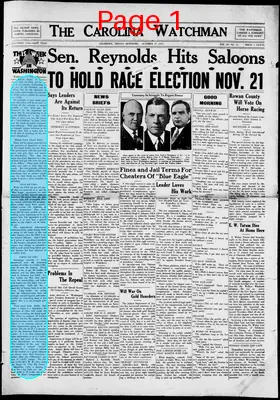
Carolina Watchman
Salisbury, Rowan County, North Carolina
What is this article about?
Washington report on clarifying Roosevelt Administration policies: no inflation after public backlash; bank assets taken over to release depositor funds; NRA advancing codes against unfair competition; faster agricultural price adjustments; rising industry strikes amid labor-capital distrust, with pro-labor tilt and push for 30-hour week.
Clipping

OCR Quality
Full Text
For example, it now seems quite clear that there will be no such inflation of the currency as seemed possible a few weeks ago. Mr. Roosevelt let the impression get about that he was preparing to go in for inflation on a big scale. That, it turns out, was the nature of a "trial balloon"-to show which way the winds of public sentiment were blowing. They were blowing so strongly against inflation in the broad sense that it seems now as if all idea of anything of the sort were abandoned.
Money From Closed Banks
There will be money provided for the payment of depositors in most of the closed banks, for one thing. The government will take over their assets and give them new money for distribution. That does not mean that every depositor in a closed bank will get 100 cents for each of his dollars. These assets will be taken over only at what they are worth. But this probably, officials think, will put a billion dollars into circulation that its owners cannot now lay their hands on, and that ought to prove a great stimulus to spending.
Prices and Codes
While the NRA has not yet done all that was expected of it, and the "Blue Eagle" agreements are only temporary, at best, business men are beginning to realize that the permanent codes will accomplish what the various industries left to themselves could never have accomplished, mainly the abolition of unfair competition. That there must also be some method of controlling prices beginning to be apparent here, but agreement is still lacking as to just how a general policy in this respect can be worked out.
The Agricultural Adjustment Administration, under George Peek, is doing its job faster, in this and other respects, than the NRA is under General Johnson. And it looks as if prices of agricultural products to the farmers, and prices that processors may charge to consumers, will be well settled long before general business has been adjusted on a similar basis.
Capital and Labor
Increasing concern is being manifested over the increasing number of strikes in various industries all over the country. Every effort so far to get the leaders of industry and the labor leaders to work in harmony has failed. Labor leaders say that they don't trust the industrialists, and industrial leaders say they don't trust organized labor. Each side has a good deal of history back of its distrust. Labor leaders are saying that the Administration leans too strongly toward Capital, and industrialists are remarking more or less openly that it is too strongly pro-labor.
There seems little doubt that when it comes to a showdown the influence of labor will weigh the heavier, everything else being equal. The effort to organize all workers in every line has the support of the Administration with reservations. There is an immense amount of labor organization going on in industry, but not all of it is sponsored by the American Federation of Labor. It is in these independent labor movements, or so it is believed here, that most of the current strike disturbances are occurring.
The tendency of the new labor movement is toward "vertical" unions-that is, unions to include all the workers in a given industry no matter what their functions-rather than the Federation's system of "craft" unions. The former is the old I. W. W. plan, under the slogan of "One Big Union."
Meantime, Labor is shaping its lines for a big fight for the 30 hour week in all trades and industries, by direct Congressional enactment.
What sub-type of article is it?
What keywords are associated?
What entities or persons were involved?
Where did it happen?
Domestic News Details
Primary Location
Washington
Key Persons
Event Details
The Administration's policies are becoming clearer through actions taken under broad executive powers. No currency inflation will occur, as a trial balloon showed public opposition. Government will provide money to depositors in closed banks by taking over assets at worth, injecting about a billion dollars into circulation. NRA's temporary Blue Eagle agreements aim toward permanent codes to abolish unfair competition, with emerging need for price controls. Agricultural Adjustment Administration under George Peek is progressing faster than NRA under General Johnson, settling farm and processor prices sooner. Increasing strikes in industries highlight distrust between labor and capital; Administration seen as leaning both ways but likely favoring labor. New labor movements favor vertical unions over craft unions, with push for 30-hour week by Congressional enactment.