Thank you for visiting SNEWPapers!
Sign up free
Rhode Island Republican
Newport, Newport County, Rhode Island
What is this article about?
This editorial critiques John Rutledge's character and actions, accusing him of forgery, perjury, and immorality based on his alleged affair and fabricated stories. It discredits witnesses defending him, highlighting biases and inconsistencies in their handwriting analyses.
Merged-components note: Continuation of the opinionated review/article on Rutledge's case from the New-York American Citizen, spanning sequential reading orders across pages 1 and 2. Relabeled to editorial due to its critical and partisan tone.
Clippings
1 of 2
OCR Quality
Full Text
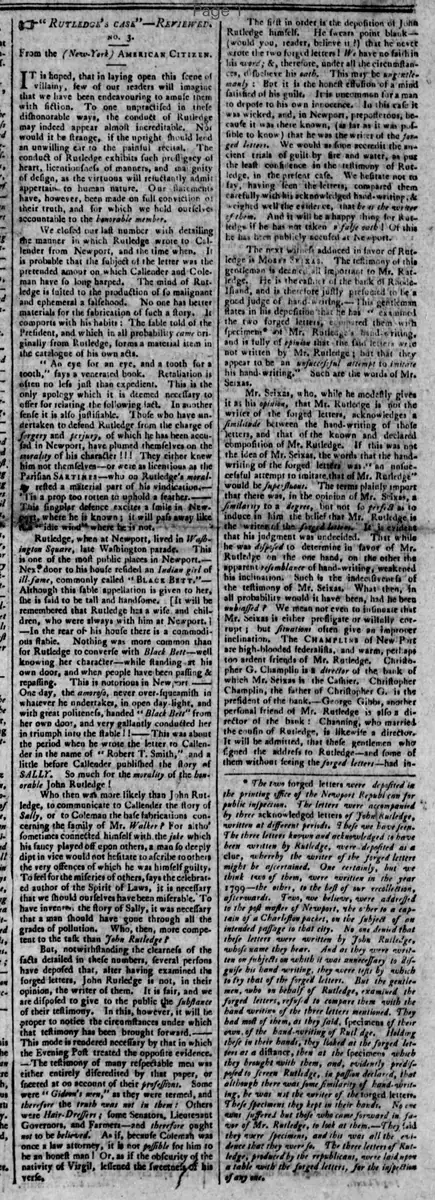
From the (New-York) American, Citizen
IT is hoped, that in laying open this scene of
villainy, few of our readers will imagine
that we have been endeavouring to amuse them
with fiction. To one unpractised in these
dishonorable ways, the conduct of Rutledge
may indeed appear almost incredible. Nor
would it be strange, if the upright should lend
an unwilling ear to the painful recital. The
conduct of Rutledge exhibits such profligacy of
heart, licentiousness of manners, and malignity
of design, as the virtuous will reluctantly admit
appertain to human nature. Our Statements
have, however, been made on full conviction of
their truth, and for which we hold ourselves
accountable to the honorable member.
We closed our last number with detailing
the manner in which Rutledge wrote to Callender
from Newport, and the time when. It
is probable that the subject of the letter was the
pretended amour on which Callender and Coleman
have so long harped. The mind of Rutledge
is fitted to the production of so malignant
and ephemeral a falsehood. No one has better
materials for the fabrication of such a story.
It comports with his habits: The fable told of the
President, and which in all probability came originally
from Rutledge, forms a material item in
the catalogue of his own acts.
"An eye for an eye, and a tooth for a
tooth," says a venerated book. Retaliation is
often no less just than expedient. This is the
only apology which it is deemed necessary to
offer for relating the following fact. In another
one it is also justifiable. Those who have undertaken
to defend Rutledge from the charge of
forgery and perjury, of which he has been accused
in Newport, have plumed themselves on the
morality of his character !!!! They either knew
him not themselves—or were as licentious as the
Parisian Satirists—who on Rutledge's morality
rested a material part of his vindication.
'Tis a prop too rotten to uphold a feather.
This singular defence excites a smile in New-
port, where he is known; it will pass away like
an idle wind where he is not.
Rutledge, when at Newport, lived in Washington
Square—late Washington parade. This
is one of the most public places in Newport.
Next door to his house resided an Indian girl of
ill-fame, commonly called "Black Bett."—
Although this sable appellation is given to her,
she is said to be tall and handsome. [It will be
remembered that Rutledge has a wife and children,
who were always with him at Newport.]
In the rear of his house there is a commodious
attic. Nothing was more common than
for Rutledge to converse with Black Bett—well
knowing her character while standing at his
own door, and when people have been passing
and repassing. This is notorious in Newport.
One day, the amoroso, never over-scrupulous in
whatever he undertakes, in open day-light, and
with great politeness, handed "Black Bett" from
her own door, and very gallantly conducted her
in triumph into the attic!!! This was about
the period when he wrote the letter to Callender
in the name of "Robert T. Smith," and a
little before Callender published the story of
SALLY. So much for the morality of the honorable
John Rutledge!
Who then was more likely than John Rutledge,
to communicate to Callender the story of
Sally, or to Coleman the base fabrications concerning
the family of Mr. Walker? For although
sometimes connected himself with the joke which
his fancy played off upon others, a man so deeply
dipt in vice would not hesitate to ascribe to another
the very offences of which he was himself guilty.
To feel for the miseries of others, says the celebrated
author of the Spirit of Laws, it is necessary
that we should ourselves have been miserable.
To have invented the story of Sally, it was necessary
that a man should have gone through all the
grades of pollution. Who, then, more competent
to the task than John Rutledge?
But, notwithstanding the clearness of the
facts detailed in these numbers, several persons
have deposed that, after having examined the
forged letters, John Rutledge is not, in their
opinion, the writer of them. It is fair, and we
are disposed to give to the public the Substance
of their testimony. In this, however, it will be
proper to notice the circumstances under which
that testimony has been brought forward. This
mode is rendered necessary by that in which
the Evening Post treated the opposite evidence.
The testimony of many respectable men was
either entirely discredited by that paper, or
sneered at on account of their profession. Some
were "Gideon's men," as they were termed, and
therefore the truth was not in them: Others
were Hair-Dressers; Some Senators, Lieutenant
Governors, and Farmers—and therefore ought
not to be believed. As if, because Coleman was
once a law attorney, it is not possible for him to
be an honest man! Or, as if the obscurity of the
nativity of Virgil, lessened the sweetness of his
verse.
The first in order is the deposition of John
Rutledge himself. He swears point blank
(would you, reader, believe it?) that he never
wrote the two forged letters! We have no faith in
his word; &, therefore, under all the circumstances,
disbelieve his oath. This may be ungentlemanly:
But it is the honest effusion of a mind
satisfied of his guilt. It is uncommon for a man
to depose to his own innocence. In this case it
was wicked, and, in Newport, preposterous, because
it was there known, (as far as it was possible
to know) that he was the writer of the forged
letters. We would no more accredit the ancients
trials of guilt by fire and water, as put
the least confidence in the testimony of Rutledge,
in the present case. We hesitate not to
say, having seen the letters, compared them
carefully with his acknowledged hand-writing,
weighed well the evidence, that he is the writer
of them. And it will be a happy thing for Rutledge
if he has not taken a false oath! Of this
he has been publicly accused at Newport.
The next witness adduced in favor of Rutledge
is Mr. Seixas. The testimony of this
gentleman is deemed all important to Mr. Rutledge.
He is the cashier of the bank of Rhode-
Island, and is therefore justly presumed to be a
good judge of hand-writing. This gentleman
states in his deposition that he has examined
the two forged letters compared them with
specimens of Mr. Rutledge's hand-writing.
and is fully of opinion that the said letters were
not written by Mr. Rutledge; but that they
appear to be an unsuccessful attempt to imitate
his hand-writing. Such are the words of Mr.
Seixas.
Mr. Seixas, who, while he modestly gives
it as his opinion, that Mr. Rutledge is not the
writer of the forged letters, acknowledges a
similarity between the hand-writing of those
letters, and that of the known and declared
composition of Mr. Rutledge. If this was not
the idea of Mr. Seixas, the words that the hand-
writing of the forged letters was "an unsuccessful
attempt to imitate that of Mr. Rutledge"
would be apt. The terms plainly import
that there was, in the opinion of Mr. Seixas, a
similarity to a degree, but not so perfect as to
induce in him the belief that Mr. Rutledge is
the writer of the forged letters. It is evident
that his judgment was undecided. That while
he was disposed to determine in favor of Mr.
Rutledge on the one hand, on the other the
apparent resemblance of hand-writing weakened
his inclination. Such is the indecision of
the testimony of Mr. Seixas. What then, in
all probability would it have been, had he been
unbiased? We mean not even to insinuate that
Mr. Seixas is either profligate or willfully corrupt;
but situations often give an improper
inclination. The Champlins of New-Port
are high-blooded federalists, and warm, perhaps
too ardent friends of Mr. Rutledge. Christopher
G. Champlin is a director of the bank of
which Mr. Seixas is the Cashier. Christopher
Champlin, the father of Christopher G. is the
president of the bank. George Gibbs, another
personal friend of Mr. Rutledge is also a director
of the bank: Channing, who married
the cousin of Rutledge, is likewise a director.
It will be admitted, that these gentlemen who
signed the address to Rutledge—and some of
them without seeing the forged letters had influence
over Mr. Seixas. Let it also be stated, that the bank is kept in Mr. Seixas's house, and that his son is one of the clerks. When all these relative circumstances are considered, the immaterial opinion of Mr. Seixas cannot have much weight.
The next deposer in favor of Rutledge is Christopher G. Champlin. This is the same gentleman, who, while in Congress, settled a point of honor with the federal champion, Bayard. Previous to the reign of terror Mr. Christopher G. Champlin was a republican. A little before that memorable period he apostatized. He expected to be appointed senator for Rhode-Island, in the room of Mr. Christopher Ellery, but was disappointed.
The rage of disappointment still swells in his breast, and on deposing for Rutledge, he vainly imagined that he was injuring the feelings of a successful rival. Under these circumstances, Mr. Christopher G. Champlin came forward to examine the forged letters and to give his opinion that Rutledge is not the writer of them. This he does on oath after having, as he states, compared them with the notes which he had received from Rutledge, which he held in his hand, but which he would not suffer any other person to look at!
We are by no means disposed to discredit the oath of Mr. Champlin. But of this we are assured, by persons who were present when he looked at the forged letters, that he did not examine them with sufficient attention to enable him to give a correct opinion; that he attended with a disposition manifestly unfriendly to that calm scrutiny which could alone satisfy the mind of a sincere enquirer.
The testimony of William Tew comes next in order. Coleman has foolishly endeavoured to quibble away that of Mr. Melville, a respectable and sensible young man, merely because he was once a hair-dresser! The folly and aristocracy of the remark is too apparent to need a comment.
Mr. Tew is a Tailor. We do not mention this in disparagement of his character, since we know many tailors much more honest and better informed than Coleman. Mr. Tew was a captain in the revolutionary army. He left the shop board to fight in defence of freedom. He was one of that phalanx of tailors, and coblers, and farmers, and if you please "hatters," that beat a disciplined but mercenary army. When the objects of the revolution were attained, Tew resumed his stitching, and is now and has been for some years Rutledge's tailor.
From the end of the war until the reign of terror, Tew was a republican. At that time, like Champlin, he veered to the federal side, perhaps convinced—as republican government then "looked squally"—that although the representative system was good, there were so many rogues in the world, that it could not be supported. After this cordial coalition with the federal party, his Son had the fortune to be appointed a lieutenant in the "Wooden Wall." of Mr. Adams.
Being Rutledge's tailor, Mr. Tew states in his affidavit that he had received billets from him on business: That he compared the hand-writing of the forged letters with that of those billets, and is convinced that Rutledge is not the writer of the forged letters.
The next affidavit maker for Rutledge, is William Littlefield, and little enough he appeared, God knows. Littlefield about three years ago was a captain of artillery in Georgia. While there, he had a remittance to make to Geffroy of Newport. This he sent from Georgia to Newport by Rutledge, for which he obtained from him a receipt. It appears that Rutledge did not know how to spell Geffroy's name. Instead of writing "Geffroy," he wrote "Jeffroy" in the receipt. When Littlefield went to the office of the Republican to examine the forged letters, he took with him Rutledge's receipt. Inclined, before he went to examine the forged letters, to certify that Rutledge was not the writer of them, he glowed with uncommon warmth when he entered the office of the Republican, and holding the receipt in his hand, vociferated where are these letters of Mr. Rutledge? By the terms of the question it was imagined that he wanted in the first place to see the acknowledged hand writing of Rutledge. It was accordingly shewn to him.
"This," says he, "this Mr. Rutledge's hand-writing! no by G—, it's no more his hand-writing than mine! Look at this receipt which he wrote in my presence, look at it; the writing which you hand to me is no more like Mr. Rutledge's than the moon's like green cheese. I swear (says Mr. Littlefield with the oriental tang) it is not Mr. Rutledge's hand-writing!"
He was told he was mistaken, the letters which had been shewn to him were confessedly Mr. Rutledge's. Perhaps you want to see the forged letters, which are ascribed to him. Littlefield blushed and answered yes. Well; the forged letter signed "Geffroy" was accordingly shewn to him. Still determined to persevere he at once declared that Rutledge was not the writer of it, And so confident was he of this that he ventured to assign a reason for his opinion. In this letter, says Mr. Littlefield, the name of Geffroy is spelled right; it is written "Geffroy." and I know of my own knowledge that Mr. Rutledge could not spell the name correctly. See here, look at this, [handing the receipt] it is signed "Jeffroy:" and the reason of it is that Mr. Rutledge did not know how to spell "Geffroy" better—poor Littlefield was yet unfortunate; the very remark made mightily against him. He was told that although one of the forged letters was signed "Geffroy" the other was subscribed "Jeffroy" and when the "Jeffroy" in the forged letter was compared with "Jeffroy" in Littlefield's receipt, they were found to accord in the structure of the word!
Littlefield bit his finger nails and wiped his face with his handkerchief: but all in vain, shame and mortification glistened in his countenance.
Littlefield however was determined to do something for Rutledge, He therefore deposes that he believes Rutledge is not the writer of the forged letters.
What sub-type of article is it?
What keywords are associated?
What entities or persons were involved?
Editorial Details
Primary Topic
Accusations Of Forgery, Perjury, And Immorality Against John Rutledge
Stance / Tone
Strongly Accusatory And Critical Of Rutledge And His Defenders
Key Figures
Key Arguments