Thank you for visiting SNEWPapers!
Sign up free
Story
January 5, 1901
Wauwatosa News
Wauwatosa, Milwaukee County, Wisconsin
What is this article about?
An official of a banana company describes how American hoboes travel to Central America, particularly Nicaragua and Costa Rica, marry local women, and settle into idle, idyllic lives on small groves, never returning home. A specific case involves a tramp who arrived three years ago and now lives comfortably without working.
Clipping
OCR Quality
98%
Excellent
Full Text
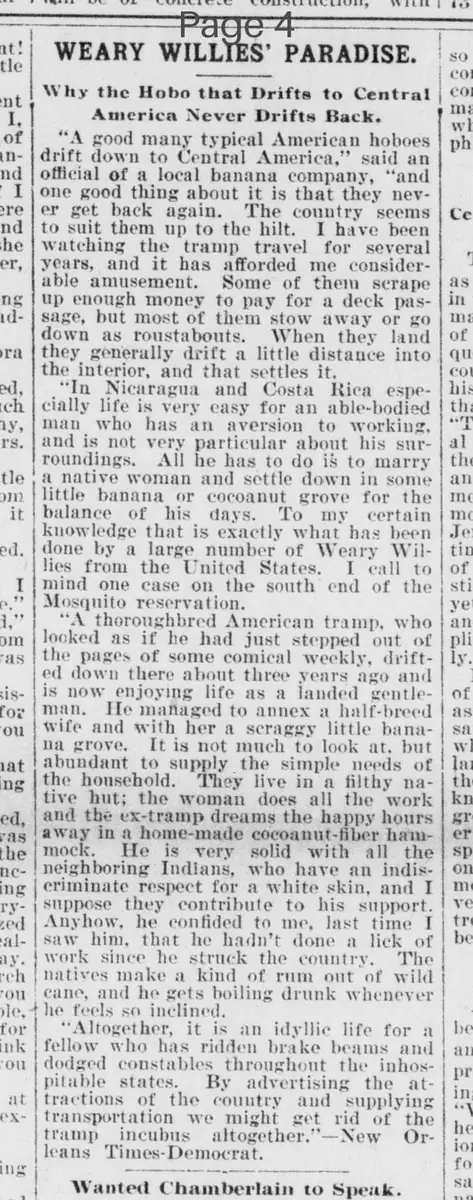
WEARY WILLIES' PARADISE.
Why the Hobo that Drifts to Central America Never Drifts Back.
"A good many typical American hoboes drift down to Central America," said an official of a local banana company, "and one good thing about it is that they never get back again. The country seems to suit them up to the hilt. I have been watching the tramp travel for several years, and it has afforded me considerable amusement. Some of them scrape up enough money to pay for a deck passage, but most of them stow away or go down as roustabouts. When they land they generally drift a little distance into the interior, and that settles it.
"In Nicaragua and Costa Rica especially life is very easy for an able-bodied man who has an aversion to working, and is not very particular about his surroundings. All he has to do is to marry a native woman and settle down in some little banana or cocoanut grove for the balance of his days. To my certain knowledge that is exactly what has been done by a large number of Weary Willies from the United States. I call to mind one case on the south end of the Mosquito reservation.
"A thoroughbred American tramp, who looked as if he had just stepped out of the pages of some comical weekly, drifted down there about three years ago and is now enjoying life as a landed gentleman. He managed to annex a half-breed wife and with her a scraggy little banana grove. It is not much to look at, but abundant to supply the simple needs of the household. They live in a filthy native hut; the woman does all the work and the ex-tramp dreams the happy hours away in a home-made cocoanut-fiber hammock. He is very solid with all the neighboring Indians, who have an indiscriminate respect for a white skin, and I suppose they contribute to his support. Anyhow, he confided to me, last time I saw him, that he hadn't done a lick of work since he struck the country. The natives make a kind of rum out of wild cane, and he gets boiling drunk whenever he feels so inclined.
"Altogether, it is an idyllic life for a fellow who has ridden brake beams and dodged constables throughout the inhospitable states. By advertising the attractions of the country and supplying transportation we might get rid of the tramp incubus altogether."-New Orleans Times-Democrat.
Why the Hobo that Drifts to Central America Never Drifts Back.
"A good many typical American hoboes drift down to Central America," said an official of a local banana company, "and one good thing about it is that they never get back again. The country seems to suit them up to the hilt. I have been watching the tramp travel for several years, and it has afforded me considerable amusement. Some of them scrape up enough money to pay for a deck passage, but most of them stow away or go down as roustabouts. When they land they generally drift a little distance into the interior, and that settles it.
"In Nicaragua and Costa Rica especially life is very easy for an able-bodied man who has an aversion to working, and is not very particular about his surroundings. All he has to do is to marry a native woman and settle down in some little banana or cocoanut grove for the balance of his days. To my certain knowledge that is exactly what has been done by a large number of Weary Willies from the United States. I call to mind one case on the south end of the Mosquito reservation.
"A thoroughbred American tramp, who looked as if he had just stepped out of the pages of some comical weekly, drifted down there about three years ago and is now enjoying life as a landed gentleman. He managed to annex a half-breed wife and with her a scraggy little banana grove. It is not much to look at, but abundant to supply the simple needs of the household. They live in a filthy native hut; the woman does all the work and the ex-tramp dreams the happy hours away in a home-made cocoanut-fiber hammock. He is very solid with all the neighboring Indians, who have an indiscriminate respect for a white skin, and I suppose they contribute to his support. Anyhow, he confided to me, last time I saw him, that he hadn't done a lick of work since he struck the country. The natives make a kind of rum out of wild cane, and he gets boiling drunk whenever he feels so inclined.
"Altogether, it is an idyllic life for a fellow who has ridden brake beams and dodged constables throughout the inhospitable states. By advertising the attractions of the country and supplying transportation we might get rid of the tramp incubus altogether."-New Orleans Times-Democrat.
What sub-type of article is it?
Curiosity
Journey
What themes does it cover?
Fortune Reversal
Survival
What keywords are associated?
Hobo Migration
Central America Paradise
American Tramps
Banana Grove Settlement
Easy Life For Vagrants
What entities or persons were involved?
American Hoboes
American Tramp
Where did it happen?
Central America, Nicaragua, Costa Rica, Mosquito Reservation
Story Details
Key Persons
American Hoboes
American Tramp
Location
Central America, Nicaragua, Costa Rica, Mosquito Reservation
Event Date
About Three Years Ago
Story Details
American hoboes drift to Central America, marry native women, and settle in banana or cocoanut groves, living easy lives without work, as exemplified by a tramp who became a landed gentleman in Nicaragua.