Thank you for visiting SNEWPapers!
Sign up free
Story
March 5, 1907
The Richmond Palladium
Richmond, Wayne County, Indiana
What is this article about?
In Richmond circuit court, Judge Fox upholds the city's peddling ordinance as constitutional, ruling it does not discriminate by exempting producers of their own goods. Defendants Henry Zuttermeister, Harry Patridge, and Ford Curry found guilty of peddling bananas without a license, reversing prior invalidation by Judge Converse.
Clipping
OCR Quality
98%
Excellent
Full Text
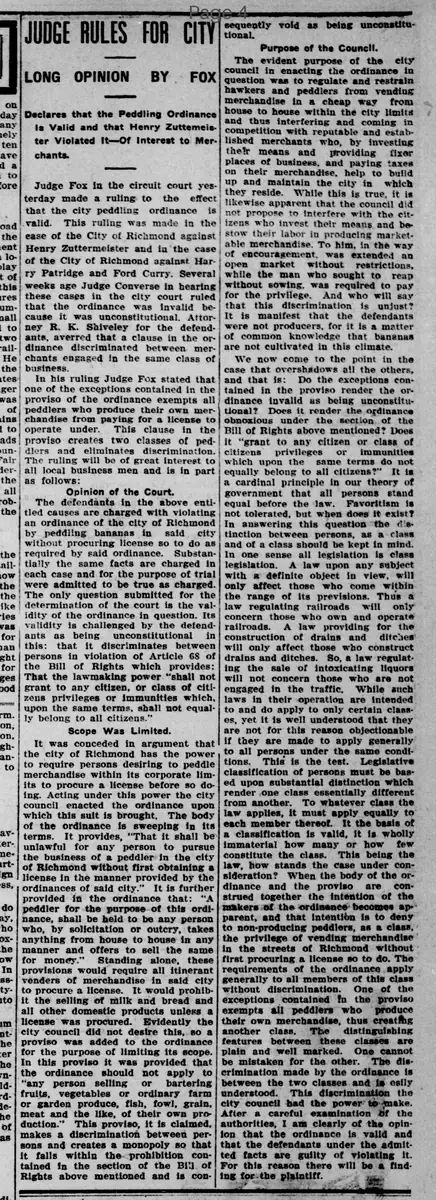
JUDGE RULES FOR CITY
LONG OPINION BY FOX
Declares that the Peddling Ordinance Is Valid and that Henry Zuttermeister Violated It—Of Interest to Merchants.
Judge Fox in the circuit court yesterday made a ruling to the effect that the city peddling ordinance is valid. This ruling was made in the case of the City of Richmond against Henry Zuttermeister and in the case of the City of Richmond against Harry Patridge and Ford Curry. Several weeks ago Judge Converse in hearing these cases in the city court ruled that the ordinance was invalid because it was unconstitutional. Attorney R. K. Shively for the defendants, averred that a clause in the ordinance discriminated between merchants engaged in the same class of business.
In his ruling Judge Fox stated that one of the exceptions contained in the proviso of the ordinance exempts all peddlers who produce their own merchandise from paying for a license to operate under. This clause in the proviso creates two classes of peddlers and eliminates discrimination. The ruling will be of great interest to all local business men and is in part as follows:
Opinion of the Court.
The defendants in the above entitled causes are charged with violating an ordinance of the city of Richmond by peddling bananas in said city without procuring license so to do as required by said ordinance. Substantially the same facts are charged in each case and for the purpose of trial were admitted to be true as charged.
The only question submitted for the determination of the court is the validity of the ordinance in question. Its validity is challenged by the defendants as being unconstitutional in this: that it discriminates between persons in violation of Article 68 of the Bill of Rights which provides:
That the lawmaking power "shall not grant to any citizen, or class of citizens privileges or immunities which, upon the same terms, shall not equally belong to all citizens."
Scope Was Limited.
It was conceded in argument that the city of Richmond has the power to require persons desiring to peddle merchandise within its corporate limits to procure a license before so doing. Acting under this power the city council enacted the ordinance upon which this suit is brought. The body of the ordinance is sweeping in its terms. It provides. "That it shall be unlawful for any person to pursue the business of a peddler in the city of Richmond without first obtaining a license in the manner provided by the ordinances of said city." It is further provided in the ordinance that: "A peddler for the purpose of this ordinance, shall be held to be any person who, by solicitation or outcry, takes anything from house to house in any manner and offers to sell the same for money."
Standing alone, these provisions would require all itinerant venders of merchandise in said city to procure a license. It would prohibit the selling of milk and bread and all other domestic products unless a license was procured. Evidently the city council did not desire this, so a proviso was added to the ordinance for the purpose of limiting its scope. In this proviso it was provided that the ordinance should not apply to "any person selling or bartering fruits, vegetables or ordinary farm or garden produce, fish, fowl, grain, meat and the like, of their own production." This proviso, it is claimed, makes a discrimination between persons and creates a monopoly so that it falls within the prohibition contained in the section of the Bill of Rights above mentioned and is consequently void as being unconstitutional.
Purpose of the Council.
The evident purpose of the city council in enacting the ordinance in question was to regulate and restrain hawkers and peddlers from vending merchandise in a cheap way from house to house within the city limits and thus interfering and coming in competition with reputable and established merchants who, by investing their means and providing fixed places of business, and paying taxes on their merchandise, help to build up and maintain the city in which they reside. While this is true, it is likewise apparent that the council did not propose to interfere with the citizens who invest their means and bestow their labor in producing marketable merchandise. To him, in the way of encouragement, was extended an open market without restrictions, while the man who sought to reap without sowing, was required to pay for the privilege. And who will say that this discrimination is unjust?
It is manifest that the defendants were not producers, for it is a matter of common knowledge that bananas are not cultivated in this climate.
We now come to the point in the case that overshadows all the others, and that is: Do the exceptions contained in the proviso render the ordinance invalid as being unconstitutional? Does it render the ordinance obnoxious under the section of the Bill of Rights above mentioned? Does it "grant to any citizen or class of citizens privileges or immunities which upon the same terms do not equally belong to all citizens?" It is a cardinal principle in our theory of government that all persons stand equal before the law. Favoritism is not tolerated, but when does it exist?
In answering this question the distinction between persons, as a class and of a class should be kept in mind. In one sense all legislation is class legislation. A law upon any subject with a definite object in view, will only affect those who come within the range of its provisions. Thus a law regulating railroads will only concern those who own and operate railroads. A law providing for the construction of drains and ditches will only affect those who construct drains and ditches. So, a law regulating the sale of intoxicating liquors will not concern those who are not engaged in the traffic. While such laws in their operation are intended to and do apply to only certain classes, yet it is well understood that they are not for this reason objectionable if they are made to apply generally to all persons under the same conditions. This is the test. Legislative classification of persons must be based upon substantial distinction which render one class essentially different from another. To whatever class the law applies, it must apply equally to each member thereof. If the basis of a classification is valid, it is wholly immaterial how many or how few constitute the class. This being the law, how stands the case under consideration? When the body of the ordinance and the proviso are construed together the intention of the makers of the ordinance becomes apparent, and that intention is to deny to non-producing peddlers, as a class, the privilege of vending merchandise in the streets of Richmond without first procuring a license so to do. The requirements of the ordinance apply generally to all members of this class without discrimination. One of the exceptions contained in the proviso exempts all peddlers who produce their own merchandise, thus creating another class. The distinguishing features between these classes are plain and well marked. One cannot be mistaken for the other. The discrimination made by the ordinance is between the two classes and is easily understood. This discrimination the city council had the power to make. After a careful examination of the authorities, I am clearly of the opinion that the ordinance is valid and that the defendants under the admitted facts are guilty of violating it. For this reason there will be a finding for the plaintiff.
LONG OPINION BY FOX
Declares that the Peddling Ordinance Is Valid and that Henry Zuttermeister Violated It—Of Interest to Merchants.
Judge Fox in the circuit court yesterday made a ruling to the effect that the city peddling ordinance is valid. This ruling was made in the case of the City of Richmond against Henry Zuttermeister and in the case of the City of Richmond against Harry Patridge and Ford Curry. Several weeks ago Judge Converse in hearing these cases in the city court ruled that the ordinance was invalid because it was unconstitutional. Attorney R. K. Shively for the defendants, averred that a clause in the ordinance discriminated between merchants engaged in the same class of business.
In his ruling Judge Fox stated that one of the exceptions contained in the proviso of the ordinance exempts all peddlers who produce their own merchandise from paying for a license to operate under. This clause in the proviso creates two classes of peddlers and eliminates discrimination. The ruling will be of great interest to all local business men and is in part as follows:
Opinion of the Court.
The defendants in the above entitled causes are charged with violating an ordinance of the city of Richmond by peddling bananas in said city without procuring license so to do as required by said ordinance. Substantially the same facts are charged in each case and for the purpose of trial were admitted to be true as charged.
The only question submitted for the determination of the court is the validity of the ordinance in question. Its validity is challenged by the defendants as being unconstitutional in this: that it discriminates between persons in violation of Article 68 of the Bill of Rights which provides:
That the lawmaking power "shall not grant to any citizen, or class of citizens privileges or immunities which, upon the same terms, shall not equally belong to all citizens."
Scope Was Limited.
It was conceded in argument that the city of Richmond has the power to require persons desiring to peddle merchandise within its corporate limits to procure a license before so doing. Acting under this power the city council enacted the ordinance upon which this suit is brought. The body of the ordinance is sweeping in its terms. It provides. "That it shall be unlawful for any person to pursue the business of a peddler in the city of Richmond without first obtaining a license in the manner provided by the ordinances of said city." It is further provided in the ordinance that: "A peddler for the purpose of this ordinance, shall be held to be any person who, by solicitation or outcry, takes anything from house to house in any manner and offers to sell the same for money."
Standing alone, these provisions would require all itinerant venders of merchandise in said city to procure a license. It would prohibit the selling of milk and bread and all other domestic products unless a license was procured. Evidently the city council did not desire this, so a proviso was added to the ordinance for the purpose of limiting its scope. In this proviso it was provided that the ordinance should not apply to "any person selling or bartering fruits, vegetables or ordinary farm or garden produce, fish, fowl, grain, meat and the like, of their own production." This proviso, it is claimed, makes a discrimination between persons and creates a monopoly so that it falls within the prohibition contained in the section of the Bill of Rights above mentioned and is consequently void as being unconstitutional.
Purpose of the Council.
The evident purpose of the city council in enacting the ordinance in question was to regulate and restrain hawkers and peddlers from vending merchandise in a cheap way from house to house within the city limits and thus interfering and coming in competition with reputable and established merchants who, by investing their means and providing fixed places of business, and paying taxes on their merchandise, help to build up and maintain the city in which they reside. While this is true, it is likewise apparent that the council did not propose to interfere with the citizens who invest their means and bestow their labor in producing marketable merchandise. To him, in the way of encouragement, was extended an open market without restrictions, while the man who sought to reap without sowing, was required to pay for the privilege. And who will say that this discrimination is unjust?
It is manifest that the defendants were not producers, for it is a matter of common knowledge that bananas are not cultivated in this climate.
We now come to the point in the case that overshadows all the others, and that is: Do the exceptions contained in the proviso render the ordinance invalid as being unconstitutional? Does it render the ordinance obnoxious under the section of the Bill of Rights above mentioned? Does it "grant to any citizen or class of citizens privileges or immunities which upon the same terms do not equally belong to all citizens?" It is a cardinal principle in our theory of government that all persons stand equal before the law. Favoritism is not tolerated, but when does it exist?
In answering this question the distinction between persons, as a class and of a class should be kept in mind. In one sense all legislation is class legislation. A law upon any subject with a definite object in view, will only affect those who come within the range of its provisions. Thus a law regulating railroads will only concern those who own and operate railroads. A law providing for the construction of drains and ditches will only affect those who construct drains and ditches. So, a law regulating the sale of intoxicating liquors will not concern those who are not engaged in the traffic. While such laws in their operation are intended to and do apply to only certain classes, yet it is well understood that they are not for this reason objectionable if they are made to apply generally to all persons under the same conditions. This is the test. Legislative classification of persons must be based upon substantial distinction which render one class essentially different from another. To whatever class the law applies, it must apply equally to each member thereof. If the basis of a classification is valid, it is wholly immaterial how many or how few constitute the class. This being the law, how stands the case under consideration? When the body of the ordinance and the proviso are construed together the intention of the makers of the ordinance becomes apparent, and that intention is to deny to non-producing peddlers, as a class, the privilege of vending merchandise in the streets of Richmond without first procuring a license so to do. The requirements of the ordinance apply generally to all members of this class without discrimination. One of the exceptions contained in the proviso exempts all peddlers who produce their own merchandise, thus creating another class. The distinguishing features between these classes are plain and well marked. One cannot be mistaken for the other. The discrimination made by the ordinance is between the two classes and is easily understood. This discrimination the city council had the power to make. After a careful examination of the authorities, I am clearly of the opinion that the ordinance is valid and that the defendants under the admitted facts are guilty of violating it. For this reason there will be a finding for the plaintiff.
What sub-type of article is it?
Crime Story
Historical Event
What themes does it cover?
Justice
Crime Punishment
What keywords are associated?
Peddling Ordinance
Court Ruling
License Violation
Richmond Merchants
Bananas Peddling
What entities or persons were involved?
Judge Fox
Henry Zuttermeister
Harry Patridge
Ford Curry
Judge Converse
R. K. Shively
Where did it happen?
Richmond
Story Details
Key Persons
Judge Fox
Henry Zuttermeister
Harry Patridge
Ford Curry
Judge Converse
R. K. Shively
Location
Richmond
Story Details
Judge Fox rules the city peddling ordinance valid, rejecting claims of unconstitutional discrimination; exemptions for producers of own goods create justified classes; defendants guilty of peddling bananas without license.