Thank you for visiting SNEWPapers!
Sign up free
Literary
August 29, 1829
The Delaware Register, Or, Farmers', Manufacturers' & Mechanics' Advocate
Wilmington, New Castle County, Delaware
What is this article about?
A Scottish tale of Douglas Warrington, adopted by his Scottish relatives into Clan Ronald, becoming chieftain. His sister Lucy, visiting the Highlands, falls in love with rival MacGregor MacDonald, leading to clan feud, misunderstanding, and her descent into madness amid Scotland's fight for independence.
Merged-components note: Continuation of the Scottish Tale across pages 1 and 2, as indicated by direct text connection.
Clippings
1 of 2
OCR Quality
95%
Excellent
Full Text
FOR THE DELAWARE REGISTER.
SCOTTISH TALE.
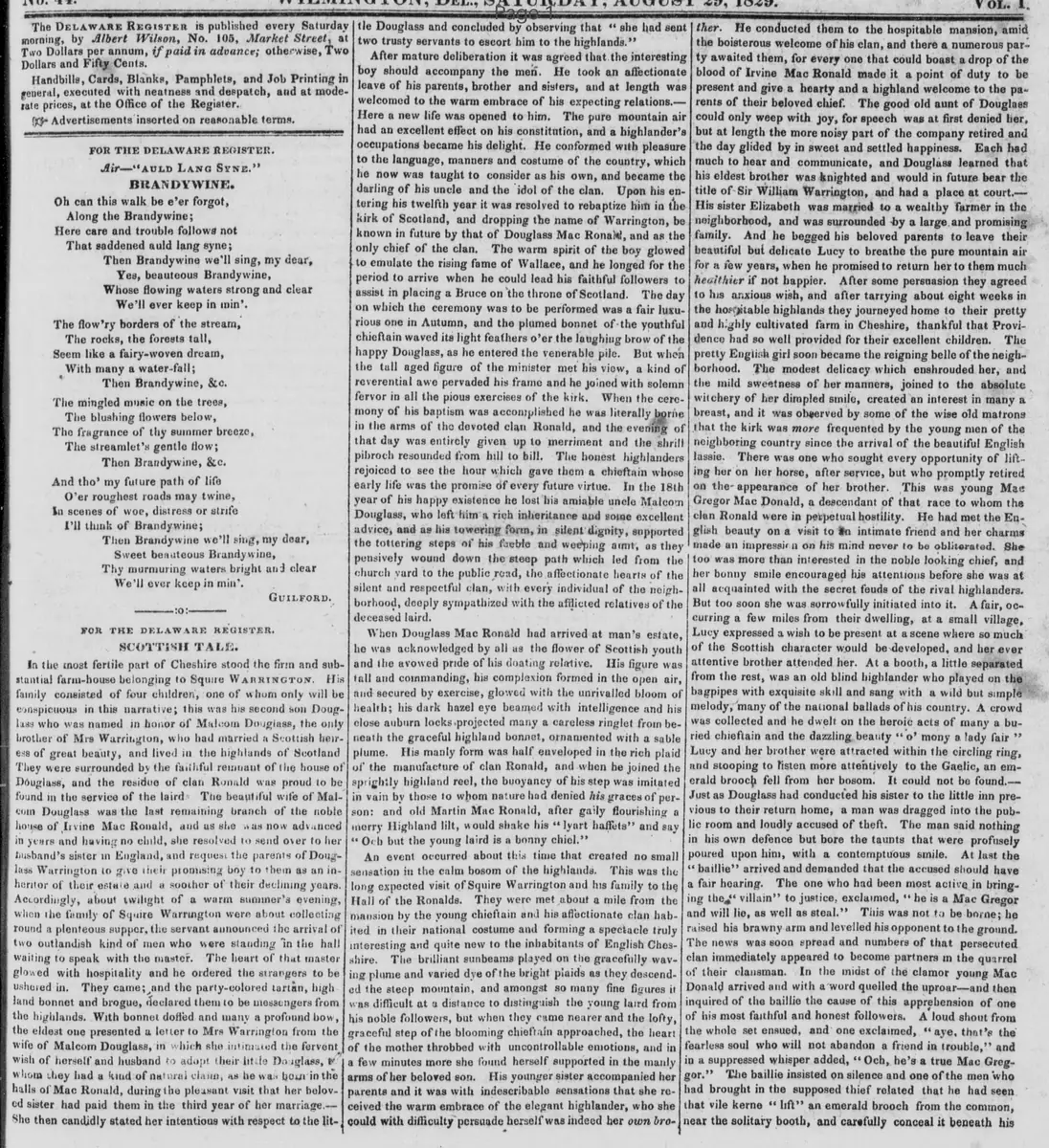
In the most fertile part of Cheshire stood the firm and substantial farm-house belonging to Squire Warrington. His family consisted of four children, one of whom only will be conspicuous in this narrative; this was his second son Douglas who was named in honor of Malcom Douglas, the only brother of Mrs. Warrington, who had married a Scottish heiress of great beauty, and lived in the highlands of Scotland. They were surrounded by the faithful remnant of the house of Douglas, and the residue of clan Ronald was proud to be found in the service of the laird. The beautiful wife of Malcom Douglas was the last remaining branch of the noble house of Irvine Mac Ronald, and as she was now advanced in years and having no child, she resolved to send over to her husband's sister in England, and request the parents of Douglas Warrington to give their promising boy to them as an inheritor of their estate and a soother of their declining years.
Accordingly, about twilight of a warm summer's evening, when the family of Squire Warrington were about collecting round a plenteous supper, the servant announced the arrival of two outlandish kind of men who were standing in the hall waiting to speak with the master. The heart of that master glowed with hospitality and he ordered the strangers to be ushered in. They came; and the party-colored tartan, highland bonnet and brogue, declared them to be messengers from the highlands. With bonnet doffed and many a profound bow, the eldest one presented a letter to Mrs. Warrington from the wife of Malcom Douglas, in which she intimated the fervent wish of herself and husband to adopt their little Douglas, to whom they had a kind of natural claim, as he was born in the halls of Mac Ronald, during the pleasant visit that her beloved sister had paid them in the third year of her marriage.
She then candidly stated her intentions with respect to the little Douglas and concluded by observing that 'she had sent two trusty servants to escort him to the highlands.'
After mature deliberation it was agreed that the interesting boy should accompany the men. He took an affectionate leave of his parents, brother and sisters, and at length was welcomed to the warm embrace of his expecting relations.
Here a new life was opened to him. The pure mountain air had an excellent effect on his constitution, and a highlander's occupations became his delight. He conformed with pleasure to the language, manners and costume of the country, which he now was taught to consider as his own, and became the darling of his uncle and the idol of the clan. Upon his entering his twelfth year it was resolved to rebaptize him in the kirk of Scotland, and dropping the name of Warrington, be known in future by that of Douglas Mac Ronald, and as the only chief of the clan. The warm spirit of the boy glowed to emulate the rising fame of Wallace, and he longed for the period to arrive when he could lead his faithful followers to assist in placing a Bruce on the throne of Scotland. The day on which the ceremony was to be performed was a fair luxurious one in Autumn, and the plumed bonnet of the youthful chieftain waved its light feathers o'er the laughing brow of the happy Douglas, as he entered the venerable pile. But when the tall aged figure of the minister met his view, a kind of reverential awe pervaded his frame and he joined with solemn fervor in all the pious exercises of the kirk. When the ceremony of his baptism was accomplished he was literally borne in the arms of the devoted clan Ronald, and the evening of that day was entirely given up to merriment and the shrill pibroch resounded from hill to hill. The honest highlanders rejoiced to see the hour which gave them a chieftain whose early life was the promise of every future virtue. In the 18th year of his happy existence he lost his amiable uncle Malcom Douglas, who left him a rich inheritance and some excellent advice, and as his towering form, in silent dignity, supported the tottering steps of his feeble and weeping aunt, as they pensively wound down the steep path which led from the church yard to the public road, the affectionate hearts of the silent and respectful clan, with every individual of the neighborhood, deeply sympathized with the afflicted relatives of the deceased laird.
When Douglas Mac Ronald had arrived at man's estate, he was acknowledged by all as the flower of Scottish youth and the avowed pride of his doting relative. His figure was tall and commanding, his complexion formed in the open air, and secured by exercise, glowed with the unrivalled bloom of health; his dark hazel eye beamed with intelligence and his close auburn locks projected many a careless ringlet from beneath the graceful highland bonnet, ornamented with a sable plume. His manly form was half enveloped in the rich plaid of the manufacture of clan Ronald, and when he joined the sprightly highland reel, the buoyancy of his step was imitated in vain by those to whom nature had denied his graces of person: and old Martin Mac Ronald, after gaily flourishing a merry Highland lilt, would shake his 'lyart haffets' and say 'Och but the young laird is a bonny chiel.'
An event occurred about this time that created no small sensation in the calm bosom of the highlands. This was the long expected visit of Squire Warrington and his family to the Hall of the Ronalds. They were met about a mile from the mansion by the young chieftain and his affectionate clan habited in their national costume and forming a spectacle truly interesting and quite new to the inhabitants of English Cheshire. The brilliant sunbeams played on the gracefully waving plume and varied dye of the bright plaids as they descended the steep mountain, and amongst so many fine figures it was difficult at a distance to distinguish the young laird from his noble followers, but when they came nearer and the lofty, graceful step of the blooming chieftain approached, the heart of the mother throbbed with uncontrollable emotions, and in a few minutes more she found herself supported in the manly arms of her beloved son. His younger sister accompanied her parents and it was with indescribable sensations that she received the warm embrace of the elegant highlander, who she could with difficulty persuade herself was indeed her own brother. He conducted them to the hospitable mansion, amid the boisterous welcome of his clan, and there a numerous party awaited them, for every one that could boast a drop of the blood of Irvine Mac Ronald made it a point of duty to be present and give a hearty and a highland welcome to the parents of their beloved chief. The good old aunt of Douglas could only weep with joy, for speech was at first denied her, but at length the more noisy part of the company retired and the day glided by in sweet and settled happiness. Each had much to hear and communicate, and Douglas learned that his eldest brother was knighted and would in future bear the title of Sir William Warrington, and had a place at court.
His sister Elizabeth was married to a wealthy farmer in the neighborhood, and was surrounded by a large and promising family. And he begged his beloved parents to leave their beautiful but delicate Lucy to breathe the pure mountain air for a few years, when he promised to return her to them much healthier if not happier. After some persuasion they agreed to his anxious wish, and after tarrying about eight weeks in the hospitable highlands they journeyed home to their pretty and highly cultivated farm in Cheshire, thankful that Providence had so well provided for their excellent children. The pretty English girl soon became the reigning belle of the neighborhood. The modest delicacy which enshrouded her, and the mild sweetness of her manners, joined to the absolute witchery of her dimpled smile, created an interest in many a breast, and it was observed by some of the wise old matrons that the kirk was more frequented by the young men of the neighboring country since the arrival of the beautiful English lassie. There was one who sought every opportunity of lifting her on her horse, after service, but who promptly retired on the appearance of her brother. This was young Mac Gregor Mac Donald, a descendant of that race to whom the clan Ronald were in perpetual hostility. He had met the English beauty on a visit to an intimate friend and her charms made an impression on his mind never to be obliterated. She too was more than interested in the noble looking chief, and her bonny smile encouraged his attentions before she was at all acquainted with the secret feuds of the rival highlanders.
But too soon she was sorrowfully initiated into it. A fair, occurring a few miles from their dwelling, at a small village, Lucy expressed a wish to be present at a scene where so much of the Scottish character would be developed, and her ever attentive brother attended her. At a booth, a little separated from the rest, was an old blind highlander who played on the bagpipes with exquisite skill and sang with a wild but simple melody, many of the national ballads of his country. A crowd was collected and he dwelt on the heroic acts of many a buried chieftain and the dazzling beauty 'o' mony a lady fair.' Lucy and her brother were attracted within the circling ring, and stooping to listen more attentively to the Gaelic, an emerald brooch fell from her bosom. It could not be found.
Just as Douglas had conducted his sister to the little inn previous to their return home, a man was dragged into the public room and loudly accused of theft. The man said nothing in his own defence but bore the taunts that were profusely poured upon him, with a contemptuous smile. At last the 'baillie' arrived and demanded that the accused should have a fair hearing. The one who had been most active in bringing the 'villain' to justice, exclaimed, 'he is a Mac Gregor and will lie, as well as steal.' This was not to be borne; he raised his brawny arm and levelled his opponent to the ground. The news was soon spread and numbers of that persecuted clan immediately appeared to become partners in the quarrel of their clansman. In the midst of the clamor young Mac Donald arrived and with a word quelled the uproar—and then inquired of the baillie the cause of this apprehension of one of his most faithful and honest followers. A loud shout from the whole set ensued, and one exclaimed, 'aye, that's the fearless soul who will not abandon a friend in trouble,' and in a suppressed whisper added, 'Och, he's a true Mac Gregor.' The baillie insisted on silence and one of the men who had brought in the supposed thief related that he had seen that vile kerne 'lift' an emerald brooch from the common, near the solitary booth, and carefully conceal it beneath his plaid; that he had heard one of the servants of an English lady say, it belonged to her mistress, who had one in her bosom when she left home; and besides, added he, I knew he was a Mac Gregor, and -- Here the haughty Mac Donald interposed, and with one grasp of his powerful hand warned him into silence by intimating that there were more Mac Gregors than one present. Here Douglass interfered and wished to see the brooch in question. The stubborn highlander would not produce it, or say if he had it or not. His master then took him aside and he related in the most simple manner, that he had seen it fall (on purpose, he thought,) into the bonnet of his master who stood very near Lucy, listening to the old man's music; that as his lord was hurrying across the common, the brooch was dropped, and believing his master valued both it and the lady to whom it had belonged, he had secured it, intending to give it to him the first opportunity, and was seeking him for that purpose, when these pitiful wretches seized him and charged him with the theft, and moreover called one of the Mac Gregors a liar, which could only be obliterated by blood. During this conference, Douglass had returned to his sister to give her an account of this unpleasant affair and to tell her that it was the practice in the highlands for every member of the clan to hold together, and that as his men were the beginners of this quarrel, he must of course end it. She clung to his arm and would have spoken, but could not. Her color rose and soon she was pale as any lily.— —
In this moment of agitation the door opened and Mac Donald entered with a flushed countenance and stood before them. Douglass eyed him with a look of piercing ire, but this was a man who could and who did "return the chief his haughty stare." At last Lucy bursting into tears sobbed out, ah! my brother, can you excuse your Lucy for concealing a circumstance from your knowledge, which she trembled to unfold before; but now fear of awful consequences emboldens her to declare the brooch was loaned by me to Donald in return for one he begged me to wear for him, until we met again at the kirk. I thought -- You thought what!! that the sister of clan Ronald's chief should exchange gifts with a Mac Gregor!? Oh! Lucy--why did I let your English prejudices prevent me from informing you of the deadly hatred between the head of that rebellious clan and every one that boasts the blood of Ronald. But it is time you should know it, and when we arrive at the mansion my excellent aunt will tell you that it is our duty to hate the Mac Gregors. But all the brother's observations were rendered pointless by an imploring look from the eloquently speaking eye of Mac Donald. She suffered herself to be conducted home by her brother, secretly determining not to be influenced by the strong prejudices of her highland relative. The affair at the inn was for the present hushed up, but every bitter word then spoken, was treasured by the separate members of each warlike clan. Now it was that every loyal chieftain was called upon to join the royal standard that waved in the camp of Wallace; and private animosities were sunk in the public good. The martial clans of Scotland favorable to the house of Stewart were called upon to exert themselves, and the heroic brother of Lucy would not stay behind. He sent off the main body of his retainers, intending to follow them immediately on his return from England, as he had resolved to see his sister safe under the paternal roof ere he joined the noble hero of his country. But the prayers, the tears of his aunt, caused him to alter his resolution, and leave his lovely sister with her to console her for his absence whilst performing his duty in camp. To this he reluctantly agreed; and the next day, with the remainder of his troop, joined the gallant train. Lucy now rarely went to the kirk, as her relation was an invalid; but one fine pleasant morning her aunt insisted on her riding there, for a little change of scene. She went and was returning down the steep pathway, followed by an old white-haired servant, when her attention was arrested by the peculiar beauty of a smiling little page that seemed to gambol around her. At last he brushed close by her and caused her to drop her handkerchief: this he returned so gracefully on one knee, that she wished to converse with him, when the old man hastily stepped up, and pointed to his tartans which were of the Mac Gregor plaid. She turned quickly away and pressing her handkerchief found the little page had very adroitly slipped a fold of paper therein. She could not read it then, for the old man was near her. She was obliged to postpone it until her return home. Then she found that her own faithful Donald had obtained a furlough from the army and would wait on the western ridge of the mountains to communicate tidings of the utmost importance to them both; but the old lady was worse that night and she could not leave her. In the morning a little lad ran in, with horror depicted on his countenance, saying the chief of the Mac Gregors was found murdered within the precincts of their domain, on the western ridge of mountains. Lucy fainted--and when recovered from insensibility, her reason had fled; and the beauteous English girl was returned to her parents a confirmed maniac. Often the valley of Cheshire re-echoed with her ravings. She saw the hand of her brother lifted against him she loved--and a plaid of Mac Gregor's was her favorite mantle. Enfolded in this she braved the winter's snow, and the summer's rain, and the only pleasure she seemed to take in this dreary world, was warbling a mournful Gaelic ditty she had learned in the Highlands.
THEODORE.
SCOTTISH TALE.
In the most fertile part of Cheshire stood the firm and substantial farm-house belonging to Squire Warrington. His family consisted of four children, one of whom only will be conspicuous in this narrative; this was his second son Douglas who was named in honor of Malcom Douglas, the only brother of Mrs. Warrington, who had married a Scottish heiress of great beauty, and lived in the highlands of Scotland. They were surrounded by the faithful remnant of the house of Douglas, and the residue of clan Ronald was proud to be found in the service of the laird. The beautiful wife of Malcom Douglas was the last remaining branch of the noble house of Irvine Mac Ronald, and as she was now advanced in years and having no child, she resolved to send over to her husband's sister in England, and request the parents of Douglas Warrington to give their promising boy to them as an inheritor of their estate and a soother of their declining years.
Accordingly, about twilight of a warm summer's evening, when the family of Squire Warrington were about collecting round a plenteous supper, the servant announced the arrival of two outlandish kind of men who were standing in the hall waiting to speak with the master. The heart of that master glowed with hospitality and he ordered the strangers to be ushered in. They came; and the party-colored tartan, highland bonnet and brogue, declared them to be messengers from the highlands. With bonnet doffed and many a profound bow, the eldest one presented a letter to Mrs. Warrington from the wife of Malcom Douglas, in which she intimated the fervent wish of herself and husband to adopt their little Douglas, to whom they had a kind of natural claim, as he was born in the halls of Mac Ronald, during the pleasant visit that her beloved sister had paid them in the third year of her marriage.
She then candidly stated her intentions with respect to the little Douglas and concluded by observing that 'she had sent two trusty servants to escort him to the highlands.'
After mature deliberation it was agreed that the interesting boy should accompany the men. He took an affectionate leave of his parents, brother and sisters, and at length was welcomed to the warm embrace of his expecting relations.
Here a new life was opened to him. The pure mountain air had an excellent effect on his constitution, and a highlander's occupations became his delight. He conformed with pleasure to the language, manners and costume of the country, which he now was taught to consider as his own, and became the darling of his uncle and the idol of the clan. Upon his entering his twelfth year it was resolved to rebaptize him in the kirk of Scotland, and dropping the name of Warrington, be known in future by that of Douglas Mac Ronald, and as the only chief of the clan. The warm spirit of the boy glowed to emulate the rising fame of Wallace, and he longed for the period to arrive when he could lead his faithful followers to assist in placing a Bruce on the throne of Scotland. The day on which the ceremony was to be performed was a fair luxurious one in Autumn, and the plumed bonnet of the youthful chieftain waved its light feathers o'er the laughing brow of the happy Douglas, as he entered the venerable pile. But when the tall aged figure of the minister met his view, a kind of reverential awe pervaded his frame and he joined with solemn fervor in all the pious exercises of the kirk. When the ceremony of his baptism was accomplished he was literally borne in the arms of the devoted clan Ronald, and the evening of that day was entirely given up to merriment and the shrill pibroch resounded from hill to hill. The honest highlanders rejoiced to see the hour which gave them a chieftain whose early life was the promise of every future virtue. In the 18th year of his happy existence he lost his amiable uncle Malcom Douglas, who left him a rich inheritance and some excellent advice, and as his towering form, in silent dignity, supported the tottering steps of his feeble and weeping aunt, as they pensively wound down the steep path which led from the church yard to the public road, the affectionate hearts of the silent and respectful clan, with every individual of the neighborhood, deeply sympathized with the afflicted relatives of the deceased laird.
When Douglas Mac Ronald had arrived at man's estate, he was acknowledged by all as the flower of Scottish youth and the avowed pride of his doting relative. His figure was tall and commanding, his complexion formed in the open air, and secured by exercise, glowed with the unrivalled bloom of health; his dark hazel eye beamed with intelligence and his close auburn locks projected many a careless ringlet from beneath the graceful highland bonnet, ornamented with a sable plume. His manly form was half enveloped in the rich plaid of the manufacture of clan Ronald, and when he joined the sprightly highland reel, the buoyancy of his step was imitated in vain by those to whom nature had denied his graces of person: and old Martin Mac Ronald, after gaily flourishing a merry Highland lilt, would shake his 'lyart haffets' and say 'Och but the young laird is a bonny chiel.'
An event occurred about this time that created no small sensation in the calm bosom of the highlands. This was the long expected visit of Squire Warrington and his family to the Hall of the Ronalds. They were met about a mile from the mansion by the young chieftain and his affectionate clan habited in their national costume and forming a spectacle truly interesting and quite new to the inhabitants of English Cheshire. The brilliant sunbeams played on the gracefully waving plume and varied dye of the bright plaids as they descended the steep mountain, and amongst so many fine figures it was difficult at a distance to distinguish the young laird from his noble followers, but when they came nearer and the lofty, graceful step of the blooming chieftain approached, the heart of the mother throbbed with uncontrollable emotions, and in a few minutes more she found herself supported in the manly arms of her beloved son. His younger sister accompanied her parents and it was with indescribable sensations that she received the warm embrace of the elegant highlander, who she could with difficulty persuade herself was indeed her own brother. He conducted them to the hospitable mansion, amid the boisterous welcome of his clan, and there a numerous party awaited them, for every one that could boast a drop of the blood of Irvine Mac Ronald made it a point of duty to be present and give a hearty and a highland welcome to the parents of their beloved chief. The good old aunt of Douglas could only weep with joy, for speech was at first denied her, but at length the more noisy part of the company retired and the day glided by in sweet and settled happiness. Each had much to hear and communicate, and Douglas learned that his eldest brother was knighted and would in future bear the title of Sir William Warrington, and had a place at court.
His sister Elizabeth was married to a wealthy farmer in the neighborhood, and was surrounded by a large and promising family. And he begged his beloved parents to leave their beautiful but delicate Lucy to breathe the pure mountain air for a few years, when he promised to return her to them much healthier if not happier. After some persuasion they agreed to his anxious wish, and after tarrying about eight weeks in the hospitable highlands they journeyed home to their pretty and highly cultivated farm in Cheshire, thankful that Providence had so well provided for their excellent children. The pretty English girl soon became the reigning belle of the neighborhood. The modest delicacy which enshrouded her, and the mild sweetness of her manners, joined to the absolute witchery of her dimpled smile, created an interest in many a breast, and it was observed by some of the wise old matrons that the kirk was more frequented by the young men of the neighboring country since the arrival of the beautiful English lassie. There was one who sought every opportunity of lifting her on her horse, after service, but who promptly retired on the appearance of her brother. This was young Mac Gregor Mac Donald, a descendant of that race to whom the clan Ronald were in perpetual hostility. He had met the English beauty on a visit to an intimate friend and her charms made an impression on his mind never to be obliterated. She too was more than interested in the noble looking chief, and her bonny smile encouraged his attentions before she was at all acquainted with the secret feuds of the rival highlanders.
But too soon she was sorrowfully initiated into it. A fair, occurring a few miles from their dwelling, at a small village, Lucy expressed a wish to be present at a scene where so much of the Scottish character would be developed, and her ever attentive brother attended her. At a booth, a little separated from the rest, was an old blind highlander who played on the bagpipes with exquisite skill and sang with a wild but simple melody, many of the national ballads of his country. A crowd was collected and he dwelt on the heroic acts of many a buried chieftain and the dazzling beauty 'o' mony a lady fair.' Lucy and her brother were attracted within the circling ring, and stooping to listen more attentively to the Gaelic, an emerald brooch fell from her bosom. It could not be found.
Just as Douglas had conducted his sister to the little inn previous to their return home, a man was dragged into the public room and loudly accused of theft. The man said nothing in his own defence but bore the taunts that were profusely poured upon him, with a contemptuous smile. At last the 'baillie' arrived and demanded that the accused should have a fair hearing. The one who had been most active in bringing the 'villain' to justice, exclaimed, 'he is a Mac Gregor and will lie, as well as steal.' This was not to be borne; he raised his brawny arm and levelled his opponent to the ground. The news was soon spread and numbers of that persecuted clan immediately appeared to become partners in the quarrel of their clansman. In the midst of the clamor young Mac Donald arrived and with a word quelled the uproar—and then inquired of the baillie the cause of this apprehension of one of his most faithful and honest followers. A loud shout from the whole set ensued, and one exclaimed, 'aye, that's the fearless soul who will not abandon a friend in trouble,' and in a suppressed whisper added, 'Och, he's a true Mac Gregor.' The baillie insisted on silence and one of the men who had brought in the supposed thief related that he had seen that vile kerne 'lift' an emerald brooch from the common, near the solitary booth, and carefully conceal it beneath his plaid; that he had heard one of the servants of an English lady say, it belonged to her mistress, who had one in her bosom when she left home; and besides, added he, I knew he was a Mac Gregor, and -- Here the haughty Mac Donald interposed, and with one grasp of his powerful hand warned him into silence by intimating that there were more Mac Gregors than one present. Here Douglass interfered and wished to see the brooch in question. The stubborn highlander would not produce it, or say if he had it or not. His master then took him aside and he related in the most simple manner, that he had seen it fall (on purpose, he thought,) into the bonnet of his master who stood very near Lucy, listening to the old man's music; that as his lord was hurrying across the common, the brooch was dropped, and believing his master valued both it and the lady to whom it had belonged, he had secured it, intending to give it to him the first opportunity, and was seeking him for that purpose, when these pitiful wretches seized him and charged him with the theft, and moreover called one of the Mac Gregors a liar, which could only be obliterated by blood. During this conference, Douglass had returned to his sister to give her an account of this unpleasant affair and to tell her that it was the practice in the highlands for every member of the clan to hold together, and that as his men were the beginners of this quarrel, he must of course end it. She clung to his arm and would have spoken, but could not. Her color rose and soon she was pale as any lily.— —
In this moment of agitation the door opened and Mac Donald entered with a flushed countenance and stood before them. Douglass eyed him with a look of piercing ire, but this was a man who could and who did "return the chief his haughty stare." At last Lucy bursting into tears sobbed out, ah! my brother, can you excuse your Lucy for concealing a circumstance from your knowledge, which she trembled to unfold before; but now fear of awful consequences emboldens her to declare the brooch was loaned by me to Donald in return for one he begged me to wear for him, until we met again at the kirk. I thought -- You thought what!! that the sister of clan Ronald's chief should exchange gifts with a Mac Gregor!? Oh! Lucy--why did I let your English prejudices prevent me from informing you of the deadly hatred between the head of that rebellious clan and every one that boasts the blood of Ronald. But it is time you should know it, and when we arrive at the mansion my excellent aunt will tell you that it is our duty to hate the Mac Gregors. But all the brother's observations were rendered pointless by an imploring look from the eloquently speaking eye of Mac Donald. She suffered herself to be conducted home by her brother, secretly determining not to be influenced by the strong prejudices of her highland relative. The affair at the inn was for the present hushed up, but every bitter word then spoken, was treasured by the separate members of each warlike clan. Now it was that every loyal chieftain was called upon to join the royal standard that waved in the camp of Wallace; and private animosities were sunk in the public good. The martial clans of Scotland favorable to the house of Stewart were called upon to exert themselves, and the heroic brother of Lucy would not stay behind. He sent off the main body of his retainers, intending to follow them immediately on his return from England, as he had resolved to see his sister safe under the paternal roof ere he joined the noble hero of his country. But the prayers, the tears of his aunt, caused him to alter his resolution, and leave his lovely sister with her to console her for his absence whilst performing his duty in camp. To this he reluctantly agreed; and the next day, with the remainder of his troop, joined the gallant train. Lucy now rarely went to the kirk, as her relation was an invalid; but one fine pleasant morning her aunt insisted on her riding there, for a little change of scene. She went and was returning down the steep pathway, followed by an old white-haired servant, when her attention was arrested by the peculiar beauty of a smiling little page that seemed to gambol around her. At last he brushed close by her and caused her to drop her handkerchief: this he returned so gracefully on one knee, that she wished to converse with him, when the old man hastily stepped up, and pointed to his tartans which were of the Mac Gregor plaid. She turned quickly away and pressing her handkerchief found the little page had very adroitly slipped a fold of paper therein. She could not read it then, for the old man was near her. She was obliged to postpone it until her return home. Then she found that her own faithful Donald had obtained a furlough from the army and would wait on the western ridge of the mountains to communicate tidings of the utmost importance to them both; but the old lady was worse that night and she could not leave her. In the morning a little lad ran in, with horror depicted on his countenance, saying the chief of the Mac Gregors was found murdered within the precincts of their domain, on the western ridge of mountains. Lucy fainted--and when recovered from insensibility, her reason had fled; and the beauteous English girl was returned to her parents a confirmed maniac. Often the valley of Cheshire re-echoed with her ravings. She saw the hand of her brother lifted against him she loved--and a plaid of Mac Gregor's was her favorite mantle. Enfolded in this she braved the winter's snow, and the summer's rain, and the only pleasure she seemed to take in this dreary world, was warbling a mournful Gaelic ditty she had learned in the Highlands.
THEODORE.
What sub-type of article is it?
Prose Fiction
What themes does it cover?
Love Romance
Patriotism
Political
What keywords are associated?
Scottish Tale
Clan Ronald
Mac Gregor Feud
Highland Romance
Scottish Independence
Walace Bruce
Lucy Madness
What entities or persons were involved?
Theodore.
Literary Details
Title
Scottish Tale.
Author
Theodore.
Key Lines
The Warm Spirit Of The Boy Glowed To Emulate The Rising Fame Of Wallace, And He Longed For The Period To Arrive When He Could Lead His Faithful Followers To Assist In Placing A Bruce On The Throne Of Scotland.
She Too Was More Than Interested In The Noble Looking Chief, And Her Bonny Smile Encouraged His Attentions Before She Was At All Acquainted With The Secret Feuds Of The Rival Highlanders.
Now It Was That Every Loyal Chieftain Was Called Upon To Join The Royal Standard That Waved In The Camp Of Wallace; And Private Animosities Were Sunk In The Public Good.
Lucy Fainted And When Recovered From Insensibility, Her Reason Had Fled; And The Beauteous English Girl Was Returned To Her Parents A Confirmed Maniac.