Thank you for visiting SNEWPapers!
Sign up free
Story
July 24, 1892
Tombstone Epitaph
Tombstone, Cochise County, Arizona
What is this article about?
In southwestern Persia, ancient rock carvings depict a king enthroned on a lion with courtiers, enclosed by a wall and mountain, predating Timour; site called Takht-I-Timur despite no connection.
Clipping
OCR Quality
95%
Excellent
Full Text
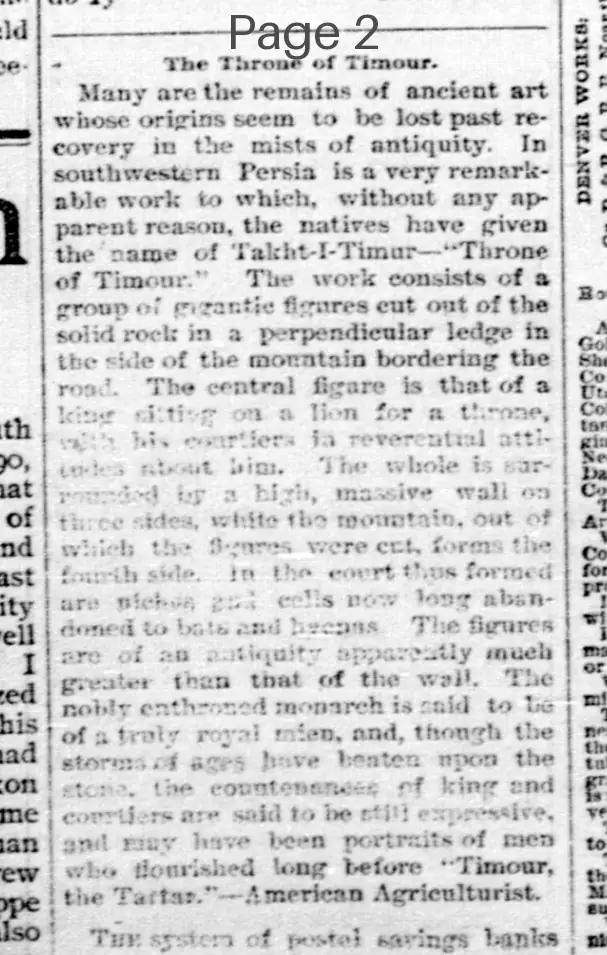
The Throne of Timour.
Many are the remains of ancient art whose origins seem to be lost past recovery in the mists of antiquity. In southwestern Persia is a very remarkable work to which, without any apparent reason, the natives have given the name of Takht-I-Timur- "Throne of Timour." The work consists of a group of gigantic figures cut out of the solid rock: in a perpendicular ledge in the side of the mountain bordering the road. The central figure is that of a king sitting on a lion for a throne, with his courtiers in reverential attitudes around him. The whole is surrounded by a high, massive wall on three sides, while the mountain, out of which the figures were cut forms the fourth side. In the court thus formed are picturesque old cells now long abandoned to bats and owls. The figures are of an antiquity apparently much greater than that of the wall. The nobly enthroned monarch is said to be of a truly royal mien, and, though the storms of ages have beaten upon the stones, the countenances of king and courtiers are said to be still expressive, and may have been portraits of men who flourished long before "Timour, the Tartar." -American Agriculturist.
Many are the remains of ancient art whose origins seem to be lost past recovery in the mists of antiquity. In southwestern Persia is a very remarkable work to which, without any apparent reason, the natives have given the name of Takht-I-Timur- "Throne of Timour." The work consists of a group of gigantic figures cut out of the solid rock: in a perpendicular ledge in the side of the mountain bordering the road. The central figure is that of a king sitting on a lion for a throne, with his courtiers in reverential attitudes around him. The whole is surrounded by a high, massive wall on three sides, while the mountain, out of which the figures were cut forms the fourth side. In the court thus formed are picturesque old cells now long abandoned to bats and owls. The figures are of an antiquity apparently much greater than that of the wall. The nobly enthroned monarch is said to be of a truly royal mien, and, though the storms of ages have beaten upon the stones, the countenances of king and courtiers are said to be still expressive, and may have been portraits of men who flourished long before "Timour, the Tartar." -American Agriculturist.
What sub-type of article is it?
Curiosity
Historical Event
What keywords are associated?
Throne Of Timour
Ancient Rock Carvings
Persia
Gigantic Figures
Timour The Tartar
Where did it happen?
Southwestern Persia
Story Details
Location
Southwestern Persia
Event Date
Antiquity
Story Details
Description of a remarkable ancient rock carving known as the Throne of Timour, featuring a king on a lion throne with courtiers, surrounded by a wall and cells, predating Timour the Tartar.