Thank you for visiting SNEWPapers!
Sign up free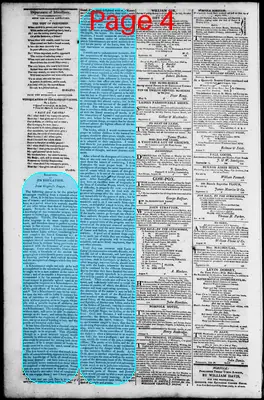
Literary
October 14, 1805
Norfolk Gazette And Publick Ledger
Norfolk, Virginia
What is this article about?
Essay from Gregory's Essays on the advantages of classical education, qualities of a good schoolmaster, and recommended reading sequence starting with simple Latin histories like Eutropius, Nepos, and Justin, emphasizing moral instruction over licentious works like Ovid and Terence.
Clipping
OCR Quality
98%
Excellent
Full Text
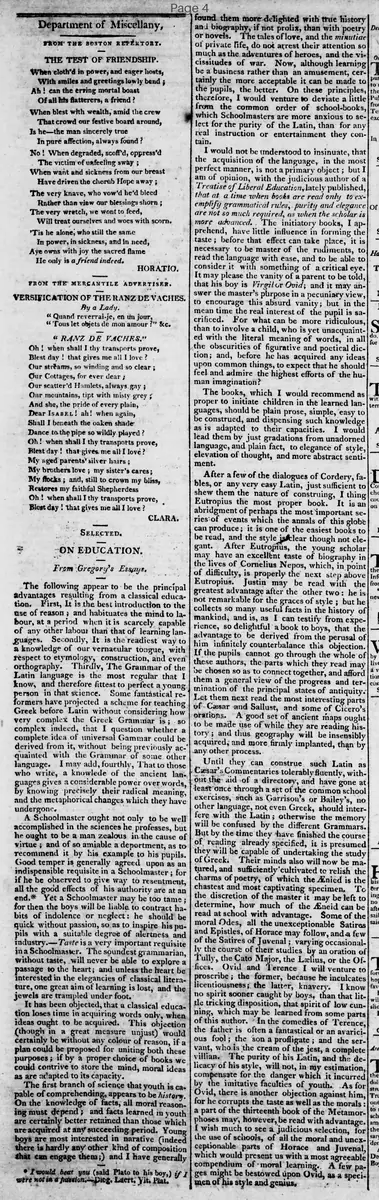
SELECTED.
-ON EDUCATION.
From Gregory's Essays.
The following appear to be the principal advantages resulting from a classical education. First, It is the best introduction to the use of reason; and habituates the mind to labour, at a period when it is scarcely capable of any other labour than that of learning languages. Secondly, It is the readiest way to a knowledge of our vernacular tongue, with respect to etymology, construction, and even orthography. Thirdly, The Grammar of the Latin language is the most regular that I know, and therefore fittest to perfect a young person in that science. Some fantastical reformers have projected a scheme for teaching Greek before Latin without considering how very complex the Greek Grammar is; so complex indeed, that I question whether a complete idea of universal Grammar could be derived from it, without being previously acquainted with the Grammar of some other language. I may add, fourthly, That to those who write, a knowledge of the ancient languages gives a considerable power over words, by knowing precisely their radical meaning, and the metaphorical changes which they have undergone.
A Schoolmaster ought not only to be well accomplished in the sciences he professes, but he ought to be a man zealous in the cause of virtue; and of so amiable a deportment, as to recommend it by his example to his pupils. Good temper is generally agreed upon as an indispensable requisite in a Schoolmaster; for if he be observed to give way to resentment, all the good effects of his authority are at an end. Yet a Schoolmaster may be too tame: for then the boys will be liable to contract habits of indolence or neglect: he should be quick without passion, so as to inspire his pupils with a suitable degree of alertness and industry. Taste is a very important requisite in a Schoolmaster. The soundest grammarian, without taste, will never be able to explore a passage to the heart; and unless the heart be interested in the elegancies of classical literature, one great aim of learning is lost, and the jewels are trampled under foot.
It has been objected, that a classical education loses time in acquiring words only, when ideas ought to be acquired. This objection (though in a great measure unjust) would certainly be without any colour of reason, if a plan could be proposed for uniting both these purposes; if by a proper choice of books we could contrive to store the mind with moral ideas as are adapted to its capacity.
The first branch of science that youth is capable of comprehending, appears to be history. On the knowledge of facts, all moral reasoning must depend; and facts learned in youth are certainly better retained than those which are acquired at any succeeding period. Young boys are most interested in narrative (indeed there is hardly any other kind of composition that can engage them;) and I have generally found them more delighted with true history and biography, if not prolix, than with poetry or novels. The tales of love, and the minutiae of private life, do not arrest their attention so much as the adventures of heroes, and the vicissitudes of war. Now, although learning be a business rather than an amusement, certainly the more acceptable it can be made to the pupils, the better. On these principles, therefore, I would venture to deviate a little from the common order of school-books, which Schoolmasters are more anxious to select for the purity of the Latin, than for any real instruction or entertainment they contain.
I would not be understood to insinuate, that the acquisition of the language, in the most perfect manner, is not a primary object; but I am of opinion, with the judicious author of a Treatise of Liberal Education, lately published, that at a time when books are read only to exemplify grammatical rules, purity and elegance are not so much required, as when the scholar is more advanced. The initiatory books, I apprehend, have little influence in forming the taste; before that effect can take place, it is necessary to be master of the rudiments, to read the language with ease, and to be able to consider it with something of a critical eye.
It may please the vanity of a parent to be told, that his boy is Virgil or Ovid; and it may answer the master's purpose in a pecuniary view, to encourage this absurd vanity; but in the mean time the real interest of the pupil is sacrificed. For what can be more ridiculous, than to involve a child, who is yet unacquainted with the literal meaning of words, in all the obscurities of figurative and poetical diction; and, before he has acquired any ideas upon common things, to expect that he should feel and admire the highest efforts of the human imagination?
The books, which I would recommend as proper to initiate children in the learned languages, should be plain prose, simple, easy to be construed, and dispensing such knowledge as is adapted to their capacities. I would lead them by just gradations from unadorned language, and plain fact, to elegance of style, elevation of thought, and more abstract sentiment.
After a few of the dialogues of Cordery, fables, or any very easy Latin, just sufficient to shew them the nature of construing, I think Eutropius the most proper book. It is an abridgment of perhaps the most important series of events which the annals of this globe can produce; it is one of the easiest books to be read, and the style is clear though not elegant. After Eutropius, the young scholar may have an excellent taste of biography in the lives of Cornelius Nepos, which, in point of difficulty, is properly the next step above Eutropius. Justin may be read with the greatest advantage after the other two: he is not remarkable for the graces of style; but he collects so many useful facts in the history of mankind; and is, as I can testify from experience, so delightful a book to boys, that the advantage to be derived from the perusal of him infinitely counterbalances this objection.
If the pupils cannot go through the whole of these authors, the parts which they read may be chosen so as to connect together, and afford them a general view of the progress and termination of the principal states of antiquity. Let them next read the most interesting parts of Caesar and Sallust, and some of Cicero's orations. A good set of ancient maps ought to be made use of while they are reading history; and thus geography will be insensibly acquired; and more firmly implanted, than by any other process.
Until they can construe such Latin as Caesar's Commentaries tolerably fluently, without the aid of a dictionary, and have gone at least once through a set of the common school exercises, such as Gasson's or Bailey's, no other language, not even Greek, should interfere with the Latin; otherwise the memory will be confused by the different Grammars. But by the time they have finished the course of reading already specified, it is presumed they will be capable of undertaking the study of Greek. Their minds also will now be matured, and sufficiently cultivated to relish the charms of poetry, of which the Aeneid is the chastest and most captivating specimen. To the discretion of the master it may be left to determine, how much of the Aeneid can be read at school with advantage. Some of the moral Odes, all the unexceptionable Satires and Epistles, of Horace may follow, and a few of the Satires of Juvenal; varying occasionally the course of their studies by an oration of Tully, the Cato Major, the Laelius, or the Offices. Ovid and Terence I will venture to proscribe; the former, because he inculcates licentiousness; the latter, knavery. I know no spirit sooner caught by boys, than that little tricking disposition, that spirit of low cunning, which may be learned from some parts of this author. In the comedies of Terence, the father is often a fantastical or an avaricious fool; the son a profligate; and the servant, who is the cream of the jest, a complete villain. The purity of his Latin, and the delicacy of his style, will not, in my estimation, compensate for the danger which it incurs by the imitative faculties of youth. As for Ovid, there is another objection against him, for he corrupts the taste as well as the morals: a part of the thirteenth book of the Metamorphoses may, however, be read with advantage.
I wish much to see a judicious selection, for the use of schools, of all the moral and unexceptionable parts of Horace and Juvenal, which would present us with a most agreeable compendium of moral learning. A few pages might be bestowed upon Ovid, as a specimen of his style and genius,
-ON EDUCATION.
From Gregory's Essays.
The following appear to be the principal advantages resulting from a classical education. First, It is the best introduction to the use of reason; and habituates the mind to labour, at a period when it is scarcely capable of any other labour than that of learning languages. Secondly, It is the readiest way to a knowledge of our vernacular tongue, with respect to etymology, construction, and even orthography. Thirdly, The Grammar of the Latin language is the most regular that I know, and therefore fittest to perfect a young person in that science. Some fantastical reformers have projected a scheme for teaching Greek before Latin without considering how very complex the Greek Grammar is; so complex indeed, that I question whether a complete idea of universal Grammar could be derived from it, without being previously acquainted with the Grammar of some other language. I may add, fourthly, That to those who write, a knowledge of the ancient languages gives a considerable power over words, by knowing precisely their radical meaning, and the metaphorical changes which they have undergone.
A Schoolmaster ought not only to be well accomplished in the sciences he professes, but he ought to be a man zealous in the cause of virtue; and of so amiable a deportment, as to recommend it by his example to his pupils. Good temper is generally agreed upon as an indispensable requisite in a Schoolmaster; for if he be observed to give way to resentment, all the good effects of his authority are at an end. Yet a Schoolmaster may be too tame: for then the boys will be liable to contract habits of indolence or neglect: he should be quick without passion, so as to inspire his pupils with a suitable degree of alertness and industry. Taste is a very important requisite in a Schoolmaster. The soundest grammarian, without taste, will never be able to explore a passage to the heart; and unless the heart be interested in the elegancies of classical literature, one great aim of learning is lost, and the jewels are trampled under foot.
It has been objected, that a classical education loses time in acquiring words only, when ideas ought to be acquired. This objection (though in a great measure unjust) would certainly be without any colour of reason, if a plan could be proposed for uniting both these purposes; if by a proper choice of books we could contrive to store the mind with moral ideas as are adapted to its capacity.
The first branch of science that youth is capable of comprehending, appears to be history. On the knowledge of facts, all moral reasoning must depend; and facts learned in youth are certainly better retained than those which are acquired at any succeeding period. Young boys are most interested in narrative (indeed there is hardly any other kind of composition that can engage them;) and I have generally found them more delighted with true history and biography, if not prolix, than with poetry or novels. The tales of love, and the minutiae of private life, do not arrest their attention so much as the adventures of heroes, and the vicissitudes of war. Now, although learning be a business rather than an amusement, certainly the more acceptable it can be made to the pupils, the better. On these principles, therefore, I would venture to deviate a little from the common order of school-books, which Schoolmasters are more anxious to select for the purity of the Latin, than for any real instruction or entertainment they contain.
I would not be understood to insinuate, that the acquisition of the language, in the most perfect manner, is not a primary object; but I am of opinion, with the judicious author of a Treatise of Liberal Education, lately published, that at a time when books are read only to exemplify grammatical rules, purity and elegance are not so much required, as when the scholar is more advanced. The initiatory books, I apprehend, have little influence in forming the taste; before that effect can take place, it is necessary to be master of the rudiments, to read the language with ease, and to be able to consider it with something of a critical eye.
It may please the vanity of a parent to be told, that his boy is Virgil or Ovid; and it may answer the master's purpose in a pecuniary view, to encourage this absurd vanity; but in the mean time the real interest of the pupil is sacrificed. For what can be more ridiculous, than to involve a child, who is yet unacquainted with the literal meaning of words, in all the obscurities of figurative and poetical diction; and, before he has acquired any ideas upon common things, to expect that he should feel and admire the highest efforts of the human imagination?
The books, which I would recommend as proper to initiate children in the learned languages, should be plain prose, simple, easy to be construed, and dispensing such knowledge as is adapted to their capacities. I would lead them by just gradations from unadorned language, and plain fact, to elegance of style, elevation of thought, and more abstract sentiment.
After a few of the dialogues of Cordery, fables, or any very easy Latin, just sufficient to shew them the nature of construing, I think Eutropius the most proper book. It is an abridgment of perhaps the most important series of events which the annals of this globe can produce; it is one of the easiest books to be read, and the style is clear though not elegant. After Eutropius, the young scholar may have an excellent taste of biography in the lives of Cornelius Nepos, which, in point of difficulty, is properly the next step above Eutropius. Justin may be read with the greatest advantage after the other two: he is not remarkable for the graces of style; but he collects so many useful facts in the history of mankind; and is, as I can testify from experience, so delightful a book to boys, that the advantage to be derived from the perusal of him infinitely counterbalances this objection.
If the pupils cannot go through the whole of these authors, the parts which they read may be chosen so as to connect together, and afford them a general view of the progress and termination of the principal states of antiquity. Let them next read the most interesting parts of Caesar and Sallust, and some of Cicero's orations. A good set of ancient maps ought to be made use of while they are reading history; and thus geography will be insensibly acquired; and more firmly implanted, than by any other process.
Until they can construe such Latin as Caesar's Commentaries tolerably fluently, without the aid of a dictionary, and have gone at least once through a set of the common school exercises, such as Gasson's or Bailey's, no other language, not even Greek, should interfere with the Latin; otherwise the memory will be confused by the different Grammars. But by the time they have finished the course of reading already specified, it is presumed they will be capable of undertaking the study of Greek. Their minds also will now be matured, and sufficiently cultivated to relish the charms of poetry, of which the Aeneid is the chastest and most captivating specimen. To the discretion of the master it may be left to determine, how much of the Aeneid can be read at school with advantage. Some of the moral Odes, all the unexceptionable Satires and Epistles, of Horace may follow, and a few of the Satires of Juvenal; varying occasionally the course of their studies by an oration of Tully, the Cato Major, the Laelius, or the Offices. Ovid and Terence I will venture to proscribe; the former, because he inculcates licentiousness; the latter, knavery. I know no spirit sooner caught by boys, than that little tricking disposition, that spirit of low cunning, which may be learned from some parts of this author. In the comedies of Terence, the father is often a fantastical or an avaricious fool; the son a profligate; and the servant, who is the cream of the jest, a complete villain. The purity of his Latin, and the delicacy of his style, will not, in my estimation, compensate for the danger which it incurs by the imitative faculties of youth. As for Ovid, there is another objection against him, for he corrupts the taste as well as the morals: a part of the thirteenth book of the Metamorphoses may, however, be read with advantage.
I wish much to see a judicious selection, for the use of schools, of all the moral and unexceptionable parts of Horace and Juvenal, which would present us with a most agreeable compendium of moral learning. A few pages might be bestowed upon Ovid, as a specimen of his style and genius,
What sub-type of article is it?
Essay
What themes does it cover?
Moral Virtue
What keywords are associated?
Classical Education
Schoolmaster
Latin Grammar
Moral Instruction
History Reading
Ancient Authors
What entities or persons were involved?
From Gregory's Essays
Literary Details
Title
On Education
Author
From Gregory's Essays
Subject
Advantages Of Classical Education
Key Lines
The Following Appear To Be The Principal Advantages Resulting From A Classical Education.
A Schoolmaster Ought Not Only To Be Well Accomplished In The Sciences He Professes, But He Ought To Be A Man Zealous In The Cause Of Virtue;
The First Branch Of Science That Youth Is Capable Of Comprehending, Appears To Be History.
Ovid And Terence I Will Venture To Proscribe; The Former, Because He Inculcates Licentiousness; The Latter, Knavery.