Thank you for visiting SNEWPapers!
Sign up free
Gazette Of The United States
New York, New York County, New York
What is this article about?
This continued editorial essay analyzes the political state of America, focusing on funding government through taxation. It advocates a gentle, equitable revenue system tailored to American character, emphasizing import duties on luxuries, low tariffs on raw materials to boost manufactures, and discouraging foreign finished goods.
Merged-components note: This is a continued political essay signed by AMERICANUS on the state of America, taxation, and trade; the text flows directly from one component to the next across pages, indicating a single logical unit. Label changed to editorial as it is an opinion piece.
Clippings
1 of 2
OCR Quality
Full Text
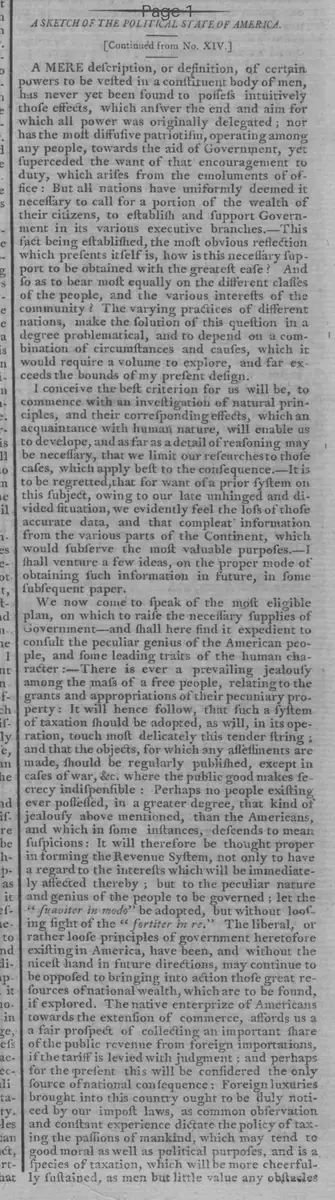
[Continued from No. XIV.]
A MERE description, or definition, of certain
powers to be vested in a constituent body of men,
has never yet been found to possess intuitively
those effects, which answer the end and aim for
which all power was originally delegated; nor
has the most diffusive patriotism, operating among
any people, towards the aid of Government, yet
superseded the want of that encouragement to
duty, which arises from the emoluments of office:
But all nations have uniformly deemed it
necessary to call for a portion of the wealth of
their citizens, to establish and support Govern-
ment in its various executive branches.—This
fact being established, the most obvious reflection
which presents itself is, how is this necessary sup-
port to be obtained with the greatest ease? And
so as to bear most equally on the different classes
of the people, and the various interests of the
community? The varying practices of different
nations, make the solution of this question in a
degree problematical, and to depend on a com-
bination of circumstances and causes, which it
would require a volume to explore, and far ex-
ceeds the bounds of my present design.
I conceive the best criterion for us will be, to
commence with an investigation of natural prin-
ciples, and their corresponding effects, which an
acquaintance with human nature, will enable us
to develope, and as far as a detail of reasoning may
be necessary, that we limit our researchesto those
cases, which apply best to the consequence.—It is
to be regretted,that for want of a prior system on
this subject, owing to our late unhinged and di-
vided situation, we evidently feel the loss of those
accurate data, and that compleat information
from the various parts of the Continent, which
would subserve the most valuable purposes.-I
shall venture a few ideas, on the proper mode of
obtaining such information in future, in some
subsequent paper.
We now come to speak of the most eligible
plan, on which to raise the necessary supplies of
Government and shall here find it expedient to
consult the peculiar genius of the American peo-
ple, and some leading traits of the human cha-
racter :-There is ever a prevailing jealousy
among the mass of a free people, relating to the
grants and appropriations of their pecuniary pro-
perty: It will hence follow, that such a system
of taxation should be adopted, as will, in its ope-
ration, touch most delicately this tender string :
and that the objects, for which any assessments are
made, should be regularly published, except in
cases of war, &c. where the public good makes se-
crecy indispensable : Perhaps no people existing
ever possessed, in a greater degree, that kind of
jealousy above mentioned, than the Americans,
and which in some instances, descends to mean
suspicions: It will therefore be thought proper
in forming the Revenue System, not only to have
a regard to the interests which will be immediate-
ly affected thereby ; but to the peculiar nature
and genius of the people to be governed; let the
"suaviter in modo" be adopted, but without losing sight of the " fortiter in re." The liberal, or
rather loose principles of government heretofore
existing in America, have been, and without the
nicest hand in future directions, may continue to
be opposed to bringing into action those great re-
sources of national wealth, which are to be found,
if explored. The native enterprise of Americans
towards the extension of commerce, affords us a
fair prospect of collecting an important share
of the public revenue from foreign importations,
if the tariff is levied with judgment ; and perhaps
for the present this will be considered the only
source of national consequence: Foreign luxuries
brought into this country ought to be duly noti-
ced by our import laws, as common observation
and constant experience dictate the policy of tax-
ing the passions of mankind. which may tend to
good moral as well as political purposes, and is a
species of taxation, which will be more cheerful-
ly sustained, as men but little value any obstacles
while pursuing the gratification of their natural
or artificial propensities: From this cause, Britons
with all their boasted freedom, consent to bear
willingly the greatest burdens. I have been speak-
ing of luxuries, but in general observe, In order
that our expectations may not be defeated, a nice
distinction ought to be made as to the quantum
each specific article imported will probably bear,
and that while we suppose our public coffers daily
increasing, the fact may not be that a premium is
held out by government to defraud the revenue.
This has been often the case where exorbitant and
ill-judged duties have been laid, calculated upon
the mistaken principle, that the consumer even-
tually bears the burthen, whereas experience
teaches us that the original importer is very often
in such cases the sufferer, as there are many arti-
cles which may not bear the additional price of
the duty, and a curtail of the consumption fol-
lows, leaving the surplus as a heavy tax in the
merchant's hands, the whole duty on which he is
bound to discharge; but while a proper caution
is observed as to those articles from which we
expect to derive an income, there are others we
are to consider in a different view; and as they may
relate to our manufactures: here it will be found
our policy to give every encouragement to the
raw materials of foreign growth, and which our
country does not afford, which ought to be intro-
duced without burthens, that we may export them
afterwards with the additional price of the labor
upon them, which is the most beneficial part of
commerce, as employing the greatest number of
hands—and the cheapness of the raw material
will tend to give a preference in competition at
foreign markets: Upon like principles every dis-
couragement ought to be placed upon the intro-
duction of foreign wrought articles, which may
be manufactured with advantage at home.—Some
considerations on this head may come under a fu-
ture number.
AMERICANUS.
(To be continued.)
What sub-type of article is it?
What keywords are associated?
What entities or persons were involved?
Editorial Details
Primary Topic
Revenue System And Taxation For American Government
Stance / Tone
Analytical Advocacy For Gentle And Judicious Taxation
Key Figures
Key Arguments