Thank you for visiting SNEWPapers!
Sign up free
Literary
September 5, 1895
The Sioux County Journal
Harrison, Sioux County, Nebraska
What is this article about?
This literary news column reports on Pierre Loti's upcoming India journey; Margaret Sherwood's identity as 'Elizabeth Hastings'; Helen Hay's poem 'The Merry Mongoose'; Israel Zangwill's anecdote on novelists writing plays; Georges Hugo's role at La Nouvelle Revue; Mary Wilkins' prizes and handwriting issues; W.D. Howells' views on literature's status; and Lillian Bell's successful book sales and early writing.
Clipping
OCR Quality
92%
Excellent
Full Text
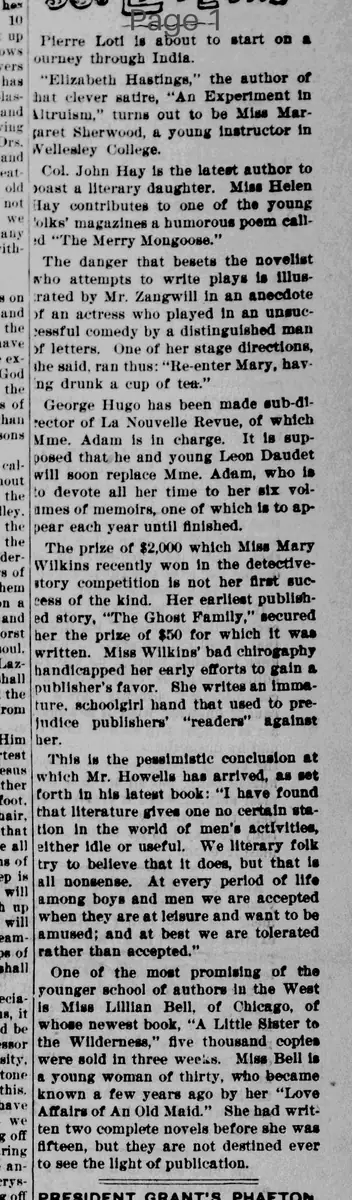
Pierre Loti is about to start on a journey through India.
"Elizabeth Hastings," the author of that clever satire, "An Experiment In Altruism," turns out to be Miss Margaret Sherwood, a young instructor in Wellesley College.
Col. John Hay is the latest author to boast a literary daughter. Miss Helen Hay contributes to one of the young folks' magazines a humorous poem called "The Merry Mongoose."
The danger that besets the novelist who attempts to write plays is illustrated by Mr. Zangwill in an anecdote of an actress who played in an unsuccessful comedy by a distinguished man of letters. One of her stage directions, she said, ran thus: "Re-enter Mary, having drunk a cup of tea."
George Hugo has been made sub-director of La Nouvelle Revue, of which Mme. Adam is in charge. It is supposed that he and young Leon Daudet will soon replace Mme. Adam, who is to devote all her time to her six volumes of memoirs, one of which is to appear each year until finished.
The prize of $2,000 which Miss Mary Wilkins recently won in the detective-story competition is not her first success of the kind. Her earliest published story, "The Ghost Family," secured her the prize of $50 for which it was written. Miss Wilkins' bad chirography handicapped her early efforts to gain a publisher's favor. She writes an immature, schoolgirl hand that used to prejudice publishers' "readers" against her.
This is the pessimistic conclusion at which Mr. Howells has arrived, as set forth in his latest book: "I have found that literature gives one no certain station in the world of men's activities, neither idle or useful. We literary folk try to believe that it does, but that is all nonsense. At every period of life among boys and men we are accepted when they are at leisure and want to be amused; and at best we are tolerated rather than accepted."
One of the most promising of the younger school of authors in the West is Miss Lillian Bell, of Chicago, of whose newest book, "A Little Sister to the Wilderness," five thousand copies were sold in three weeks. Miss Bell is a young woman of thirty, who became known a few years ago by her "Love Affairs of An Old Maid." She had written two complete novels before she was fifteen, but they are not destined ever to see the light of publication.
"Elizabeth Hastings," the author of that clever satire, "An Experiment In Altruism," turns out to be Miss Margaret Sherwood, a young instructor in Wellesley College.
Col. John Hay is the latest author to boast a literary daughter. Miss Helen Hay contributes to one of the young folks' magazines a humorous poem called "The Merry Mongoose."
The danger that besets the novelist who attempts to write plays is illustrated by Mr. Zangwill in an anecdote of an actress who played in an unsuccessful comedy by a distinguished man of letters. One of her stage directions, she said, ran thus: "Re-enter Mary, having drunk a cup of tea."
George Hugo has been made sub-director of La Nouvelle Revue, of which Mme. Adam is in charge. It is supposed that he and young Leon Daudet will soon replace Mme. Adam, who is to devote all her time to her six volumes of memoirs, one of which is to appear each year until finished.
The prize of $2,000 which Miss Mary Wilkins recently won in the detective-story competition is not her first success of the kind. Her earliest published story, "The Ghost Family," secured her the prize of $50 for which it was written. Miss Wilkins' bad chirography handicapped her early efforts to gain a publisher's favor. She writes an immature, schoolgirl hand that used to prejudice publishers' "readers" against her.
This is the pessimistic conclusion at which Mr. Howells has arrived, as set forth in his latest book: "I have found that literature gives one no certain station in the world of men's activities, neither idle or useful. We literary folk try to believe that it does, but that is all nonsense. At every period of life among boys and men we are accepted when they are at leisure and want to be amused; and at best we are tolerated rather than accepted."
One of the most promising of the younger school of authors in the West is Miss Lillian Bell, of Chicago, of whose newest book, "A Little Sister to the Wilderness," five thousand copies were sold in three weeks. Miss Bell is a young woman of thirty, who became known a few years ago by her "Love Affairs of An Old Maid." She had written two complete novels before she was fifteen, but they are not destined ever to see the light of publication.
What sub-type of article is it?
Literary News
Gossip Column
What keywords are associated?
Pierre Loti
Margaret Sherwood
Helen Hay
Israel Zangwill
Georges Hugo
Mary Wilkins
W D Howells
Lillian Bell