Thank you for visiting SNEWPapers!
Sign up free
New York Tribune
New York, New York County, New York
What is this article about?
Vital statistics report on rising pneumonia, consumption, and bronchitis deaths in New York City (1877-1883), with rates and totals compared to prior years and European cities; contagious diseases remain low despite some outbreaks like measles and typhus.
Clipping
OCR Quality
Full Text
VITAL STATISTICS OF THE CITY.
MORE DEATHS FROM PNEUMONIA, BRONCHITIS AND CONSUMPTION THAN IN PAST YEARS—CASES OF CONTAGIOUS DISEASES LESS FREQUENT.
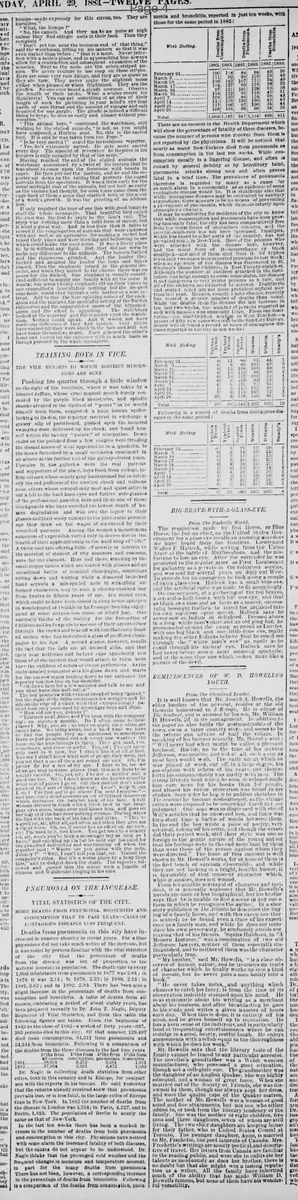
Deaths from pneumonia in this city have increased in number steadily in recent years. For a time physicians did not take much notice of the increase, but it was noted by persons familiar with the vital statistics of the city that the percentage of deaths from the disease was out of proportion to the natural increase in population. The death-rate to every 1,000 inhabitants from pneumonia in 1877 was 2.01; in 1878 it was 2.11; in 1879, 2.33; in 1880, 2.34; in 1881, 2.62; and in 1882, 2.80. There has been also a slight increase in the percentage of deaths from consumption and bronchitis. A table of deaths from all causes, embracing a period of about eighty years, has been prepared recently by Dr. John T. Nagle, Deputy Registrar of Vital Statistics, and from this table the following figures are taken. From the beginning of 1843 to the close of 1882—a period of forty years—937,365 persons died in this city. Of that number, 129,487 died from consumption, 64,311 from pneumonia and 24,344 from bronchitis. Following is a comparison of the deaths from the three diseases in the last two years:
Deaths from all causes, consumption, pneumonia, bronchitis.
1881.........38,624 4,700 1,581 947
1882.........37,924 4,747 1,581 1,134
Dr. Nagle is collecting death statistics from other cities, both in this country and in Europe, for comparison with the reports in his bureau. He said yesterday that the returns already received show that pneumonia prevails less, or is less fatal, in the large cities of Europe than in New-York. In 1882 the number of deaths from the disease in London was 4,554; in Paris, 4,127, and in Berlin, 1,823. The population of Berlin is nearly the same as that of New-York.
In the last ten weeks there has been a marked increase in the number of deaths from both pneumonia and consumption in this city. Physicians have noticed with some alarm the increased fatality of both diseases, but the causes do not appear to be understood. Dr. Nagle thinks that the prolonged cold weather and the frequent changes in moisture and temperature account in part for the many deaths from pneumonia. There has not been, however, a corresponding increase in the percentage of deaths from bronchitis. Following is a comparison of the deaths from consumption, pneumonia and bronchitis, reported in just ten weeks, with those for the same period in 1882:
Total Consumption Pneumonia Bronchitis
1882 1,088 400 140
1883 1,195 447 134
There are no records in the Health Department which will show the percentage of fatality of these diseases, because the number of persons who recover from them is not reported by the physicians. It will be noticed that nearly as many New-Yorkers died from pneumonia as from consumption in the last ten weeks. While consumption usually is a lingering disease, and often is caused by general debility or by hereditary taint, pneumonia attacks strong men and often proves fatal in a brief time. The prevalence of pneumonia therefore is regarded by many as a cause for as much alarm in a community as an epidemic of some contagious disease would be. It is significant also that while contagious diseases may be controlled by sanitary regulations, there appears to be no means of preventing a prevalence of pneumonia, which depends largely upon atmospheric changes.
It may be comforting for residents of the city to know that while consumption and pneumonia have been proving unusually fatal, the city has been comparatively free from the worst forms of contagious diseases, and the general death-rate has not been increased. Smallpox, which has raged much in New-York. Most of the persons who were attacked with the disease here, however, had the worst form of it—hemorrhagic or black smallpox—and most of them died from it. Of typhus fever only two cases were reported previous to last week; when an epidemic of this disease was discovered in St. Stephen's Home for Children, in East Twenty-eighth-st. Although the number of children attacked in the institution was large enough to cause some alarm, the disease is not dangerous to very young persons as a rule, and all of the children are expected to recover. Diphtheria and scarlet fever are not more prevalent or fatal now than last year. Measles, usually a mild disease, recently has caused a greater number of deaths than usual. While the deaths from the disease did not increase in the last two weeks, the number of persons reported as sick with measles was unusually large. From one institution—the Half-Orphan Asylum in West Tenth-st.—a report of fifty new cases was sent to the Sanitary Bureau.
Below will be found a record of cases of contagious diseases reported in the city in ten weeks:
[Table of contagious diseases cases over ten weeks, but since no specific numbers in text, merged narratively]
Following is a record of deaths from contagious diseases in the nine months:
[Table merged narratively]
While the deaths from the disease did not increase in the last two weeks, the number of persons reported as sick with measles was unusually large.
What sub-type of article is it?
What themes does it cover?
What keywords are associated?
What entities or persons were involved?
Where did it happen?
Story Details
Key Persons
Location
New York
Event Date
1843 1883
Story Details
Deaths from pneumonia in New York City have steadily increased from 1877 to 1882, with rates rising from 2.01 to 2.80 per 1,000 inhabitants. Similar increases noted in consumption and bronchitis. Over 40 years to 1882, 129,487 died from consumption, 64,311 from pneumonia, 24,344 from bronchitis. Recent ten weeks show marked rise in pneumonia and consumption deaths. Comparisons show lower pneumonia fatality in European cities. Contagious diseases less prevalent.