Thank you for visiting SNEWPapers!
Sign up free
Literary
June 5, 1910
Bisbee Daily Review
Bisbee, Cochise County, Arizona
What is this article about?
The hymn 'Blest be the Tie That Binds' by John Fawcett (1782) expresses Christian love and fellowship. It commemorates Fawcett's decision to remain as pastor in rural Yorkshire rather than accept a London position, touched by his congregation's tears. Includes biographical anecdote and mention of another hymn by Fawcett.
Clipping
OCR Quality
95%
Excellent
Full Text
GREAT HYMNS AND ABOUT THEIR AUTHORS
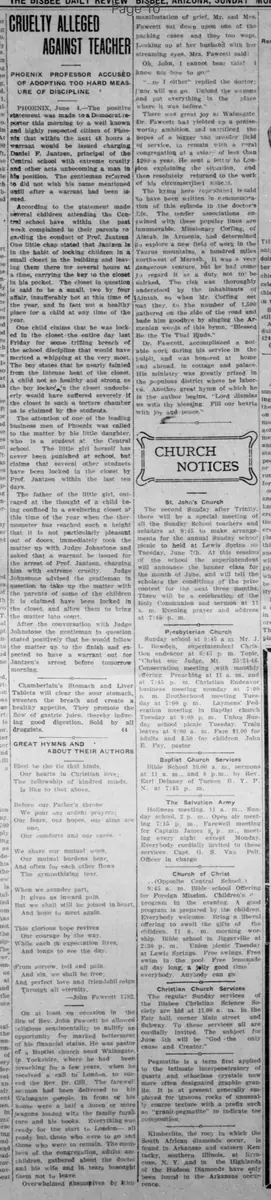
Blest be the tie that binds
Our hearts in Christian love;
The fellowship of kindred minds
Is like to that above.
Before our Father's throne
We pour our ardent prayers;
Our fears, our hopes, our aims are one,
Our comforts and our cares.
We share our mutual woes,
Our mutual burdens bear.
And often for each other flows
The sympathizing tear.
When we asunder part,
It gives us inward pain;
But we shall still be joined in heart,
And hope to meet again.
This glorious hope revives
Our courage by the way;
While each in expectation lives,
And longs to see the day.
From sorrow, toil and pain,
And sin, we shall be free;
And perfect love and friendship reign
Through all eternity.
—John Fawcett, 1782
On at least one occasion in the life of Rev. John Fawcett he allowed religious sentimentality to nullify an opportunity for marked betterment of his financial status. He was pastor of a Baptist church near Wainsgate, in Yorkshire, where he had been preaching for a few years, when he received a call to London, to succeed the Rev. Dr. Gill. The farewell sermon had been delivered to his Wainsgate people. In front of his house were a half a dozen or more wagons loaded with the family furniture and his books. Everything was ready for the start to London—all ready but those who were to go and those who were to remain. The members of the congregation, adults and children, gathered about the doctor and his wife and in tears besought them not to leave. Overwhelmed themselves by their manifestation of grief, Mr. and Mrs. Fawcett sat down upon one of the packing cases and they too wept. Looking up at her husband with her streaming eyes, Mrs. Fawcett said: "Oh, John, I cannot bear it! I know not how to go."
"Nor I either," replied the doctor; "nor will we go. Unload the wagons and put everything in the place where it was before."
There was great joy at Wainsgate. Dr. Fawcett had yielded up a praiseworthy ambition, and sacrificed the hopes of a bigger and broader field of service, to remain with a rural congregation at a salary of less than $200 a year. He sent a letter to London explaining the situation, and then resolutely returned to the work of his circumscribed sphere.
The hymn here reproduced is said to have been written in commemoration of this episode in the doctor's life. The tender associations entwined with these popular lines are innumerable. Missionary Coffing, of Aintab, in Armenia, had determined to explore a new field of work in the Taurus mountains, a hundred miles northwest of Marash. It was a very dangerous venture, but he had come to regard it as a duty not to be shirked. The risk was thoroughly understood by the inhabitants of Aintab, so when Mr. Coffing set out they, to the number of 1,500, gathered on the side of the road and bade him goodbye by singing the Armenian words of this hymn, "Blessed Be the Tie That Binds."
Dr. Fawcett accomplished a notable work during his service in the pulpit, and was honored at home and abroad, in cottage and palace. His ministry was greatly prized in the populous district where he labored. Another great hymn of which he is the author begins, "Lord Dismiss Us with Thy Blessing. Fill Our Hearts with Joy and Peace."
Blest be the tie that binds
Our hearts in Christian love;
The fellowship of kindred minds
Is like to that above.
Before our Father's throne
We pour our ardent prayers;
Our fears, our hopes, our aims are one,
Our comforts and our cares.
We share our mutual woes,
Our mutual burdens bear.
And often for each other flows
The sympathizing tear.
When we asunder part,
It gives us inward pain;
But we shall still be joined in heart,
And hope to meet again.
This glorious hope revives
Our courage by the way;
While each in expectation lives,
And longs to see the day.
From sorrow, toil and pain,
And sin, we shall be free;
And perfect love and friendship reign
Through all eternity.
—John Fawcett, 1782
On at least one occasion in the life of Rev. John Fawcett he allowed religious sentimentality to nullify an opportunity for marked betterment of his financial status. He was pastor of a Baptist church near Wainsgate, in Yorkshire, where he had been preaching for a few years, when he received a call to London, to succeed the Rev. Dr. Gill. The farewell sermon had been delivered to his Wainsgate people. In front of his house were a half a dozen or more wagons loaded with the family furniture and his books. Everything was ready for the start to London—all ready but those who were to go and those who were to remain. The members of the congregation, adults and children, gathered about the doctor and his wife and in tears besought them not to leave. Overwhelmed themselves by their manifestation of grief, Mr. and Mrs. Fawcett sat down upon one of the packing cases and they too wept. Looking up at her husband with her streaming eyes, Mrs. Fawcett said: "Oh, John, I cannot bear it! I know not how to go."
"Nor I either," replied the doctor; "nor will we go. Unload the wagons and put everything in the place where it was before."
There was great joy at Wainsgate. Dr. Fawcett had yielded up a praiseworthy ambition, and sacrificed the hopes of a bigger and broader field of service, to remain with a rural congregation at a salary of less than $200 a year. He sent a letter to London explaining the situation, and then resolutely returned to the work of his circumscribed sphere.
The hymn here reproduced is said to have been written in commemoration of this episode in the doctor's life. The tender associations entwined with these popular lines are innumerable. Missionary Coffing, of Aintab, in Armenia, had determined to explore a new field of work in the Taurus mountains, a hundred miles northwest of Marash. It was a very dangerous venture, but he had come to regard it as a duty not to be shirked. The risk was thoroughly understood by the inhabitants of Aintab, so when Mr. Coffing set out they, to the number of 1,500, gathered on the side of the road and bade him goodbye by singing the Armenian words of this hymn, "Blessed Be the Tie That Binds."
Dr. Fawcett accomplished a notable work during his service in the pulpit, and was honored at home and abroad, in cottage and palace. His ministry was greatly prized in the populous district where he labored. Another great hymn of which he is the author begins, "Lord Dismiss Us with Thy Blessing. Fill Our Hearts with Joy and Peace."
What sub-type of article is it?
Hymn Or Psalm
Essay
What themes does it cover?
Religious
Friendship
What keywords are associated?
Hymn
John Fawcett
Christian Fellowship
Baptist Pastor
Wainsgate
Yorkshire
Religious Sentiment
What entities or persons were involved?
John Fawcett, 1782
Literary Details
Title
Blest Be The Tie That Binds
Author
John Fawcett, 1782
Subject
Commemoration Of Remaining With Wainsgate Congregation
Key Lines
Blest Be The Tie That Binds
Our Hearts In Christian Love;
The Fellowship Of Kindred Minds
Is Like To That Above.
When We Asunder Part,
It Gives Us Inward Pain;
But We Shall Still Be Joined In Heart,
And Hope To Meet Again.
From Sorrow, Toil And Pain,
And Sin, We Shall Be Free;
And Perfect Love And Friendship Reign
Through All Eternity.